

August 31, 2026, 4:02 pm | Read time: 5 minutes
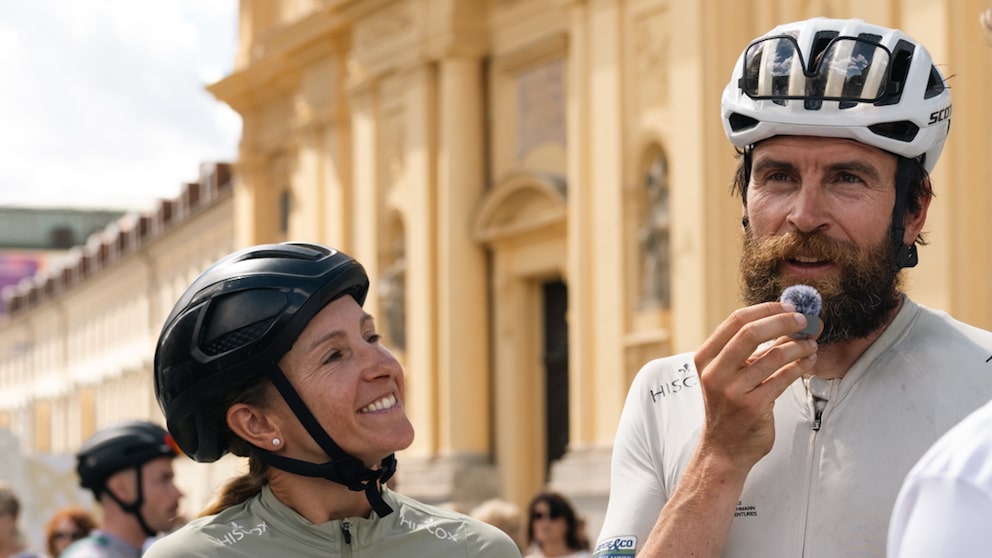
While most cyclists crave a massage and a wellness vacation after a week-long Alpine tour, Jonas Deichmann and his partner Josefine Rutkowski rolled back into Munich after 127 days in the saddle. Behind them were 24,000 kilometers, 250,000 meters of elevation, and a journey through 27 countries–without a single rest day. Anyone who thinks Deichmann is now going to take a longer break is mistaken. FITBOOK spoke with him.
Deichmann to FITBOOK: “Months of Imperfect Nutrition Took a Toll”
Extreme athlete Jonas Deichmann and Josefine Rutkowski, an experienced endurance athlete herself, have completed a monumental feat. The raw numbers of their Europe circumnavigation are staggering (24,000 kilometers, 250,000 meters of elevation), but the real challenge lies in the details: “On average, nine hours of riding per day without a rest day for over four months,” Deichmann reports. Particularly, the supply options in parts of Eastern Europe and the far north pushed them to their limits. “A few days with imperfect nutrition–no problem. But when it goes on for weeks and months, it takes a toll.” Those following the couple on Instagram saw that they repeatedly faced the problem of getting enough calories because supermarkets were closed. Overall, it was a “challenging but beautiful project,” said the Stuttgart-born extreme athlete to FITBOOK.
Jonas Deichmann is known for spectacular world records. For example, in 2021, he became the first person to circumnavigate the globe in the three triathlon disciplines. In 2024, he completed the most long-distance triathlons on consecutive days in Roth (Bavaria)–120 Ironman in 120 days. In 2018, Deichmann cycled from Prudhoe Bay (Alaska) to Ushuaia (Tierra del Fuego/Argentina)–a total of about 23,000 kilometers–solo and unsupported in a record time of 97 days. His partner Josefine Rutkowski aimed to run 60 Ironman distances on 60 consecutive days in 2025 to set a world record. She had to stop due to injury.
Couple Had to Constantly Adjust Route
Unlike previous world records, this time the experience was the focus. The route led through 27 countries, often off the beaten path through the hinterland. However, planning the “most beautiful route” repeatedly hit its limits and required multiple adjustments. Even before the start, it was clear that Russia and Ukraine had to be bypassed due to the war. During the journey, forest fires in Eastern Europe especially forced the couple to change their plans at short notice. On Instagram, Deichmann reported from Bosnia, where they passed right by a newly broken-out fire. “The fire stretched for several kilometers along the mountain, and we had thick smoke and ash on the road, but it was open,” Deichmann shared on Instagram on August 22.

Other things also didn’t go as planned, as can be seen from Deichmann’s reports on Instagram: “Dog bite and strikes in Portugal, heatwave in Spain and France, weeks of headwinds, or three weeks of continuous rain with cold temperatures in Norway. Unexpected challenges are part of it.”
Highlight, Lowlight, and Deichmann’s Insider Tip
When asked about the highs and lows, Jonas Deichmann says: “Our highlight was generally reaching Norway and the North Cape together in the evening,” says Deichmann. Being almost alone, he describes as “beautiful.” The lowlight of the trip was the road traffic. Especially in parts of Eastern Europe and the Mediterranean, the situation was often very dangerous, recalls the extreme athlete. For other road users, they were sometimes “practically nonexistent” as cyclists. People would drive “like crazy.”
His insider tip for cycling in Europe: Avoid the “hyped” places like the Lofoten, which have lost much of their charm due to social media, and stay away from the Mediterranean in summer–it’s simply “unsuitable” for cycling. Most of the beautiful places are those you find yourself, not the ones currently hyped, Deichmann tells FITBOOK.

Record Attempt! Former Teacher, 35, Aims to Complete 60 Ironman Races in 60 Days
Jonas Deichmann: “Riding 180 Kilometers on a Bike Daily Is No Longer Exhausting”
Brief Rest, Then the Next Project Awaits
And what does recovery look like after such a mega tour? “We do nothing for two or three days,” says Deichmann. But for the extreme athlete, after arrival is always before the next challenge. “Active recovery” is the term. Since they “only” did endurance sports, they would start with yoga and strength training “to get a bit more muscle strength back in the upper body.” It’s about balancing the one-sided strain of cycling.
And then, as he revealed to FITBOOK shortly before the Europe circumnavigation: he never just recovers from the old but is always ready for something new. The new: From September 24 to October 30, Deichmann plans to run 30 marathons on 30 consecutive days across Baden-Württemberg for a charity initiative. The challenge for the body is the radical change in discipline. The key is to find the balance between active recovery from the Europe circumnavigation and simultaneously building running form for the first marathon in three and a half weeks.
Giving Up Was Never an Option–Secret of His Mental Strength
There was never any doubt about the success of their Europe circumnavigation, says Deichmann. Nor any thoughts of quitting. “There was always the focus that we wanted to arrive in Munich together.”
The “secret” of his incredible mental strength was revealed to FITBOOK Editor-in-Chief Nuno Alves some time ago: “Unconditional optimism.” And the firm belief that he can do it.