

October 13, 2025, 5:41 pm | Read time: 4 minutes
Classic sit-ups were long considered optimal among bodyweight exercises for strengthening the abdominal muscles. However, experts say they don’t actually offer much benefit; in fact, poor execution can even lead to back pain.
Follow the FITBOOK channel on WhatsApp now!
On the Effectiveness of Sit-ups
Some personal trainers consider sit-ups to be ineffective for building core muscles, while others see potential risks in poor execution in a bent position, as the pressure on the spine can cause back pain. As a result, one of the most popular exercises of the past decades seems to be disappearing from workouts, with alternatives to sit-ups being favored for more effective abdominal training.
Also interesting: How many bicep curls lead to muscular upper arms?
Fitness professor Stephan Geisler isn’t quite as strict: Sit-ups and crunches still have a place in his fitness routine because they train the straight abdominal muscles, the direct counterpart to the back extensor. “It’s important to perform the movement cleanly and also do stabilizing exercises.” Geisler wholeheartedly recommends the plank in all its variations.
These and other sit-up alternatives at a glance.

2 Exercises for a Strong Core

Kettlebell Swing: The Effective Exercise for Increased Strength and Endurance
Training Abdominal Muscles: 3 Alternatives to Sit-ups
Plank
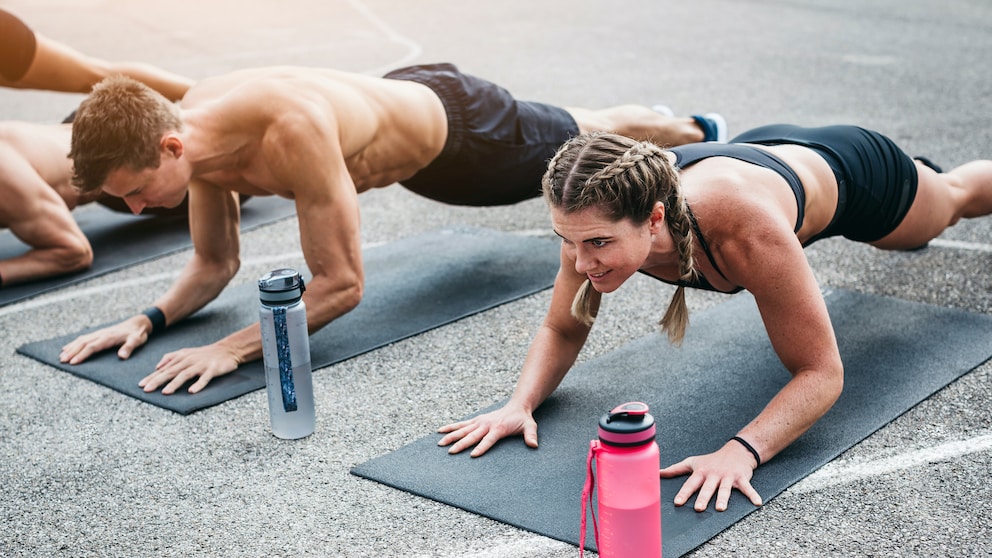
The plank–also known as the forearm support–is one of the most effective exercises for a stable core. It primarily trains the trunk muscles, thereby strengthening overall body stability. In the starting position, the exercise resembles a push-up, with the difference being that you support yourself on your forearms instead of your hands. The body remains tense throughout, forming a straight line from head to toe–like a board, which is where the name comes from. Depending on your training level, you hold this position for just a few seconds or even several minutes. The classic plank is a static exercise without movement, engaging numerous muscle groups simultaneously and differing significantly from exercises that isolate individual muscles. What to watch out for with planks–and the more challenging variations–can be seen in this video.

Also interesting: 11 minutes with four exercises–intense abdominal training for defined abs
Shrimp & Beetle
Stabilization is the prerequisite for sustainable muscle growth. To specifically strengthen the trunk muscles, functional trainer Erik Jäger recommends various isolation exercises–including the Beetle and the Shrimp.
The Beetle starts in a supine position: The legs are slightly bent at less than 90 degrees, and the hands are clasped behind the head. Now, the right elbow moves toward the left knee, which is brought to hip height toward the abdomen. Simultaneously, the right leg is extended and hovers just above the ground–without touching it. Then switch sides. Each side should be trained about ten times.
The Shrimp exercise is also performed in a supine position, this time with legs bent at a 90-degree angle. The palms press firmly against the thighs to build tension. This position is held for 30 to 45 seconds. Meanwhile, the right arm is stretched upward, and the right leg is slowly lowered and raised again without touching the ground. Then switch sides. About ten repetitions per side are recommended.
Trainer Erik Jäger demonstrates exactly how both exercises look in the following video.
Leg Raises
Another highly effective exercise for the abdominal muscles is leg raises (also known as “leg lifts” or in German: Beinheben). They primarily train the lower part of the straight abdominal muscles but also intensely engage the other abdominal muscles and hip flexors. That’s why they belong in every ambitious six-pack workout.
Leg raises can be performed in various ways: classically in a supine position, hanging from a bar (often referred to as knee raises), or in a support position. The variant in a supine position is particularly well-known–easy to learn, yet highly effective for the entire core. The key is a clean execution without momentum.
The following video shows the different variations and what to pay attention to during training.
Make Your Abs Burn in 10 Minutes
And for those who really want to know about abdominal training, we recommend this approximately ten-minute abs workout with personal trainer and stuntwoman Daniela Kahl. It includes several sit-up alternatives.