


February 3, 2026, 9:54 am | Read time: 6 minutes
The name admittedly sounds a bit morbid. However, the Dead Hang is a simple exercise with surprisingly great benefits. Under certain conditions, it’s even suitable for beginners. I’ve personally integrated the Dead Hang into my training for years.
Overview
How Does the Dead Hang Work?
Not much is needed for the exercise: A pull-up bar or another stable device that can be securely gripped is sufficient. Parks or forests often have training areas with suitable bars.
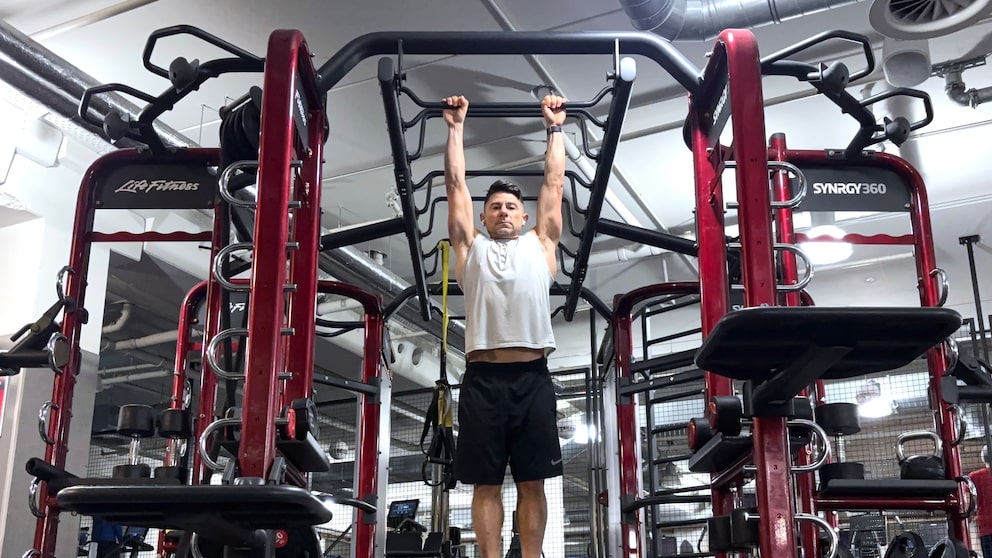
The core of the Dead Hang is simply hanging with arms extended. While it sounds easy, it can be challenging for beginners, especially if grip strength is still low. More on that below.
At home, I occasionally use a door. I place a towel over the top edge of the door to avoid pressure marks on my hands and grip the edge directly. I use a wedge to ensure the door doesn’t move. Important: Only do this if it’s absolutely certain the door can handle the load, which is the case for me.
Once you’ve found a suitable device, simply hang.
The Benefits of the Dead Hang
Hanging might initially seem inconspicuous, but it has several well-documented effects.
Grip Endurance and Grip Strength
Isometric hanging significantly improves the local muscular endurance of the forearm muscles. Studies in climbing show increases in hanging time of about 35 to 55 percent after just a few weeks. Especially at the beginning, maximum grip strength often measurably increases.1
This is more relevant than it initially seems. Low grip strength is considered a robust marker for poor overall physical condition in old age and is associated with an increased risk of early death. Large studies show that grip strength predicts overall and cardiovascular mortality better in some analyses than classic risk factors like blood pressure.2,3 This doesn’t mean that training only the hands is enough. But grip strength often reflects how resilient the body is overall.
I also address the importance of grip strength for healthy aging in my book “Highway to Health – In 7 Steps to a Healthy Long Life”, which will be published on January 4, 2027, where it is treated as a central indicator of the muscle system’s condition.
Spine and Discs
When hanging, your body weight acts as traction on the spine. This traction can temporarily reduce pressure within the discs.4
This is biologically plausible, as discs are largely composed of water-binding connective tissue and can respond to relief by absorbing more fluid.
However, high-quality studies have not yet shown reliable medical benefits of traction for back pain.5 The observed effects are usually only temporary. Nevertheless, many people find hanging subjectively relieving, which can be a relevant factor in cases of discomfort.
Shoulder Function
Passive hanging can improve shoulder mobility and alleviate discomfort for some people. Although high-quality controlled studies are lacking, there are plausible biomechanical explanations for this.6 U.S. orthopedic surgeon John M. Kirsch describes the Dead Hang as a helpful exercise for shoulder problems and reports corresponding successes from his clinical practice.7
Improved Pull-Up Performance
Pull-ups require not only strength in the back or arms but also grip strength and endurance. Thus, the Dead Hang can directly contribute to increasing the number of possible repetitions, as studies also confirm.8
Quick Progress Is Possible
Especially at the beginning, quick progress often occurs. It’s less due to muscle building and more because the nervous system increasingly efficiently controls the grip muscles. The noticeable extension of hanging time is also motivating and makes it easier to stay consistent.
Dead Hang Training Plan for All Levels
If you want to integrate the Dead Hang into your routine, you can do it like I do and simply hang at a safe spot for a certain time once a day. Alternatively, you can work in sets. Here’s a suggestion:
Beginners
- Once a day (one set): 10 to 20 sec.
- Or: 2 to 3 sets of 10 to 20 sec., 60 to 90 sec. rest between sets
Note: Especially at the beginning, typical mistakes should be avoided. Jumping to a high bar is not a good idea, as the risk of slipping and falling is high if grip strength is lacking. The distance of the feet to a stable surface should be small. For beginners, it may be helpful to lightly place the feet and partially relieve the load.
With Training Experience
- Once a day (one set): 30 to 45 sec.
- Or: 3 to 4 sets of 30 to 45 sec., 60 to 90 sec. rest between sets
Advanced
- Once a day (one set): 60 to 90 sec.
- Or: 3 to 5 sets of 60 to 90 sec., 60 to 120 sec. rest between sets
Why You Should Train Dead Hang and How Long You Should Be Able to Hang for

Prevent Muscle Loss After 40! This Training Plan Will Help
The Active Hang as an Enhancement of the Dead Hang
Unlike the Dead Hang, the body actively holds itself in the Active Hang – as the name suggests. By engaging the muscles around the shoulder blades and upper back, the shoulder girdle is controlled and stabilized, and the shoulders are no longer passively carried by body weight. This increases the distance to the ears, and the upper body builds even tension. The shoulder blades rest calmly and stably on the back without being cramped together.
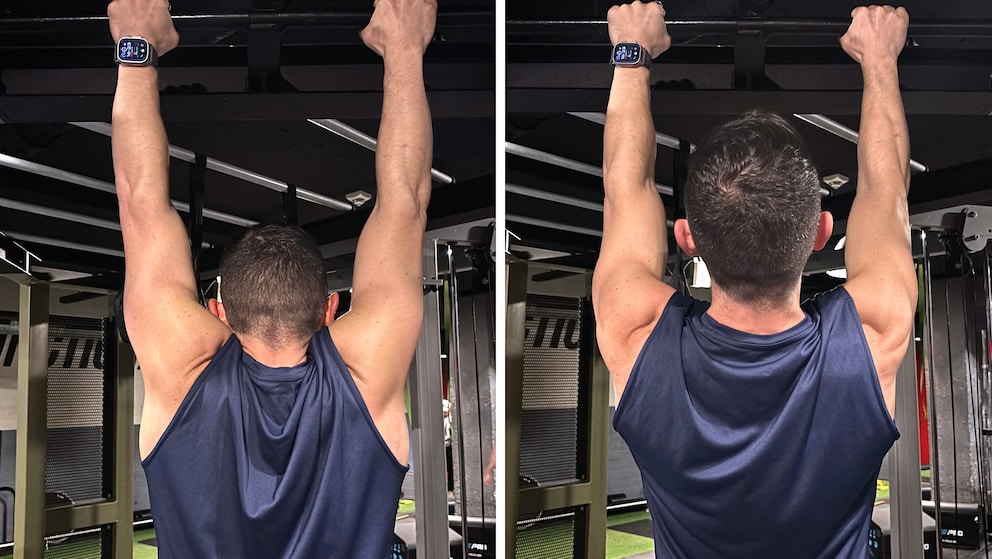
This controlled activation provides more stability in the shoulder area and creates the functional starting position for clean pull-ups. It also improves body awareness in the shoulder girdle and supports an upright, resilient posture in everyday life.

My Experiences with the Dead Hang
“I long underestimated this exercise. However, after reading and hearing several interesting articles about it and seeing corresponding challenges at many booths at the FIBO fitness fair, I finally included the Dead Hang in my training plan. Initially, I couldn’t exceed 40 seconds, but I quickly reached 1:10 minutes. My personal record is now 1:50 minutes. My next goal: 2 minutes.”
Caution with Injuries or Complaints
For known shoulder instabilities, such as a tendency to dislocations, acute disc herniation, severe osteoporosis, or other relevant complaints, the Dead Hang should only be performed after consulting a doctor or physical therapist. In such cases, it may be advisable to maintain foot contact with the ground and reduce the load.