


June 26, 2026, 6:23 pm | Read time: 5 minutes
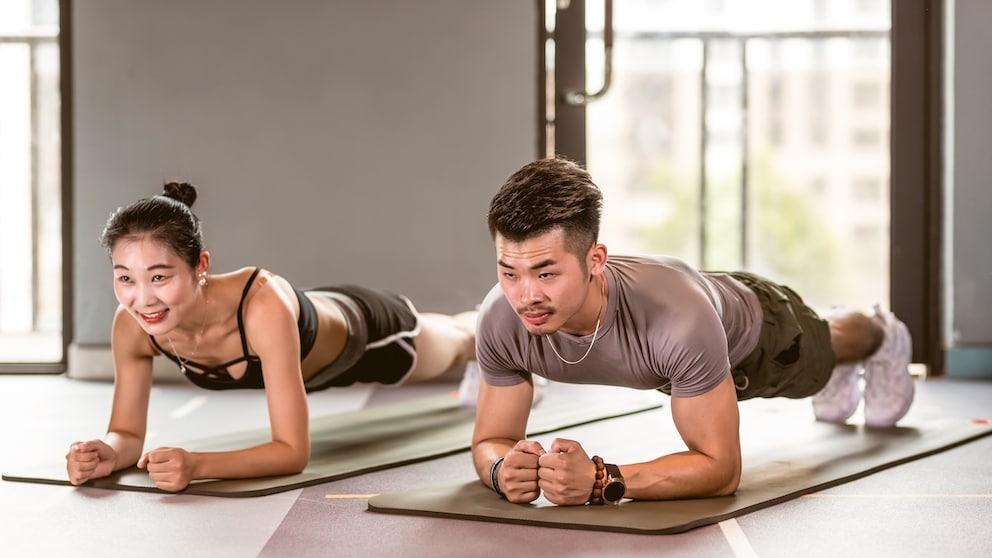
The plank is one of the most well-known fitness exercises. The forearm plank requires no equipment, strengthens the core, and is considered a key component for stable posture and a healthy back. Yet, the same question often arises: How long should one be able to hold a plank? Are there differences between men and women? As is often the case, several factors play a role, providing only a rough guideline. FITBOOK author Tony Poland discussed this with sports scientist and personal trainer Markus Bremen.
Is Holding a Plank Longer Really Better?
Those active on social media frequently encounter plank challenges where people remain in the forearm plank position for several minutes or even longer. Pop star Helene Fischer recently revealed that she can hold a plank for eleven minutes. While impressive, it’s not necessarily beneficial for health.
“Holding a plank for more than 90 seconds offers little additional benefit for back health,” explains Markus Bremen. This is based on findings from spine researcher Stuart McGill, who has extensively studied spinal endurance. Instead of holding out as long as possible, the focus should be on the quality of the movement. The longer a plank lasts, the more likely posture errors are to occur.
How Long Should Women and Men Be Able to Plank?
In general, as with exercises like bench pressing, there are no universal recommendations for planking. Age, fitness level, and individual conditions play a significant role. However, some benchmarks can be derived.
For women, according to Markus Bremen, a properly executed plank of about 60 seconds is a solid foundation. Men should be able to hold it technically correct for 60 to 90 seconds. “Anything beyond that is ambition, not a health gain,” emphasizes the fitness expert.
Those who want to assess their performance more precisely can refer to the following guidelines: “For women, a held time of 20 to 30 seconds is considered beginner level, 45 to 75 seconds as advanced, and over 90 seconds as experienced. For men, the values are slightly higher: 30 to 45 seconds for beginners, 60 to 90 seconds for advanced, and over two minutes for experienced,” Bremen notes.
Why the Times Differ for Men and Women
The different benchmarks for men and women need to be understood accordingly. The main reason is less about strength and more about biomechanics. “Men generally have more upper body mass, which extends the lever in a plank and makes holding it more challenging. Women often have a lower center of gravity, which slightly favors the position,” explains Bremen.
However, “Women generally have less absolute muscle mass in the shoulder and core areas–and these muscle groups bear the main load in a plank.” Additionally, women have hormonally lower maximum strength in the involved muscle groups and, on average, a lower training level in pressing and supporting muscles.
Considering all aspects, the biomechanical advantage of a lower center of gravity can only be partially compensated. “Net, this results in a slight disadvantage,” says Markus Bremen. Accordingly, the absolute target times are somewhat lower.
Nevertheless, women often achieve very good results relative to their body weight. Moreover, women often perform better than expected in relative endurance. “The benchmarks differ slightly—the principles do not.”
Technique Always Trumps Time
In his daily work, the sports scientist often observes that many people hold their plank for a long time but lose body tension. “Most people who can plank for three minutes do so with an arched back, sagging hips, or raised shoulders,” he describes. “That doesn’t train stability—it trains compensation.”
A correct plank is characterized by the head, shoulders, back, pelvis, and legs forming as straight a line as possible. The abdomen remains actively engaged, the glutes work, and the lumbar spine stays in a neutral position. As soon as the pelvis sags or the shoulders tense, the exercise should be stopped. His conclusion is clear: “A technically clean 30-second plank is more valuable than three poor minutes.”
The next step, the personal coach recommends more challenging variations like side planks, the RKC plank, or planks with shoulder taps. These increase the demands on stability and coordination more than simply extending static hold time.

How Long You Need to Plank Daily to See Visible Results

How Much Weight Should Women and Men Be Able to Bench Press?
Sleep and Stress Also Play a Role
How long someone can hold a plank doesn’t depend solely on muscle and technique. Factors like sleep quality, recovery, and overall health also affect performance.
“Those who are constantly stressed, sleep poorly, or are in a chronic inflammatory state will tire more quickly during isometric exercises like the plank—that’s not a weakness, that’s biology,” explains Markus Bremen. And that’s why it’s not very sensible to measure one’s performance solely by a stopwatch.
Conclusion
Whether 30 seconds or two minutes: The plank is not a discipline where longer times are automatically better. For most recreational athletes, a well-held minute is sufficient to effectively train the core muscles.
Those who hold out significantly longer can certainly be pleased with good endurance—but it offers little additional health benefit. The quality of execution remains crucial. Or, as Markus Bremen concludes: “It’s not the duration that matters, but—once again—the quality.”