


April 10, 2026, 7:32 pm | Read time: 5 minutes
If you want to train your upper body—especially the chest, shoulders, and triceps—you can’t avoid a classic: the free bench press. Additionally, few exercises are used as often as a benchmark for strength. But how much weight should you be able to bench press? When are you considered “fit”? As is often the case, several factors are crucial in providing a rough framework. FITBOOK author Tony Poland consulted personal trainer Markus Bremen.
Important upfront: The question “How much can I lift?” is too simplistic when it comes to the free bench press. More important is how your performance can be assessed in relation to your body weight and training level—and this is where clear benchmarks help.
Why a General Statement Is Difficult
The later assessment is somewhat simplified by the fact that the exercise is standardized—unlike, for example, the leg press. “The free bench press is significantly more standardized or is among the most standardized strength exercises in the fitness sector. This allows for much better comparative values than with machine exercises,” explains Markus Bremen. However, “Even here, the ratio to body weight is crucial, not the absolute number,” emphasizes the expert.
These Factors Influence Performance
Everyone approaches the free bench press with different prerequisites. Key parameters for your own performance include body weight, training level or experience, and lever ratios concerning arm length. These are crucial for how efficiently force can be transferred to the barbell. Particularly long arms can make the exercise more challenging.
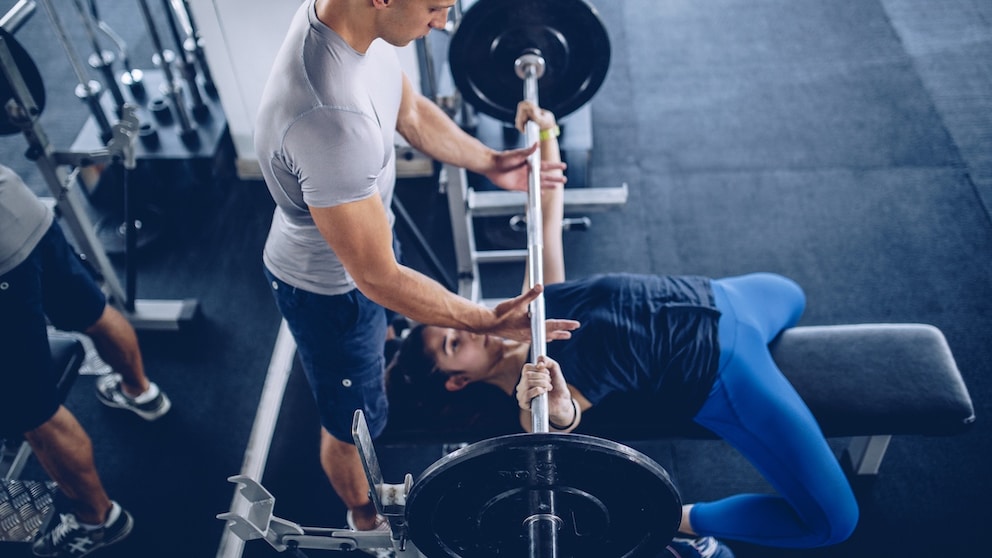
“Technique is also crucial. That is, how you perform the exercise in terms of body tension,” adds Markus Bremen. “This includes shoulder positioning and leg drive, especially when lying on your back and working from the legs. You create an arch tension that you can transfer into the push phase,” explains the expert.
Leg Drive is the conscious use of the legs during bench pressing. By pressing against the floor, stability, body tension, and a firm bridge are created. This transfers force to the upper body, protects the shoulders, and allows for more weight to be moved.
The training goal is also important: As with the leg press, it’s about the question “Maximum strength or muscle building? And of course, the overall musculature in the upper body plays a role.”
When Are You Considered “Fit”? Benchmarks for Men and Women
Even in bench pressing, there are rough numbers that provide an approximate indication of fitness level and whether you are somewhat within the norm.
Markus Bremen explains the general benchmarks: “For men, solid fitness is indicated when they can move their body weight for several clean repetitions. For women, it’s about 0.6 to 0.8 times their body weight.” Men who are already at an advanced level can even manage 1.25 times their weight, while particularly fit women can increase to their full body weight.
By the way, these differences between the sexes are mainly due to the generally lower muscle mass in the upper body for women and biomechanical factors—and are completely normal and not a training deficit.
For Every Level: Benchmarks for Muscle Building
Those focusing on hypertrophy training and aiming to build muscle should use moderate weights with multiple repetitions. How heavy should the barbell with weight plates be?
“For men in the beginner range, it’s about 0.4 to 0.6 times their body weight for 8 to 12 repetitions, for intermediates 0.7 to 0.9 times for 6 to 10 repetitions, and for experienced and fit individuals, it’s 1 to 1.2 times for 5 to 8 repetitions,” says Markus Bremen.
Women, on the other hand, can aim for the following range: Beginners can try 0.3 to 0.5 times their body weight for 8 to 12 repetitions, intermediates 0.5 to 0.8 times for 6 to 10 repetitions, and pros should manage 0.8 to 1 times their body weight for 5 to 8 repetitions.

How Much Weight Fit Men and Women Lift in Deadlifts

Bench press – better on the machine, with free weights, or with a barbell?
Technique Beats Weight
Important: These aforementioned values are only guidelines—what matters is that the last repetitions are technically clean and challenging.
“Technique massively influences quality and performance,” emphasizes Markus Bremen. “It’s important to fix the shoulder blades. Even during the warm-up, you should work on the scapular stabilizers.” Also crucial in the free bench press are stable body tension and a controlled downward movement. “The barbell should be guided to the chest in a controlled manner, and a clean full-range-of-motion execution should take place,” says the fitness coach.
The Most Important Benchmark: Progress
Even though there are numerous challenges in the gym or on social media regarding bench pressing, it’s advisable to focus on yourself and not compare with others. This applies to both genders. The magic word here is progression. “Instead of asking, what can I press, you should ask, am I getting stronger?” recommends Markus Bremen.
Correct technique and individual development are the decisive factors for training success and long-term progress. A man’s body weight or 60 to 80 percent of it for women serves as a solid reference for corresponding fitness, but not as a rigid guideline.