


April 10, 2026, 2:14 pm | Read time: 4 minutes
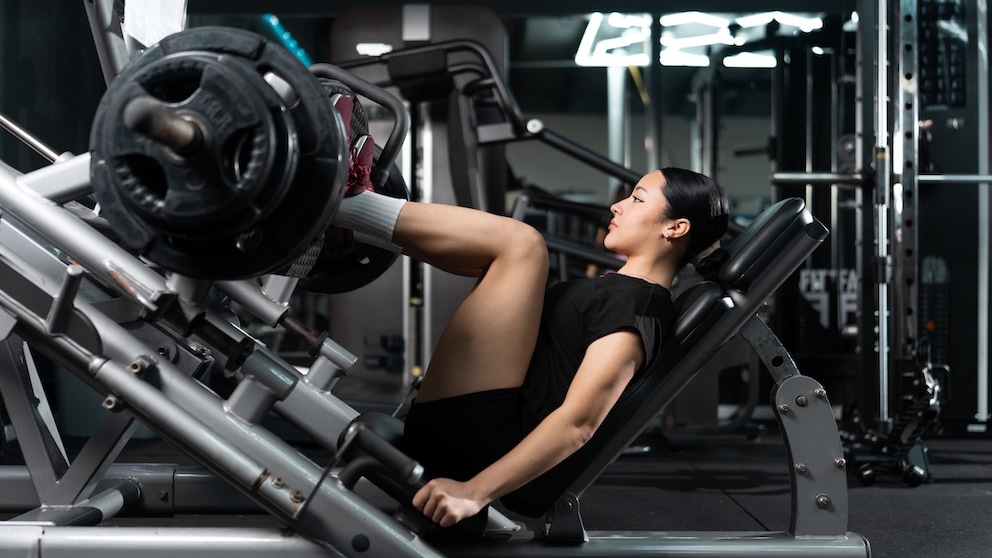
The leg press is one of the most popular machines in the gym, primarily used to train the thighs and glutes. But how much weight should you press on the leg press? What amount of weight indicates a solid training condition? There isn’t a one-size-fits-all answer, as many factors come into play. However, reasonable benchmarks can be derived to help with assessment. FITBOOK author Tony Poland consulted personal trainer Markus Bremen.
“Never skip leg day!” This expression in the fitness world is not without reason. A leg day, which many people tend to skip, is absolutely essential for building strength and stability. So, get on the leg press to move some serious resistance with your legs!
Factors Influencing Performance: What Really Matters
How many kilos someone can press on the leg press cannot be answered universally. What is crucial? “Of course, body weight and body composition—whether someone is muscular, very heavy, or rather thin,” says Markus Bremen. Training experience is also crucial. It is also sensible to categorize trainees into beginners, intermediates, and advanced.
Technique and range of motion are equally important. This means: Half repetitions allow for significantly higher weights than full or clean, deep movements. “Additionally, the type of muscle group being trained plays a role,” says the fitness expert. “Certain muscle groups can work particularly well at specific angles,” he emphasizes. “And then the training goal is an important component.” Is the focus on improving maximum strength, on strength endurance, or on achieving a hypertrophic effect? “Without quality, numbers are absolutely worthless in my view,” Markus Bremen makes clear.
Also interesting: How Many Push-ups Per Day Lead to Visible Muscles
What Is “Good”? Benchmarks for Every Training Level
Let’s get to the numbers that indicate how fit someone is. However: “In general, absolute numbers are less meaningful; instead, benchmarks should be viewed in relation to body weight. That should always be decisive,” Markus Bremen emphasizes upfront.
For muscle building (hypertrophy), 6 to 12 repetitions are usually considered optimal. In this training, the intensity is moderate to high to effectively exhaust the muscles.
This results in the following rough benchmarks: “For beginners, one can recommend 1 to 1.3 times the body weight for 8 to 12 repetitions, for intermediates 1.5 to 2.2 times for 6 to 10 repetitions, and for advanced individuals 2.2 to 3 times the body weight,” says the fitness coach.
For maximum strength, one repetition with the absolute “max-out” weight is applicable, while strength endurance is more about 15 or more repetitions.
Strength in Comparison: What Men and Women Should Achieve
The question remains, what values indicate solid basic fitness—for both genders?
Markus Bremen also knows the answer to this: “For men, a very good and solid fitness level is indicated when they can press double their body weight for several clean repetitions.” A man weighing 80 kilograms should be able to manage at least 160 kilograms. And women? “For women, the recommendation is one and a half to two times their body weight.” This means a woman weighing 60 kilograms should be able to press at least 90 kilograms on the leg press.
For both genders, it applies: “Anything beyond that is above average or very good, or also very training-specific. Track cyclists or sprinters can move significantly more, but they also have years of sport-specific training behind them,” says Markus Bremen.

How Much Weight Should Women and Men Be Able to Bench Press?

How Much Weight Fit Men and Women Can Squat
Not All Leg Presses Are the Same!
It should also be noted that there are different types of leg presses. Essentially, there are three types: the 45-degree model, the horizontal variant, and the vertical version. “Leg presses are not really standardized compared to squats,” confirms the expert.
To put the training with the moved weight into context, it must be clear which leg press is being used. Our reference is the 45-degree leg press, which is the most common in gyms.
How to Get Stronger: Tips for More Power on the Leg Press
Finally, Markus Bremen recommends how men and women can gradually improve on the leg press. “For this, I find deep repetitions crucial to utilize the full range of motion and become strong in all movement areas,” he advises. The top priority—as always in strength training: Technique over weight! So be sure to keep the knees stable during execution and the back against the machine’s backrest.
To improve, there is also a magic word: progression, meaning the increase of load. This is how muscles and strength are built. This is achieved through structured training planning that protects against injuries. “You can also consciously take a step back so that the body experiences new stimuli and gets enough recovery,” says Markus Bremen.
The takeaway is: Becoming noticeably stronger on the leg press provides good benchmarks regarding one’s performance development. “However, the focus is more on technique, training goals, and individual progression,” the expert emphasizes.