


April 21, 2026, 2:36 am | Read time: 5 minutes
The squat is one of the most effective basic exercises in strength training, engaging multiple muscle groups simultaneously. Additionally, squats are considered a central measure of lower body strength. Those who are fit perform the exercise with weights. However, many trainees wonder how much weight they should lift. In fact, there are guidelines. These must always be considered in the context of individual conditions. So, what numbers can serve as a guide? FITBOOK author Tony Poland asked personal trainer Markus Bremen.
First, it should be noted that the question of how much weight men and women should lift in the squat cannot be answered universally. An important benchmark is, for example, one’s own body weight, which provides a meaningful reference point as a relative measure. However, it should not serve as a measure of self-worth–rather as a kind of “map” to assess one’s own performance. Additionally, factors such as training experience and technique play a crucial role.
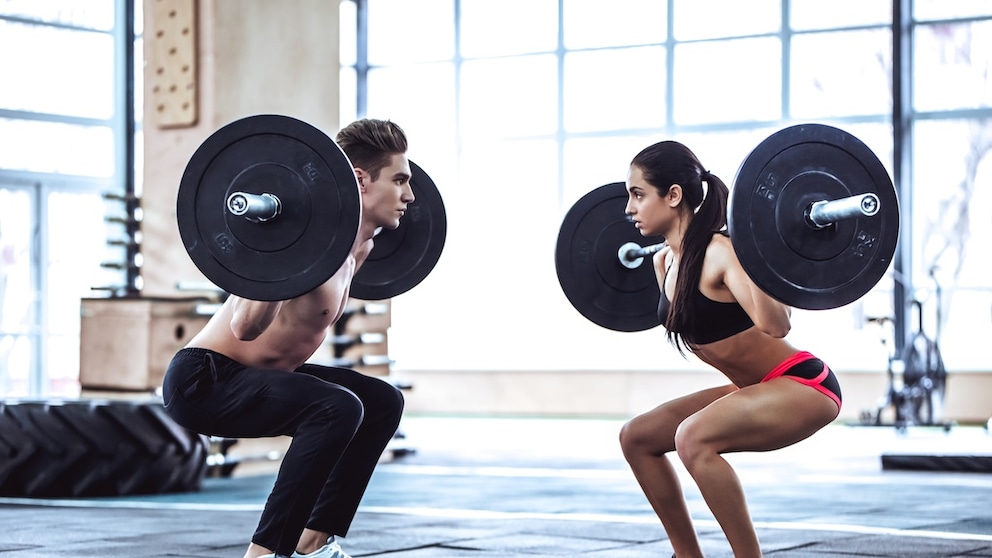
Back Squats for a Full Range of Motion
The following information refers to the classic back squat (squat with a barbell), where the hips sink below knee level in the lowest position. Other variations, such as quarter squats or half squats, may allow for higher weights but are less indicative of actual squat performance.
Also interesting: How long and far men and women should be able to cycle
Anatomical and Biological Influencing Factors
How much weight a person can lift in the squat depends on various parameters, particularly individual anatomy. For example, long thighs mean that the upper body must lean forward more due to leverage. This results in greater stress on the hip extensors, which can affect squat performance.
“Additionally, the morphology of the hip is crucial,” explains the expert. “Especially the position of the hip socket and the geometry of the femoral head determine how deep someone can go. This is not a question of technique but an anatomical prerequisite.” This should definitely be considered and accepted. Likewise, a certain level of mobility–especially in the ankle joint–is an important prerequisite that enables clean movement execution and sufficient depth in the first place.
Besides anatomy, other factors influence performance, such as body weight. Lighter individuals often achieve higher performance relative to their weight. Gender and age are also relevant: Men generally have more muscle strength than women due to higher testosterone levels, although this strength gradually declines after the age of 40. Training level and technique also have a significant impact on strength development.
Guidelines for Men and Women Relative to Body Weight
There are approximate guidelines for squats that indicate a solid fitness level. A meaningful comparison is made through the ratio to one’s own body weight (One-Repetition Maximum, 1RM). “For men, this value is about 1.5 times their body weight, for women, it’s 1 to 1.25 times,” explains Markus Bremen, citing consistent information from various sources. However, these values are merely averages and can vary depending on the training level.
When Is One Considered “Fit”? The Performance Levels
Depending on the training level, the following rough guidelines provide orientation. “For men, beginners should aim for 0.75 times their body weight, intermediates for 1.5 times, and experienced individuals for 2 to 2.25 times,” explains the personal trainer. Women generally fall below these values. “For beginners, it’s 0.5 times their body weight, for intermediates 1 to 1.25 times, and experienced trainees should aim for 1.5 to 1.7 times.”
The Recommended Training Areas
Depending on the performance level, the training design in terms of sets and repetitions also differs.
For men, the following guidelines apply: Beginners train best with three sets of squats with eight to ten repetitions at a weight of 50 to 60 percent of their body weight. Intermediates increase to four sets with four to six repetitions and 100 to 130 percent of their weight. Professionals perform three to five sets with one to three repetitions at 150 to 180 percent.
Women can effectively structure their training based on the following guidelines: Beginners should aim for three sets with eight to ten repetitions at 40 to 50 percent of their body weight. Intermediates train with four sets of four to six repetitions and 70 to 90 percent. Very fit women attempt three to five sets with one to three repetitions at about 110 to 140 percent of their weight.

How Much Weight Fit Men and Women Lift in Deadlifts
How Much Weight Should Women and Men Be Able to Bench Press?
Importance of Depth and Technique
An absolute quality feature of the squat is the depth of the movement. Generally, the deeper the execution, the better–provided it is controlled and technically sound. “This indicates good mobility with existing strength,” says Markus Bremen. Therefore, mobility, especially in the hips and ankles, should be worked on before increasing the training weight.
“Squats are as demanding as deadlifts–for some, even more so. Especially for beginners, coaching is therefore indispensable. Poor technique definitely strains the knees, lumbar spine, and hips,” warns the expert.
To train as effectively as possible, one should not overdo the training volume. “With the mentioned guidelines, a volume of about twelve to 20 sets per week should not be exceeded. This corresponds to a maximum of three to four sessions in which the squat is trained,” Markus Bremen concludes.
Summary
Guidelines for back squats provide helpful orientation but are highly individual. Anatomy, technique, mobility, and training experience play as significant a role as body weight. Those who want to make long-term progress should therefore not only focus on numbers but also on clean execution and thoughtful training planning.