


November 20, 2025, 8:31 am | Read time: 4 minutes
For a defined upper arm, not only are strong shoulders and a pronounced biceps crucial, but also their counterpart: a trained triceps. Experienced strength athletes can try the JM Press for this. FITBOOK author Tony Poland, along with personal trainer Markus Bremen, explains the uniqueness of this exercise and what makes it so effective for the triceps.
The JM Press, where “JM” refers to the American powerlifter John Mark Blakely, is fundamentally an extremely effective yet demanding exercise for strong triceps muscles. It also helps improve performance in bench pressing. Ideally, the exercise should be performed on a Smith machine to fully concentrate on the triceps.1
How It Works
The JM Press is a combination of close-grip bench pressing and skull crushers. In skull crushers, the arms are bent over the head towards the floor while lying on a flat bench and then extended again. “The close-grip bench press is the so-called pressing component, while the skull crushers are the extension component,” emphasizes Markus Bremen. “The exercise is also called a JM Press hybrid movement.”
An EZ bar is often used for this. The main task of the triceps is to extend the elbow. The JM Press is also performed lying down. The exact movement is crucial to achieve maximum effectiveness.

Starting Position
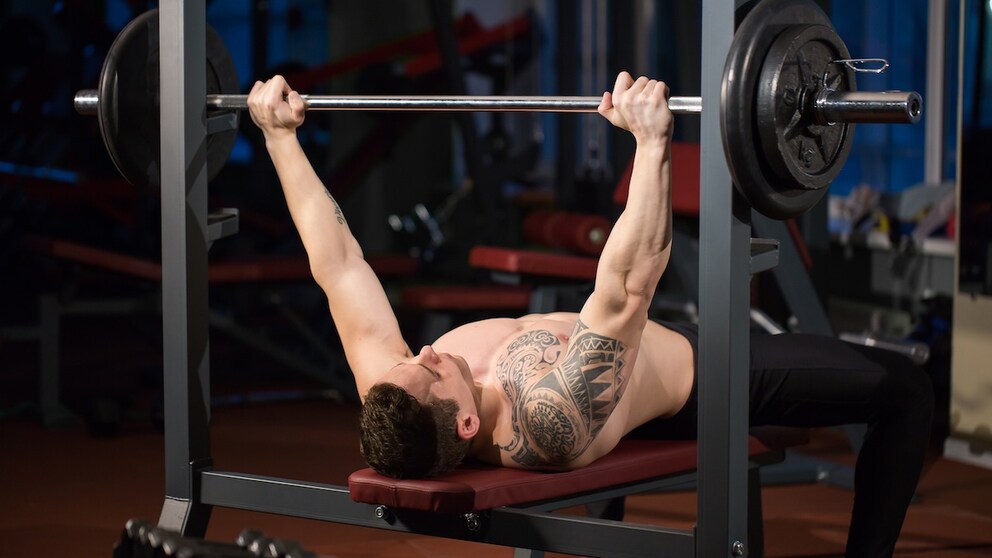
Begin the exercise by lying on your back on a Smith machine (a flat bench also works) with a tight core and glutes, similar to a close-grip bench press, and grip the bar slightly narrower than shoulder-width. Hold it above your chest with almost fully extended arms.
However, do not hold your upper arms at a right angle to the floor; instead, lean them slightly back towards your head. This is the only way to maintain constant tension on the triceps.
Lowering
Now lower the weight, but not directly towards the chest or nipples; instead, let it drop between the chin and sternum. This way, the elbows are bent strongly downward. They should point forward and slightly outward, not fully rotated. It’s crucial to keep them as close to the body as possible to focus entirely on the triceps: This is how the JM Press works best.
Take your time lowering the weight; two to three seconds per repetition is advisable. If the bar moves downwards in a mix of pressing and “slight rolling” towards the shoulder, you’re doing it right.
Turning Point
Just before the bar reaches the release point between the chin and sternum, stop the movement, with both forearms almost vertical and the elbows under the bar. You should feel your triceps here.
Pressing
Now press the weight back up, working exclusively from the triceps. Keep the elbows stable and do not fully extend them!
What Makes the Exercise Special
The JM Press is much more than regular pressing or a special extension. “It’s a combination of both,” says Markus Bremen. “It features a short range of motion, a very large lever on the triceps, which contributes to its effectiveness for the triceps, and consistently high mechanical tension,” summarizes the fitness expert.
Accordingly, during the process, ensure that the elbows remain close and do not cramp. Pay extra attention to the forearms to keep them almost vertical. This increases and focuses the load on the three triceps heads.
“The movement should be kept short and continuously combined. You must choose a smaller weight because smaller muscle groups are being moved. The chest is more or less deactivated. The focus is clearly on elbow extension, not pressing. So the skull crusher component is emphasized more, the pressing movement less,” explains Markus Bremen.
Muscles Trained
The focus of the JM Press is clearly on the triceps as the target muscle, with all three parts: the outer or lateral head, the long head, and the inner or medial head. Additionally, the front shoulders and chest muscles are also engaged.

How to Finally Master Tricep Dips: Tips From a Trainer
Bench Pressing: Targeted Muscles, Technique, and Common Mistakes
Sources of Error
Learning this demanding exercise takes time and requires patience and training. There are also some pitfalls that can make the JM Press ineffective for the triceps. If you grip the bar too wide, you stress the shoulders or chest more. If you choose the release point too low, the exercise becomes more like a close-grip bench press. A too-fast pace is also ineffective, as it reduces triceps tension. Holding the elbows too far out can even lead to injury.
Conclusion: Very Effective for the Triceps Because …
Ultimately, this is an advanced exercise ideal for building the triceps for the following reason: “Because exactly in the area where the triceps work the hardest, namely in the extension, the tension is highest. The chest and shoulder are almost deactivated. This makes the exercise very effective, with all three triceps heads being highly stressed,” summarizes Markus Bremen.