


January 10, 2026, 5:09 pm | Read time: 6 minutes
Bodyweight or weight plates? Pull-up bar or barbell? Anyone who engages in strength training will eventually encounter these fundamental questions. Which is better: calisthenics, bodyweight training, or traditional strength training? We asked a personal trainer, who posed a counter-question: Is it really sensible to pit training methods against each other?
“I do both myself and train both with my clients. It’s very important to me that we don’t think in such divisions,” says personal trainer and sports scientist Andreas Heumann. An intelligent person who wants to utilize their full training potential should not be limited by categories like “I only do calisthenics” or “I only train with weights,” says the personal trainer. All methods are ultimately tools to achieve individual goals—and depending on the goal, different paths are suitable. To choose the right tool, you must understand how they work.
Definitions: Freedom vs. Scalability
What Is Calisthenics?
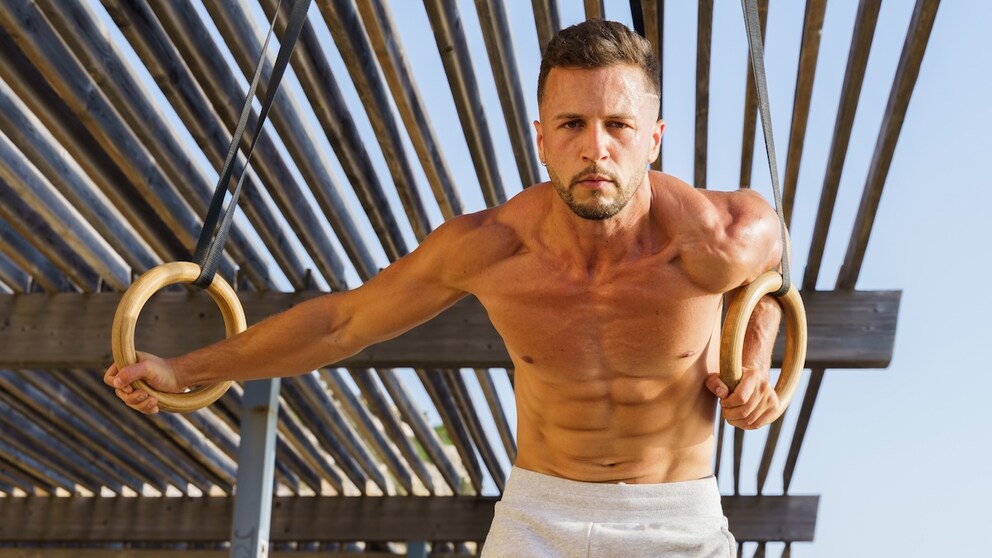
The term comes from Greek (kalos for beauty and sthenos for strength). At its core, it involves exercises performed only with one’s own body weight and minimal equipment (such as bars or rings).
The advantage: It promotes incredible coordination, flexibility, and body control. You learn to move your body as a unit. Additionally, it is location-independent—the living room or playground becomes the gym. “The biggest difference, as we generally understand calisthenics, is that it refers to training with one’s own body weight,” explains Andreas Heumann.
But this is also where the sports scientist sees a limitation: “That’s actually where the boundary lies if you want to limit yourself with this type of training.” Because your own body weight cannot be adjusted as easily as a weight plate. To make the training more challenging, you often have to change leverage or exercise complexity, which presents a high entry barrier, especially for beginners. Conversely, as you become more trained, the volume eventually becomes inefficiently high. “You don’t get any further with 100 air squats,” says Andreas Heumann.
What Is Traditional Strength Training?
In traditional strength training, we work with external loads—dumbbells and barbells, kettlebells, or machines.
The advantage: “The good thing about strength training is that you can adjust and change resistance to match your performance,” says Andreas Heumann. According to the expert, strength training offers “adjustable resistances” that can be increased “very incrementally.” “Very small weight increments are possible here,” allowing for precise control of the training stimulus.
The disadvantages: You are usually tied to a gym or expensive equipment. Additionally, there is a risk of getting lost in isolated movements and neglecting the functional unity of the body.
The Biggest Difference: The Problem of Scalability
The most crucial difference between the two worlds lies in the entry barrier and progression. In calisthenics, the “starting weight” is always your own body weight. And that can be tricky.
The Entry Dilemma: Why Bodyweight is Often Too Heavy
A common misconception is that training with your own body weight is “gentler” or better for beginners. Andreas Heumann views this critically. At the beginning, the weight of your own body is much too challenging for most athletes.
“If you start exercising at 40 and can’t do a single push-up, starting with slow negative exercises and progressions takes unnecessarily long,” notes the Berlin sports scientist. In the time a beginner struggles to control their entire body weight, they could have already built targeted strength with weights.
“You reach your goal faster by building with weights that prepare the body for the effort,” says Heumann. If the training condition is not yet sufficient for the target exercise, you often have to trick with angles in traditional bodyweight training, such as incline push-ups, where the angle is slightly increased by a hand support to reduce the load. However, it is simpler and often more motivating to adjust the resistance on a machine or with weights to match the current strength.
The Efficiency Trap: When Calisthenics Stagnates
There are points where bodyweight training reaches its limits not only for beginners, but also for advanced practitioners. The keyword is: progressive resistance. “In the end, it all comes down to adjusting the resistance to your training condition and working towards the movement you want to perform,” explains Andreas Heumann.
When an exercise becomes too easy, many tend to simply increase the number of repetitions massively. But that’s not always effective. “At some point, it becomes inefficient,” Heumann states clearly. To build muscle, you need an intense stimulus. “To promote muscle growth and train the muscles, you need a certain resistance to perform the movement—push, pull, hinge.” When body weight is no longer sufficient, additional weights are the logical next step.

At Home Instead of the Gym! Training Tips for Menopause

Fitness Icon Mark Lauren: “I Want Training to Be as Addictive as Possible”
The Question of the Goal: What Do You Want to Achieve?
To decide which method most efficiently leads to your goals, you should ask yourself the following questions, according to Andreas Heumann: “Do I have other goals that are positively influenced by my training?” Here are the expert’s recommendations for various scenarios:
The Goal is Maximum Strength
“The faster and more effective way to build strength is strength training,” says Heumann. He points out that “some movement patterns—anything involving heavy lifting—cannot be performed with just your own body weight.”
The Goal is to Try Another Sport
Here, too, strength training often serves as a foundation. “For example, track and field athletes also do strength training to become stronger as supplementary exercises for their sport,” explains the trainer.
The Goal is Body Control
This is where calisthenics shines. “Calisthenics athletes often have very well-trained bodies and can move well,” says Heumann. However, he notes: “That doesn’t mean they didn’t start in a very good condition.” From a good starting point, complex bodyweight exercises are naturally easier to learn.
The Goal is a Fit Everyday Life
Here, bodyweight training serves as an ideal compass. “Calisthenics or bodyweight training is a good indicator to see where you stand,” says Heumann. His credo: “Everyone should be able to lift themselves, master push-ups, etc.”
Why “Against” Should Be “With”
At the end of the day, the debate “calisthenics vs. strength training” is, for Andreas Heumann, an artificial barrier that hinders rather than promotes training success. Calisthenics is often more time-consuming and not always the best method to address specific weaknesses or quickly build strength. Nevertheless, mastering your own body is a desirable goal for any athlete.
“I would never say: one training method against the other, but take the best from both,” concludes the Berlin sports scientist.
Use weights and machines for precise, incremental strength increases and bodyweight training for functional control and as a test of your overall fitness. Combining these two worlds not only trains smarter but also achieves goals significantly faster.