


April 27, 2026, 8:43 am | Read time: 3 minutes
Exercise is considered an important measure for reducing high blood pressure. For a long time, the focus was mainly on endurance sports. Recent studies show that isometric training can also be a valuable complementary strategy in therapy. Chinese researchers conducted a meta-analysis to examine how effective this form of strength training is in lowering resting blood pressure.
What Did the Study Examine?
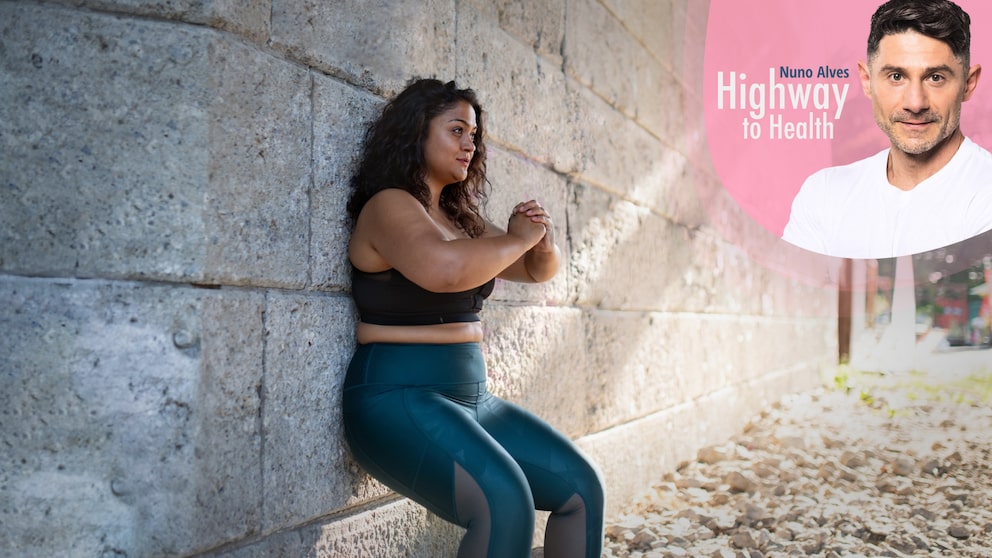
The researchers evaluated 36 studies involving a total of 1,693 adults. The work was published in the journal “Frontiers in Public Health.” 1 Various forms of isometric training were examined, along with differences in intensity, duration, and frequency. Isometric means that muscles are tensed without movement occurring, such as in a wall sit or plank. The goal was to determine the effect on systolic and diastolic blood pressure and to clarify whether certain forms of isometric training are particularly effective.
For context: In Germany, a systolic reading of 140 mmHg or higher and a diastolic reading of 90 mmHg or higher are considered high blood pressure when measured in a doctor’s office. For home self-measurement, the threshold is already at 135/85 mmHg.

Which Type of Exercise Best Lowers High Blood Pressure?

The Best Training Method for Blood Pressure, According to Research
The Results
The analysis shows that isometric training significantly lowers blood pressure.
- The systolic blood pressure, or the upper value, decreased by an average of 6.72 mmHg. This is a significant reduction. A typical value of 140 mmHg can thus drop to about 133 mmHg, moving toward a lower range.
- The diastolic blood pressure, or the lower value, decreased by 2.72 mmHg. This is a smaller but relevant reduction that can contribute to improvement.
Additional evaluations show that when the effects were particularly pronounced:
- Wall sit exercises led to the strongest reduction, with about 10.29 mmHg in systolic blood pressure. This represents a very significant improvement.
- Three training sessions per week showed greater effects.
- Programs lasting more than eight weeks yielded particularly good results.
- Higher training intensities were associated with stronger effects. The intensity was measured differently in the studies, such as by the muscle strength used or the heart rate during the exercise.
- Men and people with high blood pressure benefited more than other groups.
Important: These points come from additional analyses and provide insights, but not definitive evidence for the best training form.
What Does the Study Mean?
Although the evaluated studies differ significantly and long-term data is lacking, the analysis still provides a solid foundation for simple, everyday exercise recommendations. In an interview with FITBOOK, Prof. Dr. med. Christian Ott, board member of the German Hypertension League, spoke about the benefits of isometric strength training: “You don’t need any equipment, and bad weather is no longer an excuse!” These exercises, which may seem very simple at first glance, are actually very strenuous and become more effective the longer you hold them.
Found an error? Please send feedback to: highway2health@fitbook.de.