

April 9, 2026, 9:41 am | Read time: 4 minutes
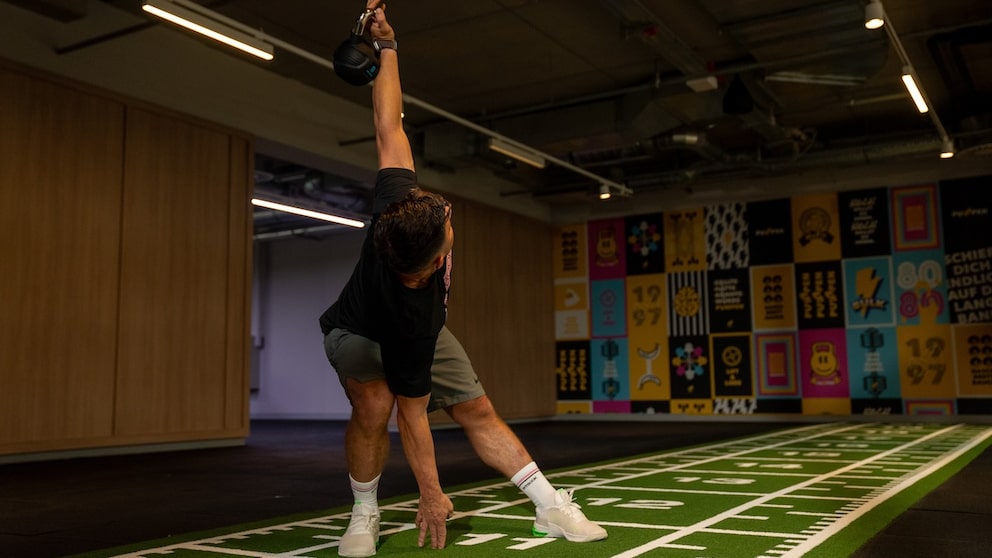
A kettlebell held overhead, mimicking a windmill, is actually one of the most valuable preventive exercises out there. Whether for mobility, rehabilitation, or strength building–the kettlebell windmill is a versatile tool, and FITBOOK editor Michel Winges explains why.1
Follow the FITBOOK channel on WhatsApp now!
“Anti-Aging Hack”–through lateral mobility
As we age, our bodies increasingly limit us. Whether bending sideways, picking something up from the floor, or quickly dodging to the side. The reason is simple. Our bodies mostly move forward and backward in daily life, while lateral movements quietly deteriorate, which becomes noticeable as we age. Noticeable with knee pain, hip problems, and back pain.2
Targeted training in the frontal and transverse planes can delay these issues. And voilà, the windmill trains exactly these planes. The lateral bending and simultaneous rotation stretch and strengthen the lateral hip muscles, oblique abdominal muscles, and inner thighs simultaneously.
Joints are nourished through movement
“Joints are nourished through movement” may sound odd at first, but it describes a real connection. Synovial fluid serves as natural lubrication and a nutrient supplier for cartilage. For it to be produced sufficiently, the joint must be regularly moved through its full range of motion. If this doesn’t happen, the joints essentially “starve” in neglected areas. This can, as a long-term consequence, promote the development of osteoarthritis.
Preventing falls
As we age, the risk of unexpected falls increases. Falls often occur not due to weakness, but because the body loses control in an unexpected lateral moment.3, 4 Regularly performing the windmill could theoretically minimize this risk. However, there are no studies that conclusively prove this.

Strengthen Your Core: 6 Pro Exercises for Core Power

‘FITBOOK Beach Camp’ Coach Shows the Best Kettlebell Exercises
The correct and challenging execution
The kettlebell windmill is one of the more challenging kettlebell exercises. It requires simultaneous shoulder stability, hip mobility, and core control–thus, improper execution can quickly lead to injuries. Before starting with weight, it’s advisable to test the movement without a kettlebell first. Perform the windmill with your arm extended upward and ensure you can execute the movement cleanly and controlled to the lowest position without the arm dropping or the back rounding. Only when this is achieved effortlessly should you add a light kettlebell and then gradually increase the weight.
Assume position
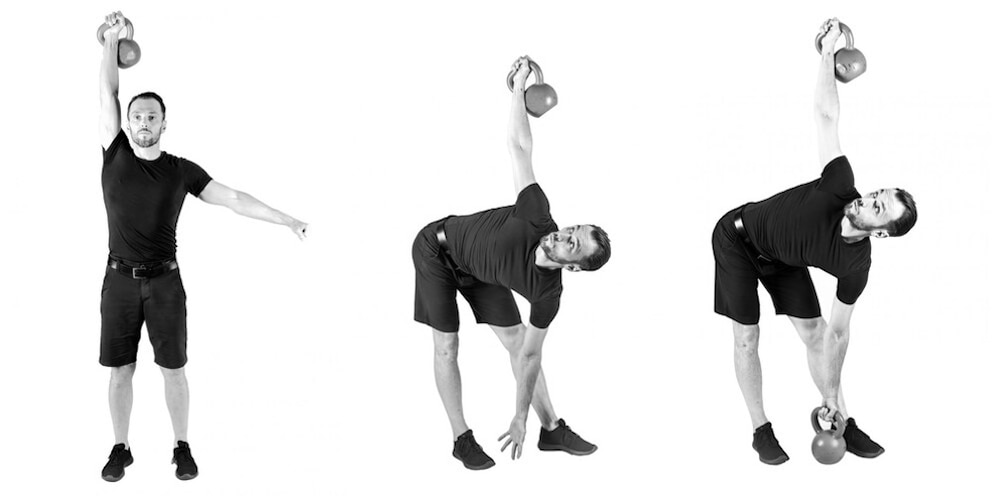
- Stand slightly wider than shoulder-width apart and hold the kettlebell in one hand overhead–the arm is fully extended. You can reach the starting position, for example, through the kettlebell snatch.
- The feet should point about 45 degrees toward the non-weight-bearing side.
Movement sequence
- Push the hip out to the kettlebell side while slowly leaning the upper body to the opposite side.
- The free hand slides down along the extended leg–toward the shin or floor, as far as your flexibility allows.
- The weight-bearing leg (the side with the kettlebell) must remain extended. This leg acts as the “pillar of strength” and carries about 70 to 80 percent of the weight. The front knee (the non-weight-bearing side) can and should be slightly bent.
- Keep your gaze fixed on the kettlebell–this helps maintain arm stability in the extended position.
- Push yourself back up from the lowest position in a controlled manner by pulling the hip back and straightening the upper body.
- Complete all repetitions on one side before switching.
Regarding breathing: Inhale when lowering, exhale when rising.
Also interesting: Lateral raises on the cable tower–properly training the lateral shoulder
Sets, repetitions, and weight
Since the kettlebell windmill is primarily a mobility and stability exercise, the principle of “as heavy as possible” doesn’t apply here. Start with a weight you can easily control; for most beginners, this is eight to twelve kilograms. Perform three to four sets per side with five to eight repetitions each, and take your time: A slow and deliberate repetition is more beneficial than a quick one. Increase the weight only when you can perform the movement cleanly and without compensatory movements over several sessions. The windmill can be integrated into a training program once or twice a week–either as a warm-up exercise before heavy pressing or pulling, or as a standalone mobility component at the end of the session.