

June 4, 2022, 3:19 pm | Read time: 10 minutes
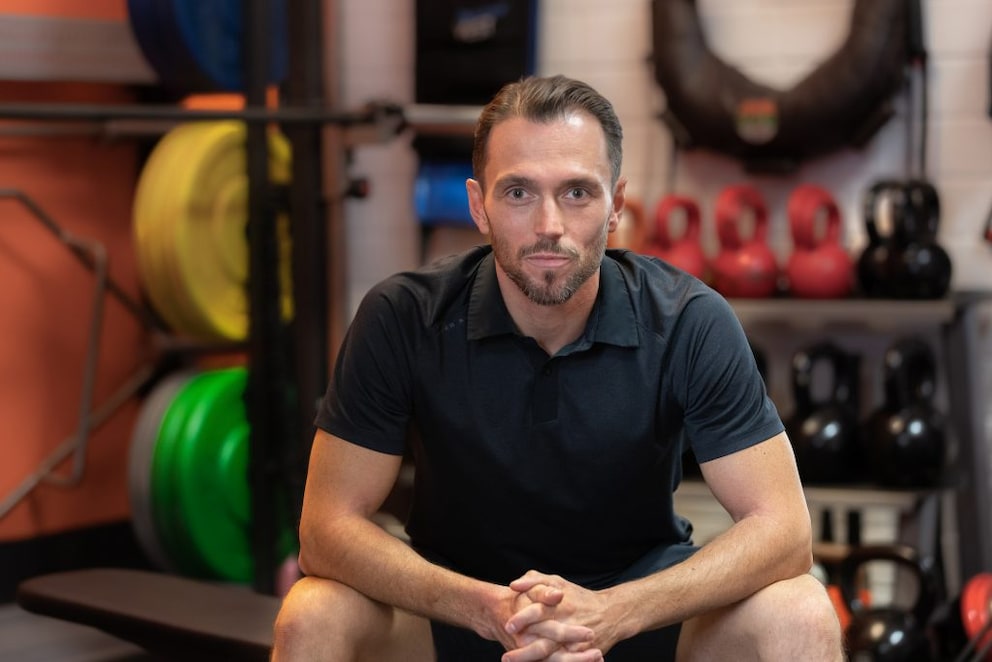
Markus Bremen is a trainer at the FITBOOK Beach Camp in Crete and an expert in functional and kettlebell training. At FITBOOK, he showcases his four best exercises with the “wonder ball.”
Markus Bremen is a certified sports scientist and will be coaching at the FITBOOK Beach Camp in Crete (September 30 to October 7). He is an absolute expert in kettlebell training. In his view, the kettlebell is a true “wonder ball.” Those who integrate it wisely into their training will benefit in many ways–whether beginner, advanced, professional, endurance athlete, or rehab patient. At FITBOOK, Markus Bremen demonstrates the four most important and best exercises with the kettlebell.
Overview
Train with our kettlebell expert at the FITBOOK Beach Camp
There are many self-proclaimed experts, but Markus Bremen is undoubtedly one of the best in his field. That’s why FITBOOK is proud to have him as a trainer at the Beach Camp. We introduce him and give a brief preview of what participants can expect this fall.
Name: Markus Bremen
Age: 43 years
Birthplace: Cologne-Nippes
Residence: Lindlar (near Cologne)
Studio: Cologne-Ehrenfeld
Education/professional background: Certified sports scientist in prevention/rehabilitation (DSHS Cologne), certified personal and athletic trainer (DSHS Cologne), Certified Functional Strength Coach (by Michael BOYLE), EXOS Performance Specialist, Kettlebell/AeroSling Master Trainer, lecturer in “Functional Training” (IST University), naturopath with numerous osteopathic trainings, founder and owner of the move-better Institute
Sporting highlights: Participation in the 2019 Trail Running World Championship
FITBOOK: What are you most looking forward to at the FITBOOK Beach Camp?
Markus Bremen: “I am especially looking forward to meeting many interesting new personalities at the camp. The special spirit that can only arise in a camp. Motivated athletes who are ready to learn, who want to receive new training impulses, who are interested in taking their training to a higher level, and who support each other. And a perfect training location.”
Also interesting: “FITBOOK Beach Camp” director Prof. Stephan Geisler explains why you should definitely be there
Perfect Workouts with the Wonder Ball
What courses will you offer?
Bremen: “I will mainly show and teach the perfect handling of the kettlebell. What do the most important exercise forms look like, how can the kettlebell be perfectly integrated into training, or how does the kettlebell usefully complement training? How can perfect workouts be designed with the wonder balls for different goals–whether fat reduction, increasing cardiovascular performance, building strength, or increasing flexibility. I offer both thematically progressive courses–for example, for beginners or runners–and thematically closed units.”
What else is on your workout plan?
Bremen: “I will offer various ‘Functional Training’ courses. Here I convey the optimal entry into functional training based on one’s own body weight. How can the basic movement patterns be adapted to the individual performance level and which tools are helpful or useful?”
Why should participants not miss your course?
Bremen: “In a very short time, a tremendous amount of best-practice knowledge from over 15,000 hours of personal training and small group sessions is conveyed in a structured and results-oriented manner. And in a very entertaining and charming way. I definitely practice what I preach…like all the coaches in the camp. We are authentic!”
Also interesting: Martial arts pro Tim von Fintel explains why fitness boxing is the better HIIT
“Sweat is Fat Crying!”
Where will you be found at the Beach Camp?
Bremen: “If I’m not coaching and giving tips or relieving tension, definitely with my colleague Sascha Wingenfeld on the bike, getting to know the area and recharging energy. In the evening, more likely at a nice sundowner spot.”
What question can trainees ask that might annoy you?
Bremen: “There really isn’t one–as long as it’s asked sincerely and not repeated constantly!” (laughs)
Do you have a fitness motto?
Bremen: “I like a few: Just do it but first move well and then move often! And: In the end, the duck quacks. And: Sweat is fat crying!”
Do you want to train with Markus Bremen at the FITBOOK Beach Camp in Crete? Here you can find more information about the trip and booking:
Below, Markus Bremen has compiled his best exercises with the kettlebell for us:
Kettlebell Swing
The swing is the exercise for fat burning, back strengthening, and improving mobility and athletic abilities. It enhances your power, endurance, and strength performance.
Muscle groups trained:
- Core,
- glutes, and
- hamstrings
Execution
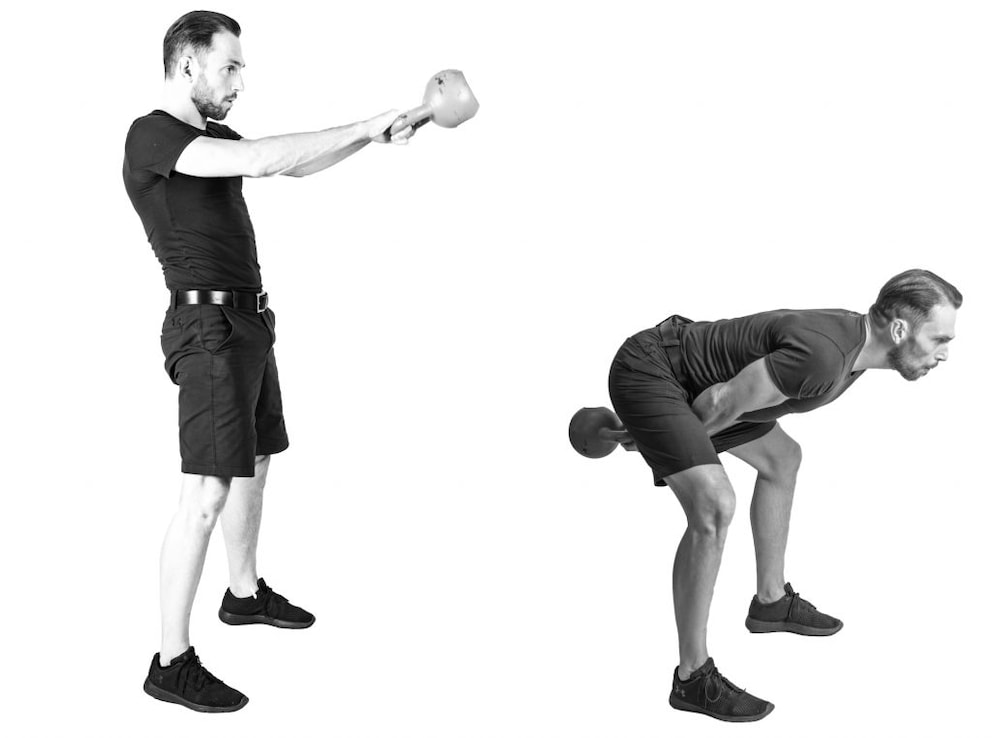
Swings are–biomechanically speaking–explosively executed deadlift movements. The basic body movement is the same for both exercises. Stand with feet shoulder-width apart about half a meter behind the kettlebell and pull your hips back so that the weight shifts to your heels. Tense your entire body, grab the kettlebell handle with straight arms, and aggressively pull the ball back between your legs until the insides of your wrists touch the insides of your thighs near the groin. Tighten your abs and glutes and explosively extend your legs through your heels–until your ankles, knees, hips, and shoulders form a line. The explosive hip extension causes the ball to fly up to about chest height. On the way back, aim for your own step so that your wrists again touch the insides of your thighs.
Note: The power comes from the legs and glutes, not from the arms or shoulders. The shoulders always stay back and down.
Technique Check
- Back remains straight.
- Glutes are pulled far back.
- Gaze is directed forward and down.
- Explosive hip extension: In the end position, knees and hips are extended; knees, hips, and shoulders form a line
- Arms and kettlebell form a line.
- Shoulders are “stable” on the torso (back and down), the latissimus dorsi is tense
- Wrists touch the inner thighs on the backswing
- Biomechanical breathing (inhale through the nose at the bottom, exhale through the mouth at the top)
Also interesting: The benefits of training with battle ropes
Turkish Get-up (TGU)
This exercise was performed by Turkish wrestlers more than 200 years ago and provides excellent mobility and stability for the entire body, primarily the shoulder joints. Throughout the entire movement, the lumbar spine must be continuously stabilized while the arms and legs move in all directions.
Muscle groups trained:
The TGU is a very effective full-body exercise for stability, strength, and mobility throughout the body.
Execution
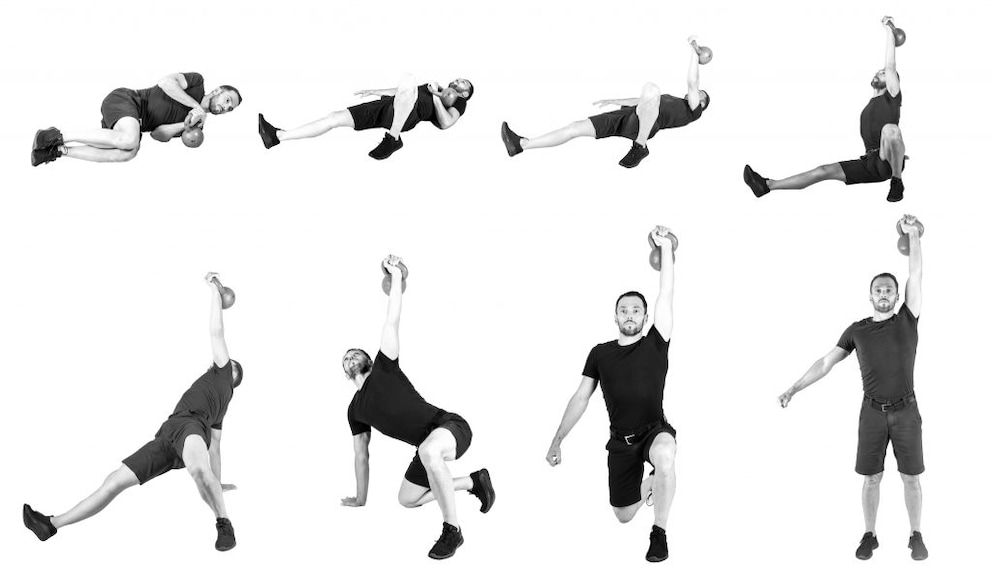
First, practice the movement sequence with just your body weight until you feel confident. Then practice with a shoe on your fist to build even more body tension and optimize the movement execution. Due to the complexity of the exercise, preparatory exercises such as the side plank, arm bar, glute bridge, and lunges are recommended. Only when this is successful should a kettlebell be added (men: initially 8 kg, women: 4-6 kg).
You can start the exercise from a lying position on the floor and then stand up. However, experience shows that it is easier to start with the reverse Turkish Get-up, where the movement sequence begins from an upright stand.
Technique Check
- Lift the kettlebell from the floor with both hands close to the body and set it down again after the exercise
- Keep the lumbar spine straight or in a neutral position (tighten abs)
- Grip is diagonal in the hand
- Elbows and wrists remain straight
- Arm always remains vertical. Every movement should be safely possible even with a very heavy kettlebell
- Shoulders stay back and down
Also interesting: Yoga teacher Stephan Suh: “I don’t put on a show, I want to ground people”
5 Step-Up Variations for an Effective Full-Body Workout
What Are the Benefits of Sled Pushing Compared to Traditional Leg Workouts?
Goblet Squat
Execution
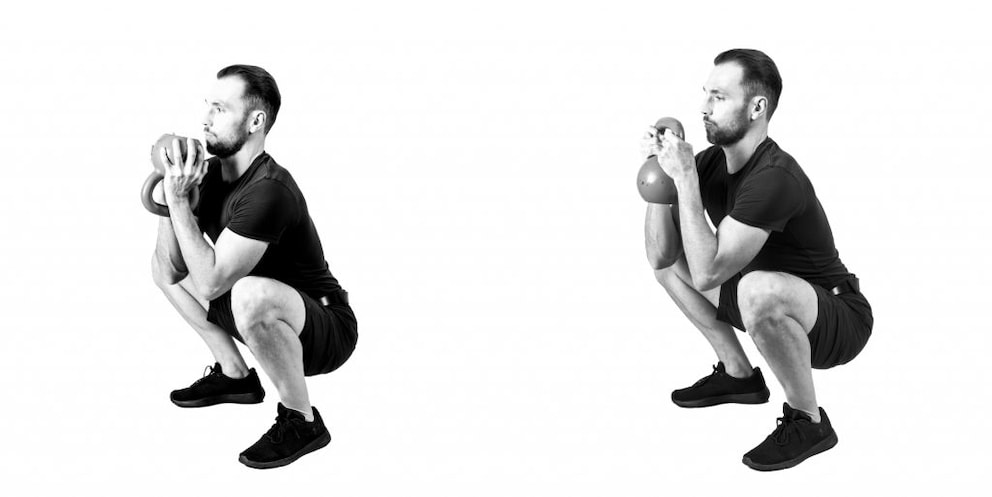
In the Goblet Squat (“chalice squat”), stand shoulder-width apart. The toes point slightly outward. Take a short, sharp breath through the nose, then, under abdominal tension, pull the glutes back and down and the knees up and out in a V-shape toward the armpits. The spine remains as upright as possible. Imagine the head and tailbone moving apart as you descend, stretching the spine at both ends.
The movement starts with active hip flexion. In the lower position, the front of the thighs should be at least parallel to the floor, with the pelvis not tilting. The elbows should not come below the knees.
Exhale when pushing up. Tighten your glutes and try to press your heels maximally into the ground. In the standing position, the hips and knees are extended.
Technique Check
- “Root” or slightly push feet outward
- Spine remains upright; active abdominal tension
- Heels on the ground
- Knees point toward the toes. Stay briefly in the lowest position and
- maintain tension.
Also interesting: Five-time “Fittest Man in the World” reveals training and nutrition secrets
Windmill
The windmill is also one of the best exercises with the kettlebell. It’s worth integrating it into your training to benefit from its positive effects on flexibility and muscle strengthening.
Muscle groups trained:
The windmill promotes mobility in the hip joints and thoracic spine and effectively trains the lateral core muscles. Overhead variations add additional shoulder stabilization (similar to the Turkish Get-up).
First practice the movement without a kettlebell and find a partner to ensure your spine remains straight. Only add weight (kettlebell) once you have developed a good sense and body awareness for the correct movement and this has been checked by a partner or your trainer.
Also interesting: “FITBOOK Beach Camp” coach Daniela Hüllen-Deutscher: What women should consider in strength training
Execution
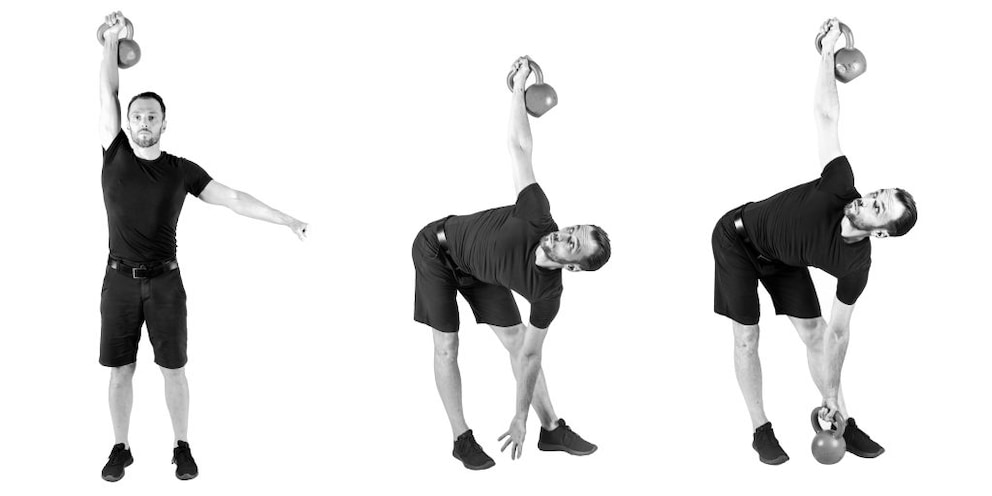
Start standing, feet about hip- to shoulder-width apart. Now turn the toes about 45 degrees to one side, stretch the back arm up, and shift the weight onto the back heel by pushing the back hip far back and out. The back remains straight. The hip is bent, and the thoracic spine rotates. The back leg (under the kettlebell) remains straight and vertical. Most of the weight is shifted onto the back heel.
Take a short, intense breath through the nose, tighten the abs, and lean the upper body forward between the feet as far as a neutral spine position can be maintained. Rotate the upper body toward the back foot. The back arm is stretched upward. Pull the shoulder blades back and down and look at the upper hand.
Easier execution: With the front (lower) hand, slide along the back of the thigh from the front of the body until you can grasp the back hamstrings.
This usually ensures that the body moves in the right direction (forward and inward).

Technique Check
- Always look up to keep the back straight and rotated.
- Tighten the glutes and hamstrings of the back leg
- Press the back heel firmly into the ground and pull the upper body back to an upright position from the lateral core muscles, glutes, and hamstrings (like in the swing). Exhale–this further stabilizes the spine.
- The upper arm always points vertically to the ceiling, and the shoulder blade remains pulled back and down.
Repeat the movement, taking a short, intense breath through the nose, continuing to look at the upper hand, and lowering the already rotated upper body diagonally forward and down in a controlled manner. Always try to rotate the upper chest upward. If you cannot lower the upper body as far due to lack of mobility, slightly bend the front knee. However, the body weight should still rest mainly on the back heel (push the hip out!).