


May 31, 2026, 4:17 pm | Read time: 8 minutes
As effective as free pull-ups are, unfortunately, they are among the most challenging exercises in the entire fitness world. Fortunately, there is a great aid that is especially helpful for beginners: the pull-up machine. FITBOOK author Tony Poland, along with personal trainer Markus Bremen, explains why the device can be so crucial, how it works, and how to perform pull-ups correctly with it.
Follow the FITBOOK channel on WhatsApp now!
What Makes the Pull-Up Machine Special
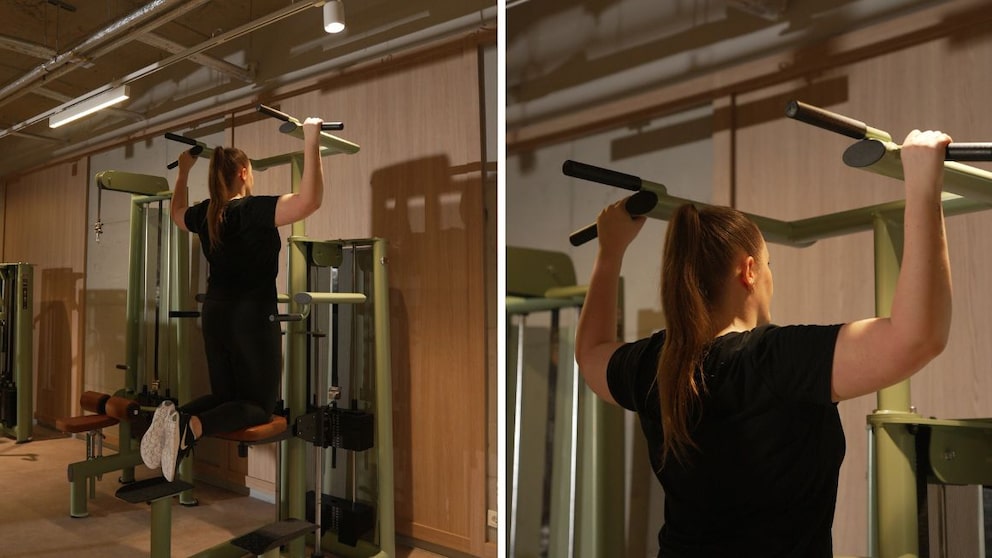
Simply put, this machine can be defined as a construction with a movable platform for knee support. This is usually connected by a cable to a weight stack and a grip bar. This is important to describe its specific functionality.
To train with it, the first step is to set the appropriate weight. And here’s a real peculiarity! Normally, with most exercises, the difficulty increases as the weight goes up. However, here it’s the opposite. The lower the set weight, the more challenging the pull-ups become. This is because the weight acts not as resistance but as support.
What may initially sound contradictory can be logically explained. The set weight supports you during the pull-up by lifting or relieving part of your body weight. If you set less weight, you have to lift more of your own mass. “Your own body weight becomes more of a focus. The support that the weight would provide is lost,” says Markus Bremen.
Why Most People Fail at Pull-Ups
Without a doubt, pull-ups are the exercise of choice for a well-trained back and pronounced shoulder and arm muscles. The problem is that the back and arms, or the entire upper body, must first be strong enough to pull the entire body weight upward without assistance. And that’s where most people fail. However, those who don’t want to give up on pull-ups and want to work their way up in this supreme discipline will find a reliable partner in the pull-up machine. If the machine is used wisely, initial success can be achieved quickly. However, it’s important to know that it’s still a long way to achieving a free pull-up.
A Practical Example for Illustration
To illustrate, let’s take a man who weighs 90 kilograms. If he sets a weight of 20 kilograms on the pull-up machine, he effectively becomes 20 kilograms lighter. This means he then has to move 70 kilograms himself. If he chooses 60 kilograms, he only has to pull up 30 kilograms on his own. Without relief, the man would perform a free pull-up with his entire 90 kilograms of body weight.
By the way, for beginners, it’s advisable to choose a support weight of about 40 to 60 percent of their body weight.
How to Train Pull-Ups on the Machine Correctly
Once you’ve selected the right weight for yourself, first support your knees on the platform. Then grip the bar with both arms on the left and right. Keep your upper body upright, chest out, and eyes forward. Also important: Actively lower your shoulders, keep your core engaged, and your arms almost fully extended.
Now pull yourself up in a controlled manner until your chin is about level with or slightly above the grips. Pull your elbows back and down. Then slowly return to the starting position by lowering yourself calmly and evenly. When your arms are almost fully extended again, you’ve reached the turning point of the exercise. Above all, maintain body tension throughout.
Different Grip Variations
In the classic overhand grip (pull-up), the palms face away from the body, shifting the load intensely onto the latissimus and upper back. If you turn your hands to an underhand grip (chin-up), so the palms face your face, the biceps strongly engage in the movement–this variation is considered the most powerful and is particularly easy for beginners to implement. If you want to protect your wrists and elbows even more, choose the hammer grip (neutral grip) on parallel bars, as it allows for a particularly natural movement.
Besides the grip type, grip width also plays an important role. You can choose a distance that roughly corresponds to your shoulder width. This relieves the shoulder joints and ensures stable movement. If you grip significantly wider, the space in the shoulder joint narrows, which can lead to a so-called impingement syndrome over time: Tendons and bursae in the shoulder area become pinched, causing pain when raising the arm.
Many gym-goers also instinctively grip the bar without wrapping their thumb around it–the so-called “monkey grip,” because it allows the back to tense better and the biceps to support less.
Also interesting: Hyrox–what’s behind the fitness trend
Common Mistakes
To keep the effectiveness of push-ups on the machine as high as possible and avoid injury, several things must be considered. Lowering, often underestimated, is crucial. The rule is: not too fast and not too deep, otherwise joints could be overloaded. If you swing your legs or gain too much momentum, the target muscles are relieved, and the exercise is less effective.
Additionally, it’s important to find the right weight. If pull-ups are too easy, the muscle stimulus is lacking. The shoulders are also in focus and should not rise too high during the pull-up, as this would engage the neck more, which is unnecessary for this exercise.
As mentioned earlier, you must also focus on the back. A rounded back or an overly arched back does more harm than good, especially concerning the spine and intervertebral discs. Lastly, the grip must be symmetrical on both sides to ensure even loading. Throughout the execution, the exercise should not be performed too quickly or hastily, but slowly and controlled up and down!
The Advantages
If the exercise is performed correctly, there are numerous benefits. The adjustable counterweight is particularly useful, allowing everyone to adjust the pull-ups to their level and strength. The machine also allows for clean learning of the movement. An improper execution due to lack of strength should not occur. Naturally, the machine also reduces the risk of overload or even injury.
The pull-up machine is especially a good choice for people with excess weight or those coming from rehab. The guided movement and the possible reduction of weights quickly lead to success experiences.
Another advantage lies in the progressive increase by simply reducing the weights as support. “You can scale very nicely. The more advanced you are, the more weight you can remove. It’s easy to control,” says Markus Bremen. This way, you can specifically work towards free pull-ups. “However, to prepare for real pull-ups, I would also work more with bands and eccentric pull-ups,” the fitness expert advises.
The Disadvantages
But even in the case of pull-ups on the machine, not everything that glitters is gold. It’s clear that the device dictates the entire movement. As a result, you have to focus less on stabilization. Thus, our functional strength is less trained, and mobility is somewhat restricted. Another downside is that our core is also less challenged. Clearly, the body is stabilized almost automatically. “Due to the predetermined movement, you don’t learn the sequence needed for a normal pull-up,” emphasizes Markus Bremen. Therefore, it’s advisable not to delay the transition from machine-assisted pull-ups to free pull-ups for too long.
Bench press – better on the machine, with free weights, or with a barbell?
Pull-Ups – How the Grip Variation Affects the Target Muscles
Pull-Ups on the Machine–Also Suitable for Advanced Users?
Pull-ups on the machine are primarily perfect for beginners. The technique is learned, the risk of injury decreases, and the motivation curve rises. After all, you achieve success faster because you need significantly less strength.
But advanced users can also benefit. This fitness group can correct small execution errors under low load on the machine, and with less load, the focus on individual muscle groups can be increased. When returning, for example, after injuries, the machine can also help. Experienced users can also build strength by consciously lowering themselves slowly with minimal support. Another option is to add machine-assisted pull-ups to initially free push-ups. This way, you can increase the volume of your workout.
Guided Pull-Ups vs. Free Pull-Ups
Finally, a brief comparison between machine-assisted pull-ups and free pull-ups, the absolute supreme discipline, should not be missing. The two exercises differ not only in that one uses a machine and the other does not.
“Ultimately, you train similar muscle groups, such as the latissimus, brachioradialis (forearm muscle), other back muscle groups, and the scapular muscles,” says Markus Bremen. “But it’s definitely true that the neuromuscular control of the movements cannot be implemented one-to-one. That means someone who has very little additional weight on the machine won’t immediately be able to do one or two clean free pull-ups. You really have to train freely for that. But through the machine, you can build basic strength in the target muscles,” says Markus Bremen.