


November 20, 2025, 10:42 pm | Read time: 10 minutes
Reformer Pilates, mat Pilates, flying Pilates, fascia Pilates, wall Pilates … The list of Pilates trends could go on almost endlessly. The variety of Pilates styles and classes raises the question: What is still Pilates and what is more bodyweight training or stretching? In fact, there are 34 exercises considered original Pilates exercises, as they were created by Pilates founder Joseph Pilates. FITBOOK author Nina Ponath explains which ones they are.
The core of Pilates, which distinguishes it from other forms of training, is the focus on the so-called powerhouse, or the body’s center, from which every movement should be controlled. Besides this focus on the body’s center, Pilates always involves control, precision, and–often forgotten today–fluid movements connected with breathing.
Contrology – now Pilates
Originally, Joseph Pilates developed his method–what we now call “Pilates”–under the name “Contrology.” Pilates understood this as the study of conscious control over one’s own body. The focus was not on the “abdominal muscle” itself, but on the ability to control movements from the body’s center. Indeed, there is a fixed set of 34 exercises that Pilates designated as his “Original Mat Work.” These exercises, which form the core of the Pilates method, are all performed on the mat without equipment. This world, where it is very calm and always lying down, is quite different from what is seen on social media as “Pilates.” It’s time to take a closer look at the originals.
Within the framework of “Contrology,” Joseph Pilates placed special emphasis on six principles that still form the basis of classical Pilates today:
- Concentration
- Control
- Center (Powerhouse)
- Flow
- Precision
- Breathing
These principles run through the 34 classic mat exercises that Joseph Pilates recorded in his book “Return to Life through Contrology” (1945).
The 34 Original Exercises by Joseph Pilates – Explained
The Hundred
The name says it all: In this exercise, from a lying position, the arms are quickly but controlledly pumped up and down–ideally a hundred times, if you can manage it. The core is tight, and the legs are lifted straight up, like in a V-sit-up.
The Roll-up
Here, you slowly roll up vertebra by vertebra from a lying position. Ideal for abdominal and back stretching.
Roll-over
This position also starts lying down. The feet and legs, extended forward, are slowly lifted and pulled back over the head. The movement resembles a controlled shoulder stand, as is also common in yoga, and strengthens the spine and the core.
Single Leg Circles
From a lying position, first, the right leg is lifted and slowly moved in a large circle, extending from the foot end to hip height. The leg remains stretched the entire time. The hip stays almost immobile, and the abdomen is kept tight throughout.
Rolling Like a Ball
From a rounded posture, we roll over the spine. This exercise strengthens balance and control.
Single Leg Stretch
From a lying position, alternately pull one knee to the chest while extending the other leg into the air without resting it. The abdomen is tightly engaged.
Double Leg Stretch
Here, too, you start lying down with a tight core. Both knees are pulled to the chest, and the arms hold the shins. Simultaneously, extend arms and legs away from you and then bring them back to the starting position in a controlled manner.
Spine Stretch Forward
You sit upright with legs extended and feet slightly apart. Your arms are extended forward. From here, bend forward vertebra by vertebra over the legs, as if overcoming an imaginary ball, and roll back up just as controlled. This mobilizes the spine.
Open Leg Rocker
You sit upright, your legs are extended and slightly apart (V-shape). You hold your ankles or calves with your hands. From this upright position, roll back onto your back and forward again, maintaining the V-shape of the legs and training balance and core strength.
Corkscrew
You lie on your back, legs extended upward and together. Your arms are firmly beside your body. Now, move the closed legs in controlled circular motions, first clockwise, then counterclockwise. This exercise stabilizes your center and simultaneously mobilizes the hips.
Saw
You sit upright with legs extended and slightly apart, arms extended to the sides. Now, rotate your upper body to the side and bend over the extended leg forward, as if reaching the opposite foot with your hand and making a sawing motion over your leg.
Swan
You lie on your stomach, hands placed beside your shoulders. Your legs are long and extended, feet resting with the tops on the floor. Lift your upper body fluidly and powerfully, stretch into a backbend, and then lower yourself again.
Single Leg Kicks
You lie on your stomach, upper body slightly raised and supported by your forearms, looking forward. The legs are long and extended. Now, alternately pull one heel twice in quick succession to the buttocks and then extend the leg again.
Double Leg Kicks
You lie on your stomach, hands clasped behind your back. Pull both heels simultaneously three times quickly to the buttocks and then extend the legs long while lifting your upper body into a slight backbend. The focus here is on the back and the entire posterior chain of your body.
Neck Pull
You lie on your back, hands clasped behind your head, legs extended. From this position, roll up slowly vertebra by vertebra, similar to the roll-up, but the hands behind the head make this version even more intense for the abdomen and posture.
High Scissors
From a supine position, the legs are stretched vertically into the air, then alternately crossed in quick, controlled movements, always alternating one leg over the other–similar to a scissor movement. The exercise promotes flexibility and strength in the posterior leg muscles and requires a stable core.
High Bicycle
From a supine position, both legs are alternately extended and pulled to the chest while the upper body remains slightly raised–similar to cycling in the air. The controlled execution trains abdominal muscles, hip flexors, and coordination.
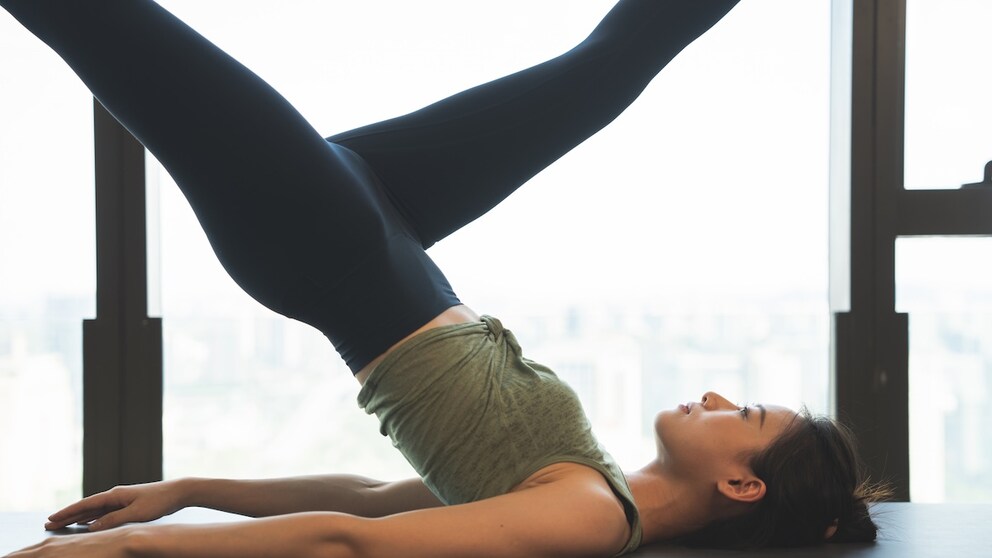
The Shoulder Bridge
From a lying position, the pelvis is lifted to create a line between shoulders, hips, and knees. Optionally, one leg can be lifted straight. The exercise strengthens the back, glutes, and hamstrings–at the same time, the spine is mobilized. Typical for Pilates is also the controlled, segmental movement when rolling the spine back onto the mat.
Spine Twist
You sit upright with legs extended and slightly apart, arms extended to the sides. Now, rotate your upper body controlled to one side while keeping your spine straight. Your pelvis remains stable and firmly on the mat. This exercise improves trunk mobility.
Jack Knife
You start lying down, legs extended upward and together. Your arms are firmly beside your body. Lift your pelvis and bring the extended legs controlled over the head until they are almost parallel to the floor. Then roll down vertebra by vertebra while keeping the legs extended.
Side Kick Series
You lie on your side, your body forming a straight line. Your lower arm supports your head, and the upper arm rests in front of you on the mat. From here, perform a series of controlled leg movements: lifting, lowering, swinging forward and backward, circling. This really works the legs!
Teaser
You start either sitting with bent knees or lying down. From there, lift your upper body and legs simultaneously until your body forms a V-shape–your legs are extended, and your arms are extended forward parallel to the legs.
Hip Twist
You start in the teaser position, your legs are extended and together. Now, rotate your closed, extended legs controlled from one side to the other while keeping your upper body stable and upright.
Swimming
You lie on your stomach, arms and legs extended, head slightly raised. Now, alternately lift and lower one arm and the opposite leg, similar to swimming. The gaze remains directed downward. This exercise strengthens your back muscles.
Leg Pull Front
You start in a plank position, your hands under the shoulders, the body in a straight line. Now, lift one leg controlled off the ground and hold it extended in the air. Maintain the plank, and your core remains tight as a board. A challenging exercise for strength and stability.
Leg Pull Back
You start in a reverse plank variation. You lie with extended legs, belly facing up, hands supported behind the body, fingertips pointing to the feet. From here, lift your pelvis and upper body to form an inclined line. Then lift one leg extended off the ground and hold it. Particularly effective for the glutes and your entire posterior chain.
Side Kick Kneeling
You kneel on one knee, the other leg extended to the side, your body upright. You can extend your arms to the sides for balance. From here, perform various leg movements, such as lifting and lowering or small circles.
Side Bend
You start in a side plank position: One arm is extended, the hand under the shoulder. Your legs are extended, one foot on top of the other. The upper arm points to the ceiling. Now, lower your hips controlled to the floor and then lift them back up.
Boomerang
The boomerang is a complex movement for advanced practitioners that combines several positions. You start sitting, cross the legs, and then roll back, lift the legs over the head, switch the crossing of the legs, roll back up, and bend forward.
Seal
Similar to “Rolling Like a Ball,” you sit in a rounded posture. This time, however, you thread your hands through your legs and grasp your ankles. As you roll back and come forward again, clap your feet together lightly three times. It’s like “Rolling Like a Ball,” but with a playful element and additional core activation.
Crab
This exercise is similar to the seal but even more unusual. You sit in a similar rounded posture as in the seal, but you cross your legs and reach over your shoulders with your hands to grasp your feet. You roll over your head backward and forward again. This functional movement mobilizes your spine and challenges your core strength.
The Rocking
From a prone position, the feet are grasped with the hands to form an arc–then the body is rocked back and forth. This exercise combines back stretching, strength, and flexibility. It is demanding and requires control to steer the rocking motion from the core without falling into the lower back.
The Control Balance
From the shoulder stand position, one leg is lowered backward while the other remains in the air–then switch. The movement requires enormous core stability, balance, and control.
Push-up
As the conclusion of the series: The classic push-up, but with Pilates precision. You start in a plank position. Your hands are under the shoulders, the body in a straight line. Bend the elbows close to the body and lower your upper body controlled to the floor before pushing yourself powerfully back up. Pay attention to a stable core and a straight line from head to heels.