


May 1, 2026, 6:54 am | Read time: 6 minutes
The reverse butterfly is an exercise that specifically targets the rear shoulder, neck, and back. In the gym, there is a special machine for this–at home, the exercise can alternatively be performed with dumbbells or a resistance band. Learn about the correct execution, which muscles are engaged, and what alternatives exist at FITBOOK.
Follow the FITBOOK channel on WhatsApp now!
The Best Grip?
Typically, there are two grip options on the machines: the neutral grip and the pronated grip. The neutral grip is also called the hammer grip because the grip arm of the machine is held like the handle of a hammer–thumbs pointing up. With the pronated grip, the palms face down. But does one option actually engage more muscles?
Yes! At least, that’s what a study showed, which examined this in 19 men.1 By measuring electrical muscle activity, scientists were able to prove that the neutral grip activates the rear deltoid muscle more than the pronated grip. From this, it can be deduced that you might want to choose the neutral grip if you want to maximize your muscle growth.
Should the pronated grip be completely dismissed then? No, because not everyone responds the same way to a grip option. Some trainees simply feel a stronger tension in the rear shoulder with the pronated grip than with the neutral grip.2 For recreational athletes, the difference between the two grips is so small that they can simply choose the grip that feels more comfortable. Additionally, if you want to train not only the rear shoulder but also the upper back, the pronated grip might be more suitable.
Combination Machine
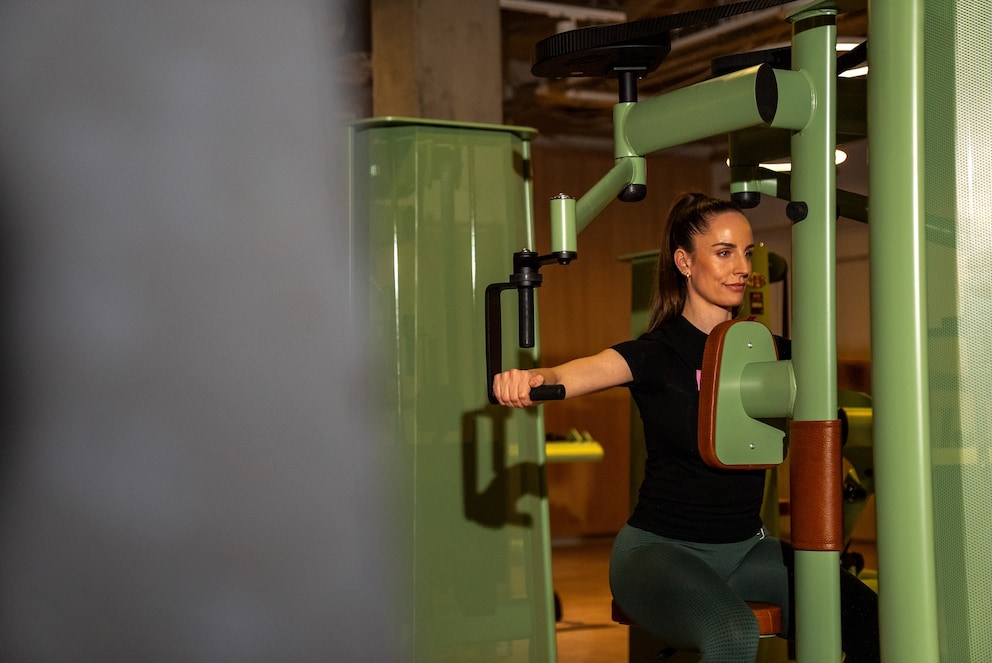
In gyms, you often find a combination machine for reverse butterfly and the usual butterfly. On this machine, the “arms” are adjustable with two knobs or screws. Adjust the “arms” so that you achieve the largest possible range of motion–it is usually optimal to lock the “arms” in one of the front holes.
What a Reverse Butterfly Looks Like: Technique and Movement
Starting Position
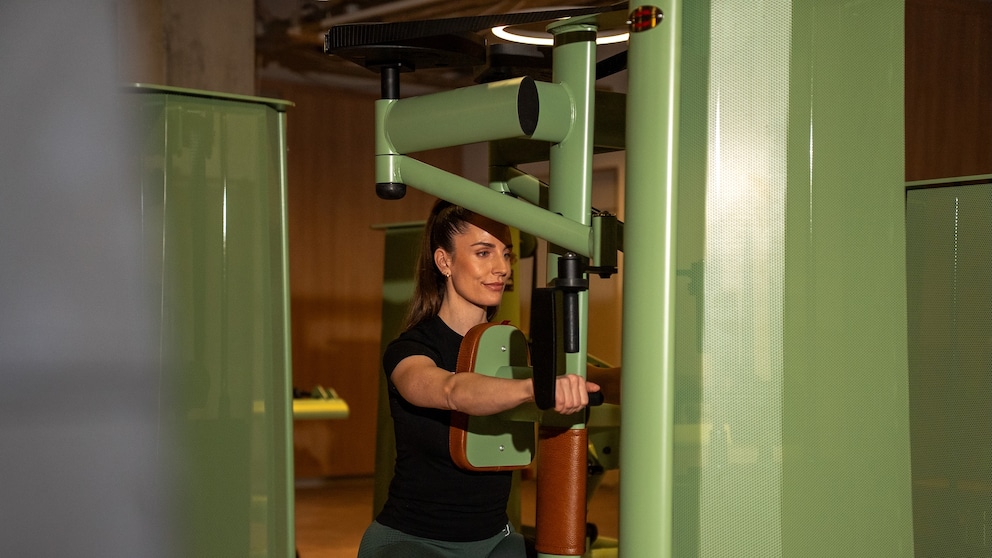
Sit at the reverse butterfly machine, facing the machine. The upper body is supported on the vertically attached pad, feet firmly on the ground, and thighs and lower legs form an angle of about 90 degrees. Now grasp the handles, arms should be slightly bent at the elbows, and hands should be at shoulder height. If this is not the case, the seat pad must be adjusted up or down until hands and shoulder joints are at the same height. The back is straight, gaze directed forward, and abdominal muscles tightly engaged.
Movement
Slowly spread the arms and move them outward in a controlled manner. During exhalation, guide the handles as far back as possible with almost straight arms. It is important to work not from the arms but with the rear shoulder muscles and the trapezius muscle. Pause briefly in the position and then return the arms just as controlled to the starting position, but without fully resting the weight before the next repetition. With inhalation, slowly bring the handles back forward to the machine.
Avoid Common Mistakes
A common mistake in this exercise is pushing the head forward during exertion. This prevents the shoulders from working properly and can lead to shoulder and neck injuries in the worst case. Therefore, make sure the head remains in a neutral position.
Another frequent mistake is using uncontrolled technique with momentum. This causes the chest to lose contact with the pad. The momentum weakens the training and minimizes the training effect.
Muscles Engaged in the Reverse Butterfly
The reverse butterfly primarily trains the muscles of the shoulder area, neck, and back:
- Deltoid muscle (musculus deltoideus)
- Spinal muscle (musculus spinalis)
- Transverse muscle (musculus transversus)
Supporting Muscles
- Major and minor rhomboid muscles (musculus rhomboideus minor et major)
- Infraspinatus muscle (musculus infraspinatus)
- Abdominal muscles
How Much Weight Should You Use?
With the reverse butterfly, there’s a risk of using momentum, which reduces the training effect. We often use momentum when our muscles are overwhelmed. Therefore, you should not start with too much weight. It’s better to start slowly with 15 to 20 repetitions per set and gradually increase. Over time, a higher training weight will become easier.
The 5 Most Important Strength Exercises for Men Over 50
Forget Bicep Curls! This Exercise Tones Your Upper Arms
How Often Should You Perform the Exercise?
The reverse butterfly is a great exercise for back training. Athletes who follow the “push-pull” principle–a form of split training–perform the exercise on one of the pull days. The exercise can be done on a training day with at least three sets of 8 to 12 repetitions. You can also vary between reverse butterfly on the machine and free repetitions with dumbbells or a resistance band.
Also interesting: Overhead press–shaping shoulders with dumbbells
Exercise Variations
The reverse butterfly is occupied? No problem! The reverse butterfly machine is particularly convenient for training the shoulders and back, but it’s not absolutely necessary. There are plenty of alternatives to train the same target muscles. You can achieve a similar effect with the following exercises:
For Beginners
Reverse Butterfly with a Resistance Band
This training variant can easily be incorporated into your home workout plan. In this variant, hold a resistance band with arms extended forward. From this position, move to the side and back as if drawing the upper part of a semicircle; the same movement you would do on the machine.
Reverse Butterfly on the Cable Machine
The exercise can also be performed on the cable machine. The difficulty level is higher with this variant than on the machine because you stand during the exercise and need to maintain the necessary body tension.
For Advanced Users
Reverse Butterfly with Dumbbells
Instead of a resistance band, you can also use two dumbbells for the exercise. Choose a weight that is not too high.
Rowing
Rowing is also a great exercise to train the trapezius or hood muscle. Equipment such as a barbell, dumbbells, or a cable machine is suitable.