



September 22, 2025, 5:50 pm | Read time: 3 minutes
Even though crunches and sit-ups may look similar at first glance, they differ significantly in terms of the muscles engaged, risk of injury, and efficiency. But what exactly are the differences between the two exercises? Trainer and FITBOOK expert Alina Bock explains.
Follow the FITBOOK channel on WhatsApp now!
Execution of the Two Exercises
Sit-ups and crunches are both exercises that involve spinal flexion to engage the abdominal muscles. Despite this, there are significant differences in how the two exercises are performed.
What Is the Same
Both sit-ups and crunches are performed lying on your back with your legs bent. You can either cross your arms in front of your chest or place them at the sides of your head if you want to support your cervical spine. Then, you lift your upper body toward your legs until your shoulder blades lift off the ground.
What Is Different
In a crunch, you stop the movement at this point and roll back down. In a sit-up, you also bend at the hips, so your entire upper body, including the lower back, lifts off the ground. The crunch only moves the spine, while the sit-up also involves the hip joint.

Are Sit-ups and Crunches Really Ineffective Ab Exercises? Here’s What the Expert Says
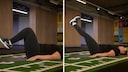
Leg Raises: How to Properly Perform One of the Most Effective Ab Exercises, According to Studies
Different Muscle Engagement
Due to the different executions, there are also differences in terms of muscle engagement, efficiency, and risk of injury.
Muscles
Since the movement in a crunch ends with spinal flexion, it primarily trains the upper and middle parts of the rectus abdominis. In a sit-up, the upper body is fully raised, engaging the entire rectus abdominis. Additionally, the oblique and deep abdominal muscles, as well as the hip flexors, are also engaged.
Also interesting: 4 variations of the side plank that make the workout even more effective
Efficiency
The increased muscle activation might suggest that the sit-up is significantly more efficient than the crunch. However, sit-ups are often performed incorrectly and thus ineffectively. Mistakes are more likely to occur in sit-ups than in crunches. The full lifting of the upper body often leads to working too quickly and using too much momentum, resulting in a significant loss of effectiveness. It is important to perform the sit-up with continuous abdominal tension to avoid this mistake and enhance the abdominal muscles.
Risk of Injury
If the sit-up is performed with a lot of momentum and little abdominal tension, a hollow back can form, increasing the risk of improper spinal strain. Over time, this can lead to pain or other spinal issues. Additionally, both sit-ups and crunches often inadequately support the cervical spine, leading to a bending of the neck and subsequent overload. This can also result in pain and problems in the neck area over time.
Which Exercise Is Better Suited for Whom?
The sit-up is particularly suitable for those who have mastered the technique and can maintain abdominal tension throughout the exercise. Additionally, the sit-up can be more easily varied due to the increased movement and freedom of movement, making it an ideal exercise for those seeking a new challenge in their training. Weights can be easily added, or movements can be modified. The crunch, on the other hand, is suitable for those who cannot yet maintain abdominal tension and want to avoid using momentum. It is easier to control and ideally prepares one for the sit-up.