

March 21, 2026, 5:23 pm | Read time: 6 minutes
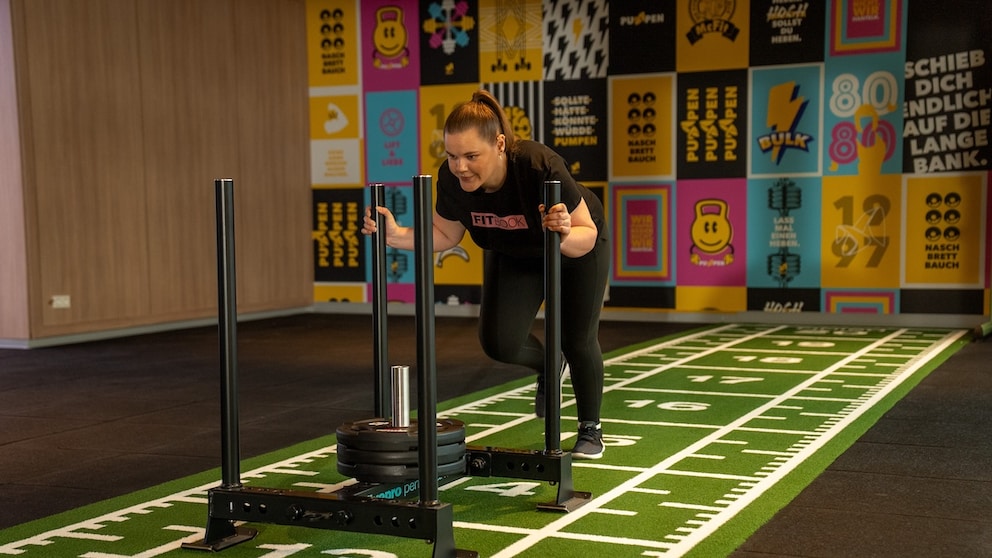
From agriculture to the Hyrox carpet: The sled has become one of the most popular disciplines–whether for football players, CrossFitters, strongmen, or the military. The exercise is widely appreciated because it is extremely effective for your fitness and health. We explain why the sled is so popular, how to move it best, and what Hyrox enthusiasts should particularly pay attention to.
Follow the FITBOOK channel on WhatsApp now!
Origin and History
The roots of sled training go back to early agrarian societies, where heavy sleds were simply used for transporting goods. Later, they were repurposed in strength competitions like the so-called “Tractor Pulls” of the 1920s.
However, the sled only established itself as a training device for sports in 2004. Strength coach Joey Batson developed the modern “Prowler” sled at Clemson University in collaboration with Williams Strength–originally designed for football players to improve their hip drive from a low position. From 2005, the device spread worldwide in the strength and athletics scene through mass production.
Techniques and Execution
Proper execution begins with a firm grip, a tense core, and a neutral spine.
Straight-Arm Technique (High Grip)
Arms extended, body at a 45-degree angle to the ground. Well-suited for beginners, but can put more strain on the shoulders and lower back.
Bent-Arm Technique (Mid Grip)
Arms bent, upper body almost parallel to the ground. Allows for enormous power output with heavy loads, but fatigues the upper body muscles faster.
Full-Contact Technique/The Wheelbarrow
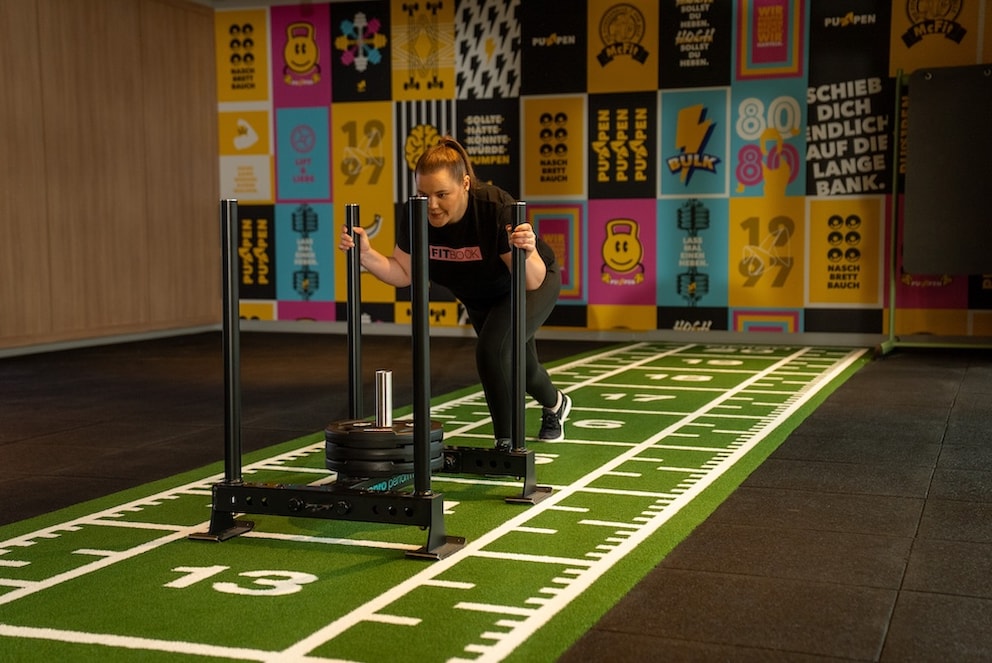
Forearms rest directly on the bars, hands grasp the poles. Your own body weight is used as a lever, allowing for optimal power transfer. Considered the most effective and safest method for advanced users.
Hyrox Tips
The Sled Push is already the second station at Hyrox–acting smart here lays the foundation for a strong race. The technique that has proven successful for most athletes is the Full-Contact Technique/Wheelbarrow.
Start as explosively as possible to get the sled moving right away–yet keep an eye on your lactate levels. It’s only the second discipline; you shouldn’t exhaust yourself completely.
Another point many beginners underestimate: The competition weight feels heavier than in training. Many athletes report that the sled glides much more sluggishly over the competition carpet than usual–a good preparation for this is to occasionally set the training weight a bit higher than the planned competition weight.
Muscles Engaged
Primary Muscles
- Quadriceps: Main driver for knee extension
- Gluteus Maximus: Key power generator for hip extension
- Hamstrings: Support hip extension and stabilize the knee joint
- Calf Muscles: Under constant tension when pushing off the forefoot
Supporting Muscles
- Core Muscles: Keep the upper body stable and ensure that the power from the legs is directly transferred to the sled
- Shoulders, Triceps, and Chest: Statically stabilize the upper body
- Hip Flexors and Adductors: Support the step mechanics and secure the knee with each ground contact
Impact on Sprint Performance and Jump Power
Sprint Performance
A high horizontal impulse force is needed for the crucial acceleration phase in sprinting. This exact force is excellently trained with the Sled Push, as the body assumes a forward-leaning posture with the typical push-off–just like in a real sprint. The exercise is superior to another exercise popular among sprinters, the squat, because while the force in the squat is vertical, it acts horizontally in the Sled Push–and is therefore much more sprint-specific.
Studies also show that heavy loads of 50 to 75 percent of body weight improve sprint times over short distances more effectively than unweighted sprints.1 Notably, the “priming” effect also occurs: Just two short, powerful sled sessions over 15 meters can lead to faster sprints the next day.2, 3
“Priming” Effect
The term “priming” originally comes from psychology and describes how a previous stimulus unconsciously influences our perception or behavior.
An everyday example: If you think intensely about a red car, you will suddenly notice red cars everywhere in traffic–even though nothing has objectively changed.
In sports, this principle transfers to the body: A targeted, short load before the actual competition or training “sensitizes” the nervous system for the upcoming performance–making the body more quickly ready to perform.
Jump Power
Although the Sled Push is horizontal, there is a significant transfer to vertical jump power. The reason lies in the so-called triple extension–the simultaneous extension of the hip, knee, and ankle–which is intensely trained during the Sled Push and forms the basis of every explosive jump.
The often underestimated gluteal muscles are also specifically strengthened, playing a crucial role in take-off, which many underestimate. Additionally, the previously described “priming” effect also applies to jump power.
What Are the Benefits of Sled Pushing Compared to Traditional Leg Workouts?

How to Truly Increase Your Speed on the Soccer Field
Faster Recovery
Eccentric Phase and Concentric Phase
Muscles work in two ways. They can contract and shorten–such as when lifting a weight in a bicep curl–or they can contract and lengthen, meaning they give way in a controlled manner–for example, when slowly lowering the same weight. The former is called the concentric phase, and the latter is the eccentric phase. The eccentric phase is the main trigger for muscle soreness and muscle damage because the muscle fibers are stretched under high tension.
In the Sled Push, the eccentric phase is almost nonexistent.4 You push the sled forward, the muscles shorten–done. There is no controlled “giving way.” This makes the load on the muscles significantly gentler, even though the intensity remains high. The body recovers faster, allowing for more frequent and higher volume training.
Also interesting: For endurance and strength! How training on the SkiErg works
The Body is Protected
Sled exercises are particularly joint-friendly–and for several reasons. Unlike the squat, where the heavy weight rests directly on the spine, the force in the Sled Push is horizontal–relieving the lower back muscles by 75 percent.5
Additionally, as described in the previous section, the eccentric phase is largely absent, so joints and tendons are significantly less stressed. There is also a practical safety advantage: Since the resistance is based on friction, the sled stops immediately when you stop pushing–an uncontrolled drop of the weight like in free exercises is not possible.
Finally, the Sled Push mimics the sprint movement without creating its joint-straining impacts. You push off powerfully from the ground instead of landing hard. The muscles work in a sprint-specific manner, but the joints are significantly protected.