


October 6, 2025, 4:38 am | Read time: 6 minutes
To build lower body muscles, squats, deadlifts, or lunges are among the most popular exercises. However, a piece of equipment that should be present in most gyms is often overlooked: the weight sled. Working with this versatile tool is highly recommended. FITBOOK author Tony Poland, along with an expert, explains the structure, function, effectiveness, and benefits of this valuable training partner.
What a Weight Sled Is, and Why It’s Not in the Weight Area
Weight sleds in gyms are usually referred to as “sleds” or “prowlers.” The equipment typically consists of metal and a sturdy platform where weights or weight plates can be loaded according to need and strength. Handles or bars are installed on the sled for holding during execution. The underside of the platform is either flat or equipped with wheels or runners. This allows the sled to be moved by pushing or pulling it over a certain distance. Therefore, it is not located in the weight area but in the functional fitness area on a smooth track, artificial turf, or a special carpet. “Artificial turf is much more comfortable. Carpets like those used in HYROX competitions are really tough because they have higher resistance, making it harder to push the runners over them,” says Markus Bremen. “It always feels like you’re moving 20 to 30 kilograms more.” The “blades of grass” on artificial turf are softer and have less friction.
The size of the tracks, by the way, depends on the size of the gym. They range from 10 to 30 meters, and at HYROX events, the tracks are even 50 meters long.
Pushing and Pulling the Sled
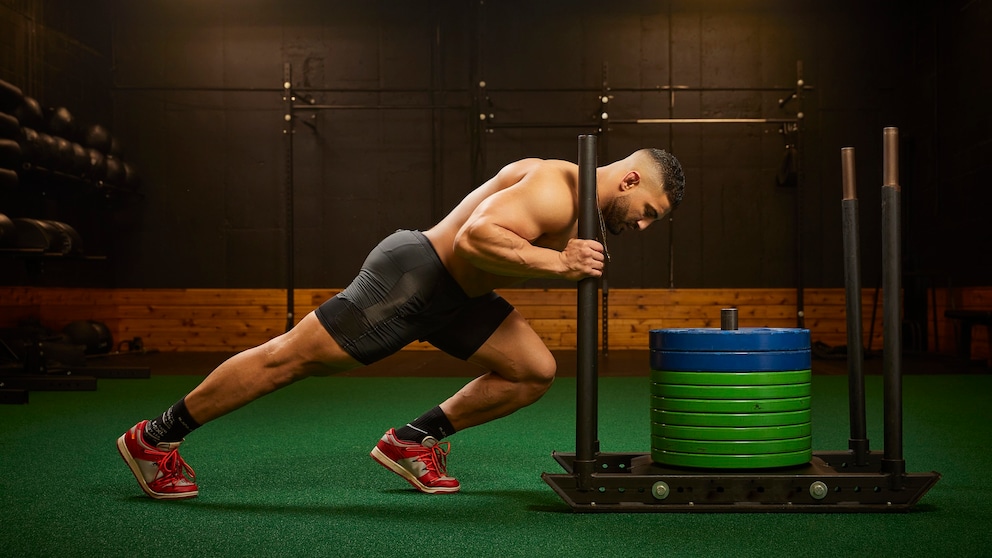
Initially, you should start with just a few weight plates, or even just the sled itself, as it already weighs several kilograms. When pushing (“sled push”), you grip the bars or handles, lean your upper body forward, and push the sled forward with your legs. Important: The power comes from the legs! Ensure that the core is tightly engaged and the back is straight. The gaze should be directed downward or straight ahead when pushing the sled. “And then you push off the forefoot with a very low center of gravity. The hips are pushed back, and the legs are extended,” emphasizes the personal trainer.
Pulling the sled (“sled pull”) is also possible. For this, you need a rope or strap to attach yourself to. You then turn away and pull the resistance behind you. It’s best to take a slightly bent position and lean back to create tension on the rope. To move the entire sled, you then push the hips forward. “From a slightly seated position, you push off the back foot, meaning the heel,” says the expert.
Sled Pull for Rehab Patients
Walking backward is particularly beneficial if you’re recovering from a meniscus or cruciate ligament injury. “Because with the sled pull, there’s a strong focus on the thigh and calf muscles, which relieves the knee. But of course, you train with little weight,” says Markus Bremen.
Strength and Speed from a Standstill
By moving the sled by pushing, pulling, or even sideways, leg training becomes extremely versatile: You simultaneously train strength, endurance, and speed. Legs, hips, glutes, and core are engaged just as much as the hamstrings. Additionally, our acceleration improves: the ability to quickly develop power and speed from a standstill or movement.
Differences from Traditional Leg Training
A key distinction from standard leg exercises like squats lies in how the muscles are loaded. While normal squats involve the concentric phase when standing up and the eccentric phase when lowering, which are extremely taxing on the joints—knees, spine, and hips are subjected to high loads during squats—the sled primarily works concentrically. You push it forward, but don’t have to actively brake it. This reduces the risk of injury and results in less muscle soreness, yet you still train very intensively. Due to the lack of an eccentric phase, joint stress is low,” emphasizes the fitness expert. “This phase, however, promotes muscle growth, which is naturally desired.” In short: Training with the sled spares the muscles!
Moreover, sled workouts are much more functional than traditional exercises, where muscles are often trained in isolation. In sled training, a full-body movement occurs: legs, glutes, core, shoulders, and arms work together during the sprint or acceleration movement. Depending on the weight and speed, you also train muscular endurance, explosiveness, and conditioning. Squats or the leg press, the more common exercises, focus more on maximum strength or muscle building.
Markus Bremen on additional benefits: “You can beautifully train explosiveness and acceleration speed with it. There’s also a metabolic effect, depending on how many tracks you push or how long the time interval is. Of course, strength building is also possible, but it is secondary compared to traditional methods.”
Sled Push: Building Strength in Your Lower Body and Core

These Exercises Make Padel Players Stronger
Strength Building vs. Metabolic Stimulus: Other Training Forms with the Sled
Sled training can also be easily integrated into HYROX events. How? By pulling the sled with an upper-body focus, without the ropes or straps previously attached to the hips. “You then pull the sled with your hands using a rope over a certain distance, creating a nice upper body effect,” describes Markus Bremen.
Even within sled training itself, you can vary wonderfully. “If you load the sled with 80 to 100 percent of your body weight and then cover 20 meters, you’re in a strength-building hypertrophic range. But if you only load 10 to 20 percent of your body weight and cover 50 meters, it’s a metabolic stimulus, not strength building.”
Conclusion
In summary, pushing a sled has several advantages over traditional leg exercises. While traditional leg training focuses more on muscle growth and building as much strength as possible, sled workouts effectively train conditioning, explosiveness, speed strength, functional strength, and athleticism. And it spares the joints! The movements simulate sprints, accelerations, or duels like in soccer or American football. By the way, sled training is also extremely effective for burning calories. After all, many muscles are engaged simultaneously at a high pulse. “For me, sled training is a supplement; I would never do it exclusively,” concludes Markus Bremen.