

August 10, 2026, 3:15 pm | Read time: 4 minutes
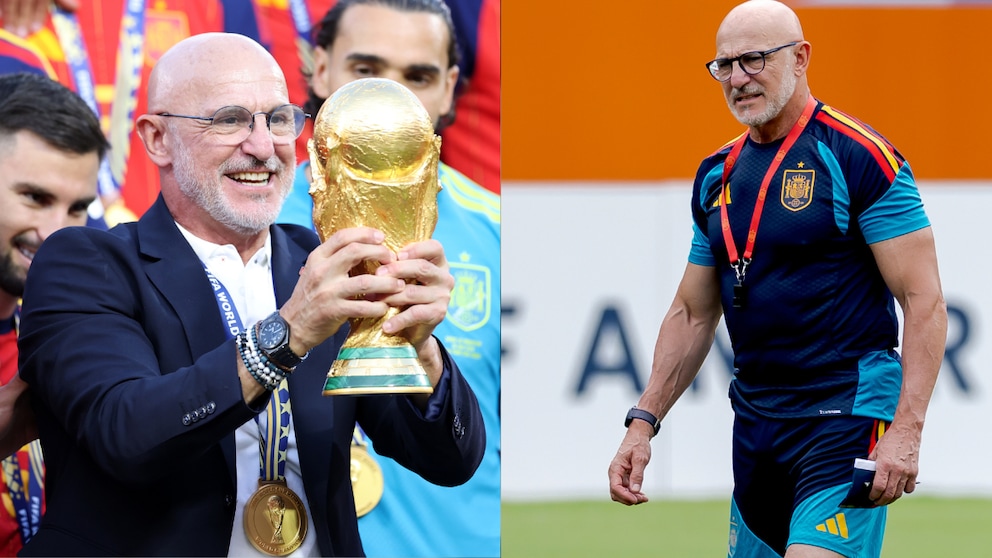
Luis de la Fuente not only led the Spanish national team to win the 2026 World Cup, but he also earned the title for the biggest biceps among all coaches—awarded by FITBOOK, of course. And the man is actually 65 years old. Becoming a world champion as a Spanish coach is certainly challenging for all of us. However, you can aim to look as good as de la Fuente at 65. FITBOOK took a closer look at the well-trained Spaniard.
“This Is My Elixir of Life”
Luis de la Fuente is not only a gifted coach but was also a successful player who played for Athletic Bilbao and FC Sevilla during his career. However, during his active time, he suffered severe knee injuries. As a result, he began lifting heavy weights regularly and grew increasingly fond of it. But it didn’t stop at mere fondness. According to the Spanish sports portal “Relevo,” the current world champion said: “Work, work, and more work. Discipline. I always talk about values, discipline, and the ability to exert effort and endure. This is my elixir of life. For me, sports are a way of life, more than just looking better or worse.”
He grew up this way, has been doing sports since he can remember, and knows he can’t live without it. When Luis de la Fuente slipped and injured his hand during the 2021 Tokyo Olympics, in the Spain vs. Ivory Coast match, the worst part for him was that the injury disrupted his routine and took away an important source of motivation, writes “Relevo.”
De la Fuente emphasized how much sports mean to him in an interview with the “Comité Olímpico Español”: “Every day, when I see myself in my moment of glory, which is my sport and my gym, I tell myself: This is success.”1
David Corenswet’s Training for Superman Shoulders and Chest
A heart attack at only 18! The training Bronny James used to make it to the NBA
De la Fuente’s Arm Training
If FITBOOK is awarding world champion coach Luis de la Fuente the prize for the biggest biceps in the coaching business, we must, of course, take a look at his arm training. In the documentary “El hombre tranquilo,” which translates to “The Quiet Man,” we get fragmentary insights into what the man delivers in the gym—especially his four arm exercises.2
During training, the coach wears gloves and performs all his arm exercises one-handed. This makes sense, as it allows better focus on the target muscle. Additionally, just like de la Fuente does, you can gain extra sensation in the muscle by touching it with your free hand. It also seems that de la Fuente follows the pyramid system, increasing the weight from set to set. Typically, there would be three sets, with the weight in the last set being so high that you can only manage six to eight repetitions.
Biceps
The first one-handed exercise de la Fuente does for the biceps is dumbbell curls. It’s important that he performs them seated on an incline bench. The bench is set at about 60 degrees. This way, the arm hangs behind the body’s plane, and the biceps, especially the long head of the muscle, are stretched more than with standing curls. This actually maximizes muscle growth.
For the next biceps exercise, the bench remains at a 60-degree angle, and you stand behind the backrest and place your arm on it. The same principle as before applies here. The posture leads to a stronger stretch of the muscle. And repeatedly, the Spaniard touches his biceps to gain the aforementioned extra sensation. This is also referred to as the “Mind-Muscle Connection.” This simple trick used by de la Fuente could be the cherry on top for your training. A 2018 study showed that the “Mind-Muscle Connection” led to 12.4 percent growth in the biceps, while the comparison group, which did not focus on a “Mind-Muscle Connection,” achieved only 6.9 percent muscle growth.3

Triceps
For the first triceps exercise, it stays with the dumbbells. The bench is brought to a horizontal position, and you lie on it. Then de la Fuente begins with dumbbell skull crushers—naturally, as you might have guessed, one-handed. The bent arm with the dumbbell is pushed upward next to the head.
For the second triceps exercise, he moves away from the dumbbells to the cable tower. There, de la Fuente performs triceps pushdowns standing: He attaches a rope to the carabiner and pushes it down one-handed, standing upright.
Discipline and the Right Choice
De la Fuente’s arms are no magic trick; the essentials are given to us by the world champion himself: first and foremost, discipline, and secondly, a good selection of exercises. Perhaps one of the exercises will interest you, and maybe your biceps will also burst out of your T-shirt at 65.