


September 26, 2026, 3:25 pm | Read time: 5 minutes
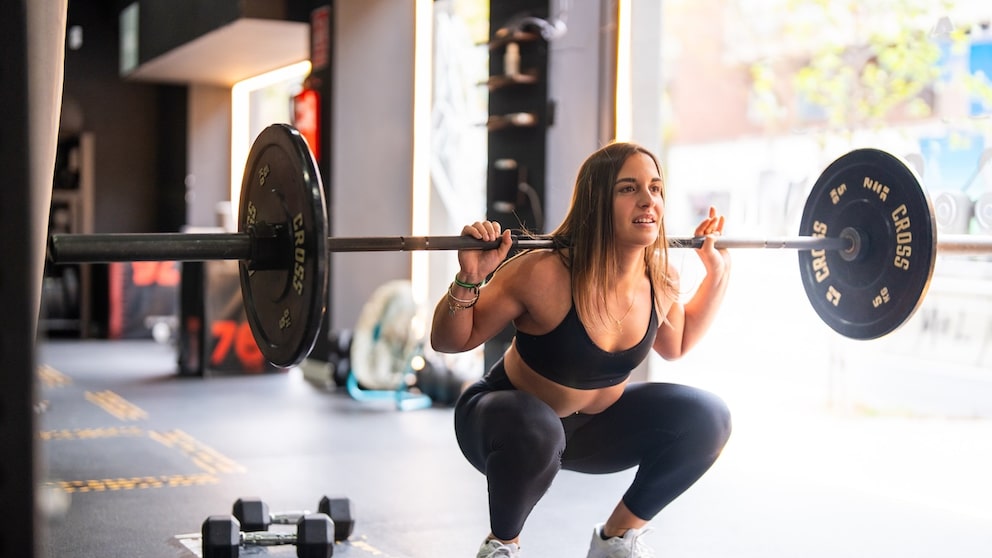
The barbell rests on the shoulders, eyes forward, then a controlled squat follows. Often, the question arises: How much weight is actually appropriate? What might be realistic for a 30-year-old isn’t necessarily a benchmark for a 60-year-old. Personal trainer Markus Bremen has compiled guidelines for individuals, showing that the execution of squats naturally adapts with age.
How much weight should one manage in squats at 30, 40, 50, or 60 years old? It’s clear: The answer to this question isn’t straightforward but consists of several components. Besides age, body weight, training experience, technique, and individual physical conditions have a significant impact.
The following guidelines apply to men and women with solid fitness who train regularly. Nevertheless, there are benchmarks to roughly assess one’s performance. The standard is the so-called 1RM (One-Rep Maximum)–the maximum weight one can move once with proper technique.
Between 20 and 70 years: How squat strength changes
According to Markus Bremen, the benchmark for a roughly 80-kilogram, regularly training 20-year-old man is about 100 kilograms. At 30 years, it’s about 95 kilograms, and at 40, around 85 kilograms. “A 50-year-old should be able to move about 75 kilograms, at 60 around 65 kilograms, and at 70 approximately 55 kilograms,” says the fitness expert.
Important to know: “The values are not based on fixed kilo amounts but on body weight multipliers.” Thus, it’s not just the weight on the barbell that matters, but also the ratio to one’s body weight. And, of course, these are not targets every man must achieve. Markus Bremen explicitly refers to a “reasonably fit, regularly training man.”
Also interesting: How much weight fit men and women manage in squats
How much weight women manage in squats–relative to body weight
The same method applies to women. For a roughly 60-kilogram, regularly training 20-year-old woman, the benchmark is about 57 kilograms. At 30 years, it’s about 54 kilograms, at 40 about 49 kilograms. For 50-year-olds, around 43 kilograms are set, for 60-year-olds about 38 kilograms, and for 70-year-olds approximately 32 kilograms. Again, these are merely guidelines–not a weight every woman at a certain age must achieve.
“Women typically achieve about 65 to 75 percent of the male multipliers relative to body weight, depending on the exercise. Squats and deadlifts are (relatively) closer to male values because lower body strength is less gender-divergent than upper body strength,” explains Markus Bremen. “The greatest difference is seen in the bench press.”
Strength peak reached–what now?
The strength maximum for both genders is roughly between the ages of 25 and 30. After that, maximum strength performance tends to decline. Markus Bremen estimates about an 8 to 10 percent strength loss per decade with regular training. “The mentioned benchmarks take this age trend into account,” emphasizes the expert.
However, those who regularly engage in strength training can maintain muscle and performance even at an older age. It’s by no means the case that everyone automatically loses up to ten percent of their strength starting at age 30. One just needs to take action to counteract the process.
Strong is who is strong in relation
Those who want to compare their squat performance with benchmarks should always consider their own body weight. The mentioned values are reference points for about 80 kilograms for men and 60 kilograms for women.
A 60-year-old man weighing 100 kilograms should not consider the mentioned 65 kilograms as a personal target. Conversely, a lighter person can achieve a comparable performance with less absolute weight.
This is also why significantly higher strength values can sometimes be found online. Strength sports databases often record performances of people who specifically engage in strength training. The values mentioned here are deliberately chosen to be conservative and are intended more as a guide for regularly active people–not as a standard for ambitious strength athletes or powerlifters. “Our values are deliberately set lower to be closer to the reality of the active reader,” says Markus Bremen.

Bench Press in the Age Check: How Much Weight Is Realistic?

How Much Weight Fit Men and Women Can Squat
A squat is not just a squat
The execution of squats also significantly influences the result. Depth, technique, and range of motion can determine how much weight can be moved. Therefore, two performances are not automatically comparable just because the same kilo amount is on both barbells. Additional factors include individual anatomy, flexibility, training age, and technical experience. Health limitations can also play a role.
Conclusion: There is no ideal squat weight for every age
The benchmarks show a general trend: Maximum strength performance is highest between 25 and 30 years and tends to decline afterward. At the same time, individual differences are significant.
For an 80-kilogram, regularly training man, the mentioned squat benchmarks range from about 100 kilograms at 20 years to 55 kilograms at 70 years. For a 60-kilogram woman, they range from about 57 to 32 kilograms.
Those who want to assess their own performance should not view the numbers as a test. “They are more like guidelines and not a medical or clinical norm,” emphasizes the personal coach. “Individual factors–technique, training age, leverage ratios, pre-existing conditions–can vary greatly.” More important than the highest possible weight are controlled movement execution, clean technique, and long-term development. Those who maintain or even increase their strength over the years have already achieved a lot.