

August 25, 2025, 5:00 pm | Read time: 5 minutes
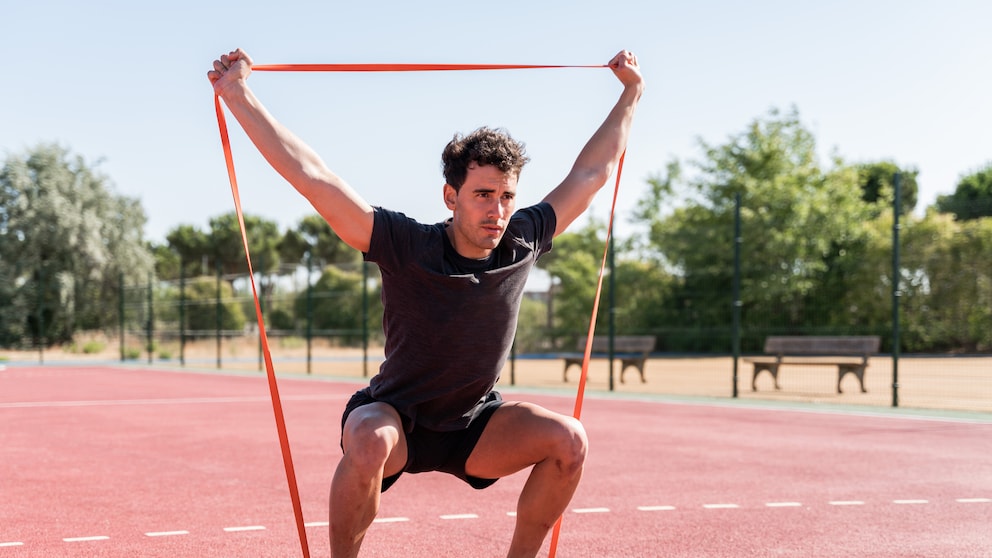
A home gym—especially for targeted strength training—sounds perfect right now? Then take the first step and set one up! You don’t need large or expensive equipment. Our recommendation: train with resistance bands. They’re compact, versatile, and ideal for home workouts—whether you’re saving time or simply want to train independently from the gym. Find out why they’re so effective here.
What Makes Resistance Bands Special
A major advantage of training with resistance bands is their versatility. They don’t take up space and can be taken and used anywhere. Plus, you can train different muscles depending on where you attach them. This alone gives these handy tools an edge over many gym machines (such as chest press, leg press), which are often focused on specific body parts.1
Moreover, they come in various lengths, materials, and strengths—from rubber and latex to fabric variants. This makes them suitable for a wide range of exercises: from targeted muscle training to a complete full-body workout, as well as warm-up and stretching sessions that enhance mobility and flexibility. The continuous resistance provides a consistent training stimulus.2
Additionally, the resistance band is a relatively simple training tool that can be surprisingly effective. It is made of stretchable material and is available in various resistance levels. This way, everyone can find the right band—from rehab patients with light resistance to beginners with medium categories, and advanced users and professionals who work with stronger variants. This allows for individual adjustment of training intensity.
Training for All Target Groups
The secret weapon of the bands is the tension they create. FITBOOK’s Flavio Treppner discussed this with sports scientist Jörn Giersberg. Conclusion: The further the weight moves from the point where the bands are attached, the more intense the training stimulus on the muscle.
If you don’t want it too intense, that’s no problem—resistance bands allow you to easily adjust the resistance yourself. This is why bands are also used in medical rehabilitation: because you can increase or decrease the load as needed.
“Various levers and angles can be adjusted to specifically improve weakened functions,” says physiotherapist Andre Scholz, CEO of Physion. In his view, resistance bands are perfect for training movement patterns and muscle chains, “both for endurance strength and pure strength workouts.”
This makes resistance bands interesting for virtually every target group: They are suitable for all ages and fitness levels, promote muscle rebuilding, improve mobility, and enhance overall performance. Originally used in physiotherapy, they are now a staple of modern fitness training.

At Home Instead of the Gym! Training Tips for Menopause

For a Toned Butt: The Proper Execution of Cable Kickbacks
Safe and Joint-Friendly Training with Resistance Bands
Shoulders, arms, back: Resistance bands allow you to train various body parts in a joint-friendly manner. Under expert guidance, working with resistance bands can be well-targeted toward a desired goal. This makes it effective and reduces the risk of injury, which exists in any sport—but much less with resistance bands than, for example, on a weight bench.
Those who are well-trained likely know how to use resistance bands for their purposes. But of course, less advanced users can also try out these gadgets. Especially for beginners, it’s recommended to start while seated. This way, they can better focus on the movements without having to worry about balance and stability.
Important Basic Rules for Training
For everyone: The core should remain engaged during each exercise, the pelvis should be upright, and the navel should be pulled inward toward the spine. Exercises must be performed slowly and controlled—jerky movements pose a risk of injury. Two to three sets of ten to twenty repetitions several times a week will lead to noticeable training effects.

Exercises for the Whole Body
The basic exercises (such as stepping on the band and lifting the arms in a controlled manner, even crosswise) are quickly internalized. Shoulders, back, arms, legs, and abs—with a resistance band, you can train all muscle groups. Because the movements are performed slowly, a particularly intense strengthening effect is created in the muscles.
Try this exercise for a strong core:
Sit on the floor with a straight back, legs spread wide, and one foot connected to the resistance band. Hold the band taut and slowly rotate your entire upper body to the side—legs remain on the floor and back straight! You’ll quickly feel the pull in your lower back.
Especially convenient: Resistance bands take up little space, fit in any bag, and can be used anywhere—at home, on the go, or on vacation. So there’s no excuse to skip a workout.
The Advantages at a Glance
Resistance bands—also known as resistance bands, loop bands, or Therabands—are practical helpers for training at home, outdoors, or on the go. They enable individual strength training for nearly all muscle groups, are joint-friendly due to smooth movements, easy and space-saving to store—and thus the perfect alternative to the gym.3
Finding the Right Band
Which band is right for you mainly depends on the color—regardless of aesthetic preferences. Depending on the manufacturer, colors like yellow, red, and black are associated with different resistances. This should be clear when purchasing, and it’s best to get advice from a staff member.