

February 24, 2026, 2:11 pm | Read time: 3 minutes
Everyone is probably familiar with knee bends, also known as squats. This bodyweight exercise is a classic and primarily targets the quadriceps. However, with a slight modification, other muscle groups can be targeted as well: for example, the inner thighs with lateral squats. FITBOOK fitness editor Janine Riedle reveals how it’s done.
There are countless variations of squats that primarily target different muscle groups. In a classic squat, you mainly train the front thigh muscles, with support from the large gluteal muscle and the back of the thigh. However, if you want to train the inner and outer sides of your legs, you should perform lateral squats.
These Muscles Are Trained
Lateral squats, which are often called cossack squats, also primarily train the four-headed thigh muscle—but mainly the part that lies on the inside of the leg. The movement also activates the leg biceps, i.e., the back of the thigh, as well as the large gluteal muscle and the adductors. The back extensor muscles are also strengthened.
Advantages
This exercise combines two important points: On the one hand, you stretch the inside of your legs with the lateral squats, and on the other hand, you also strengthen your thighs at the same time. This bodyweight exercise is particularly suitable for people who sit a lot in everyday life, as it can prevent joint pain and injuries. What’s more, this squat variation is easy to do at home without any equipment!

Why You Should Incorporate Side Lunges Into Your Workout

7 Effective Exercises for the Glute Muscles
Execution
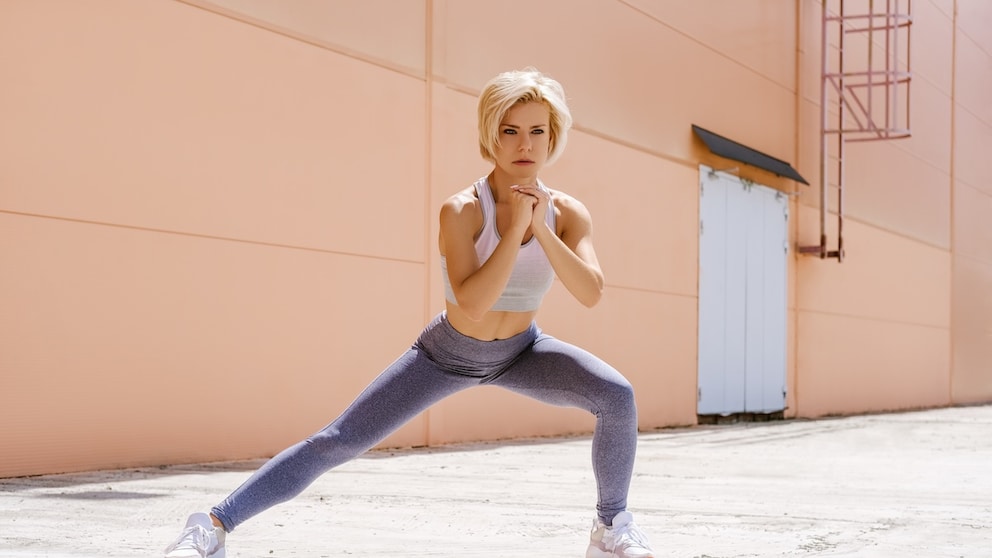
For the lateral squats, start by standing upright with your feet shoulder-width apart. Point your toes slightly outwards and stretch your arms straight out in front of you or cross them in front of your chest.
Now shift your weight to one side first. Let’s start with the right side. Move your buttocks to the right side and downwards so that your knee is bent. Go down as far as your right heel remains on the floor. This automatically stretches your left leg; you feel a slight stretch, and your left foot only touches the floor at the side. The upper body remains upright.
Now perform the same movement on the left side. It is important that you do not return to the standing position, but shift directly from the right side to the left in the lower position.
You Should Avoid These Mistakes
But be careful: as simple as side squats sound at first, many mistakes can easily creep in! The exercise is often confused with side lunges. This is why it is so important, as described above, not to return to the high stance but to move directly from one side to the other.
Furthermore, it often happens that the heel of the standing leg lifts off the ground. This should be avoided at all costs to ensure a stable stance. Therefore, if you notice that your heel is lifting off the floor, do not lower it so far!
You should also keep your upper body straight throughout the exercise. To avoid a hunched back, you can maintain a slight arch in your lower back.