


October 17, 2026, 4:33 pm | Read time: 5 minutes
Resistance bands may seem inconspicuous next to dumbbells and exercise machines. However, they can be a serious alternative for strength training. What’s crucial is not the weight of the equipment but whether the muscles are sufficiently challenged. Especially at home or on the go, elastic bands show their strengths. Those who want to become permanently stronger will eventually encounter a practical problem. FITBOOK Editor-in-Chief Nuno Alves explains the essentials.
Who Benefits Most from Training with Bands
For an effective full-body workout, you don’t need a whole collection of different resistance bands. Many exercises can be done with just a long loop band. For certain movements, such as clamshells, a short mini-band is more suitable.
Elastic training devices can apparently keep up with traditional weights in building strength. A Brazilian analysis of several comparative studies with over 220 participants found that resistance bands performed similarly well in strength gains as dumbbells and exercise machines.1
Personal Trainer and Longevity Coach Tobias Elsholz uses the training devices in versatile ways. “Bands work not only for the upper body but also for the legs.” They are particularly interesting for beginners and people who want to train at home or on the go. However, Elsholz does not view them solely as beginner equipment: “I also like to use them as a supplement for advanced users.”
Healthy older adults can also benefit from training with resistance bands. A scientific review showed significant strength gains in seniors.2
How Training with Bands Works
For a roughly 30-minute full-body workout, eight exercises can be combined. The right band strength is more important than a specific color on the product: The load should be chosen so that the last two repetitions are particularly challenging.
All exercises: 2 rounds
- Squats: 15 to 20 repetitions: Place both feet on the band and hold the ends at shoulder height. Bend your knees and push your hips back before straightening up against the resistance.
- Deadlifts: 15 to 20 repetitions: Stand hip-width on the band and hold the ends with straight arms. Push your hips back, lean your upper body forward with a straight back, and slowly straighten up again.
- Chest Press: 15 to 20 repetitions: Lie on your back and thread the band under your upper back. Press the band ends up from your chest and then lower your arms in a controlled manner.
- One-Arm Row: Ten to 15 per side: Secure the band under one foot and support yourself with the other hand on a bench. Pull the band with the free arm toward your hip and let it slowly glide back down.
- Shoulder Press: Ten to 15 repetitions: Position the band under both feet and hold the ends at shoulder height. Stretch your arms over your head against the resistance and then bring them back down in a controlled manner.
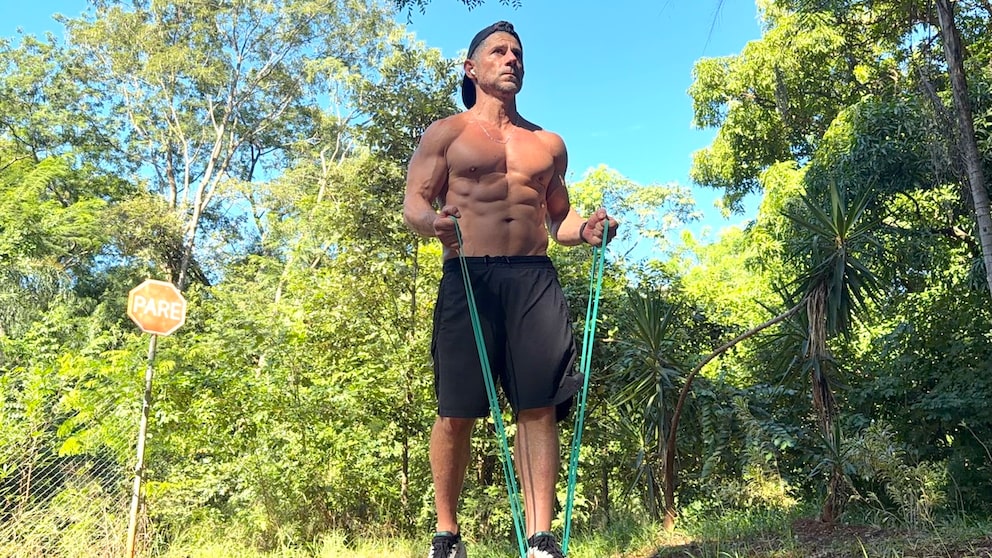
- Bicep Curls: Twelve to 15 repetitions: Stand on the band and grip the ends with palms facing forward. Pull your hands toward your shoulders by bending your elbows, keeping your upper arms close to your body.
- Tricep Extensions: Ten to 15 repetitions: Secure the band under one foot and bring the ends behind your head. Stretch your arms upward without moving your upper arms much, and slowly lower your hands again.
- Clamshell (with Mini-Loop): Ten to 15 per side: Place the mini-band just above your knees and take a side-lying position with bent legs. Open the top knee against the resistance while keeping your feet together and your hips stable.
The movements should be performed in a controlled manner without momentum. About five minutes of warm-up should be added before training, such as jumping jacks, jumps, or marching in place. The joints should also be moved beforehand. Two sessions per week are one way to use the workout as standalone strength training or as a supplement to other sports programs.
If the training remains unchanged over weeks, the necessary additional stimulus will eventually be missing. Therefore, a simple check is recommended after about two weeks: If the intended repetitions are now easy to manage, the load should increase. This can be done with additional repetitions or sets, a stronger band, or by gripping the existing band shorter.

At Home Instead of the Gym! Training Tips for Menopause

7 Exercises for Defined Shoulders
The Biggest Problem Isn’t the Resistance
It becomes more complicated when you want to track your performance as accurately as possible. With a dumbbell, the weight used can be easily recorded. With a band, however, the indicated resistance strength only partially reflects the actual load during an exercise.
The resistance changes with the stretch of the band. Therefore, a training session cannot always be compared as precisely with the previous one as with training using fixed weights. This can become a disadvantage with increasing training experience.
The colors of the bands also provide limited guidance. Manufacturers do not use a uniform color standard for their resistance levels. Sometimes there are additional indications in kilograms, but here too, the stretch affects the actual load.
These Variants Exist
Which resistance band is suitable depends primarily on the planned exercises. Four variants are common:
- Mini-bands or short loop bands
- Long loop bands or pull-up bands
- Open flat or gym bands
- Tube bands with handles
If you want to increase the resistance, you don’t necessarily have to buy a new band immediately. Different resistance bands can also be combined.
Also interesting: “My 5 Most Important Rules for Muscle Building”
Where Dumbbells Have the Long-Term Edge
A major challenge in training with resistance bands is the precise control of the load. While progress with fixed weights can be precisely dosed and documented, the resistance with bands depends on several factors–especially how much they are stretched during a movement.
For beginners, home training, and sports while traveling, resistance bands are particularly practical. Advanced users can use them as a supplement.