

April 22, 2022, 8:54 am | Read time: 8 minutes
“Germany has back pain”–a phrase we’ve all heard before. And probably everyone knows someone currently suffering from back pain. Luise Walther, an expert in neurocentric training, shows easy exercises that can be done anytime and anywhere to provide relief.
Even before COVID-19, many people suffered from back pain due to sedentary office work. The pandemic, with home office, homeschooling, and closed gyms and sports clubs, has worsened the situation. But for a change, something positive: It’s not that hard to do back training at home–without equipment. Your own body is enough to get moving.
Overview
Why is back training so important?
A strong core is essential in everyday life. Whether you’re carrying a crate of water, moving boxes, or your own child–the back plays a crucial role in stability during all movements. The connection between the upper and lower body is not only anatomically important.
It’s especially important to continually introduce new stimuli and incorporate new movements. Balancing a sedentary lifestyle is crucial. Sitting for long periods at a desk, in a car, on a train, or on a bike, on the sofa, or at the dining table leads to less engagement of the back muscles. This, in turn, causes the muscles to gradually atrophy, resulting in a loss of stability and mobility.
Since we often have limited control over how our daily lives unfold, and work and family leave little time for movement and balance, it’s all the more important to consistently set movement stimuli. This not only leads to more stability but also to greater flexibility. Only muscles used in their full range of motion, from tension to relaxation, enable safe and effective movement.

What should you pay attention to in training?
Back training is about strengthening the entire core musculature. Any imbalances can be corrected. Because unilateral stress and disuse often lead to certain muscle groups being overworked while others become increasingly restricted in their function.
There is no best exercise, as “one size fits all” doesn’t work when it comes to physical performance. Every body is unique, and training must be tailored accordingly. It’s particularly important to perform exercises carefully and mindfully. Only by consciously feeling the areas being trained does the brain receive the impulse to sustainably reintegrate the trained parts into everyday life. Training without focus often doesn’t provide the nervous system with enough stimulus to establish a long-term change in the muscles being worked. More isn’t always better: Mindful and conscious training is the most effective and efficient.
Also interesting: The smart way to a six-pack is through functional abdominal muscles

Mobilize Your Spine Effectively in 8 Minutes
10-Minute Workout: Mobility Flow with Fernanda Brandão
What is activated during back training?
The back muscles are part of the human skeletal muscles. Anatomically, there is a distinction between primary and secondary back muscles. The primary back muscles surround the spine. They also have a crucial protective function for the spine and surrounding tissues.
Besides moving the spine, they are mainly responsible for upright posture. They are collectively referred to as the erector spinae and consist of centrally located muscles, lateral fibers, and short neck muscles. They are surrounded by a fascial layer, the so-called thoracolumbar fascia, which extends from the chest to the pelvis and attaches to the spine.
The secondary back muscles include the superficial back muscles. They attach to the shoulder muscles, bronchial muscles, and extremity muscles.
Also interesting: Should you continue training or take a break when experiencing back pain?
How can you train your back?
The following exercises provide inspiration on how to train the back muscles. It’s important never to push into pain or discomfort. Ensure all exercises are performed slowly and controlled.
Rolling up the back extensor
This exercise mobilizes the back muscles and prepares them for the workout. It particularly trains the small muscles that control the facet joints, improving body awareness and posture.
Exercise procedure
- Stand up straight and ensure an upright spine. Begin by bending your chin to your chest and roll down vertebra by vertebra. Make sure to first roll the cervical spine, then the thoracic spine, and finally the lumbar spine. Only go as far into the bend as is comfortable and pain-free.
- Then roll back up vertebra by vertebra, starting with the lumbar spine, through the thoracic spine, to the cervical spine. Continue this rolling down and up until you feel a smooth and coordinated transition between the different areas.
- If needed, you can palpate the areas you want to activate with your hands. This sensory information can help perform the movement more controlled.
Also interesting: Back training can help with pain–and it may hurt initially
Back activation in prone position
The following exercise trains the entire back muscles as well as the shoulder muscles. Both areas work closely together. Therefore, it’s always sensible not only to train the back in isolation but also to pay attention to shoulder mobility.
Exercise procedure
- Lie on your stomach, with your gaze directed at the floor. The feet are on the ground.
- Pull your pubic bone towards your navel and feel a slight tension in the lower back.
- Lift the upper body slightly and extend the arms forward. Now pull the arms back along the sides of the body as if you were pulling a package over your head towards you. The goal of the exercise is not to lift the upper body as far off the ground as possible, but to build as much tension in the back muscles as possible when pulling the arms. If this exercise is too easy, you can also hold a towel with both hands and pull it apart. This particularly activates the latissimus additionally.
Spinal rotation with isometric tension
This exercise combines isometric tension with mobilization. The focus is on deep muscle stabilization of the cervical and thoracic spine. At the same time, it strengthens the arms, upper body, chest muscles, biceps, and abdominal muscles.
Ensure a long and straight spine. The shoulders are pulled down and back towards the spine throughout the exercise. Perform the movement only as far as it feels comfortable and safe.
Exercise procedure
- Fold your hands in front of your chest and press them together. The fingers point upwards. Actively pull the shoulders and shoulder blades down. Choose a pressure intensity that is comfortable.
- Now take a deep breath and, as you exhale, rotate your arms and chest as far to the right as is comfortable and pain-free. Turn your head and eyes in the opposite direction as far to the left as is comfortable and pain-free. Try to perform the counter-rotation simultaneously. Return to the center as you inhale. Now perform the exercise on the left side.
- Then perform the same movement with a pulling motion. To do this, fold your hands in front of your chest and pull them apart. The fingers point upwards. Actively pull the shoulders and shoulder blades down. Choose a pulling intensity that is comfortable.
- Now take a deep breath and, as you exhale, rotate your arms and chest as far to the right as is comfortable and pain-free. Turn your head and eyes in the opposite direction as far to the left as is comfortable and pain-free. Try to perform the counter-rotation simultaneously. Return to the center as you inhale. Now perform the exercise on the left side.
The distance of the hands from the chest determines the intensity. The further the hands are from the chest, the more intense the exercise becomes. Vary the height of the arms in front of the chest–depending on which part of the muscles you want to target more. Those prone to severe shoulder-neck problems should start with the arms at navel height and then gradually vary the height upwards. The eyes guide the movement. Try to look as far left and right as possible with your eyes. Keep the pressure with the hands constant the entire time. Pay special attention to maintaining the pressure and keeping the shoulders down in the end position.
Also interesting: What helps with painful back blockages?
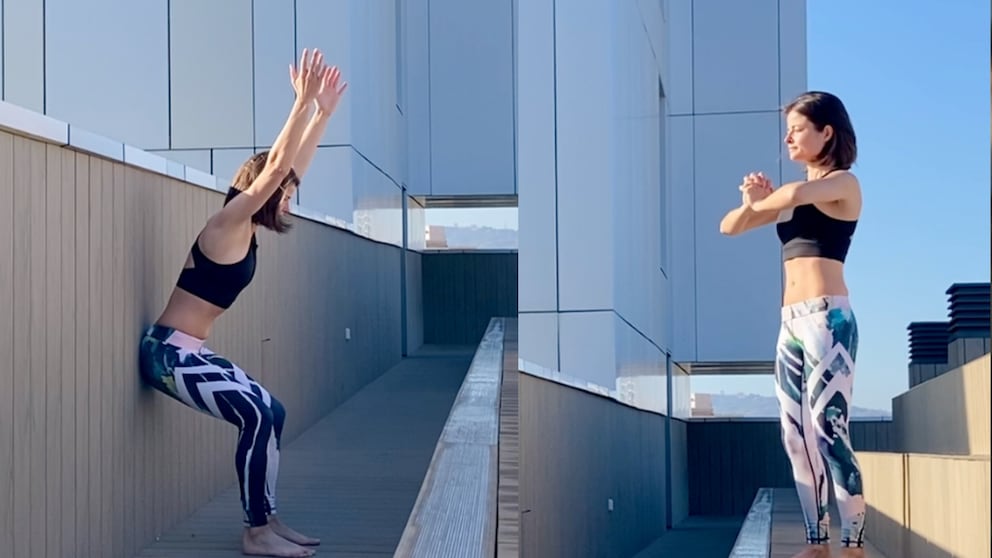
Back extensor activation
This exercise particularly trains the latissimus and the back extensor.
Exercise procedure
- Stand with bent legs and your buttocks against a wall. The further you move your feet from the wall, the harder the exercise becomes.
- In this position, mobilize the pelvis 2-3 times by tilting it forward and backward, creating a slight arch in the lower back and then a rounded back.
- Hold the arch and lean the upper body forward as far as you can while maintaining the arch. You should feel the tension in the lower back.
Exercise variations:
- Easy: Hold this position for 10 seconds and return to the starting position. Repeat the exercise 10 times.
- Medium: Extend the arms above the head and pull them down close to the body as far as you can while maintaining the arch and forward-leaning upper body. Extend the arms again and repeat the process 10 times.
- Hard: Extend the arms above the head and perform a pendulum motion with the extended arms. Ensure you maintain the arch and do not deviate with the upper body. Perform the pendulum motion of the arms for 10 seconds and then return to the starting position. Repeat the exercise 20 times.