

November 21, 2021, 7:03 am | Read time: 5 minutes
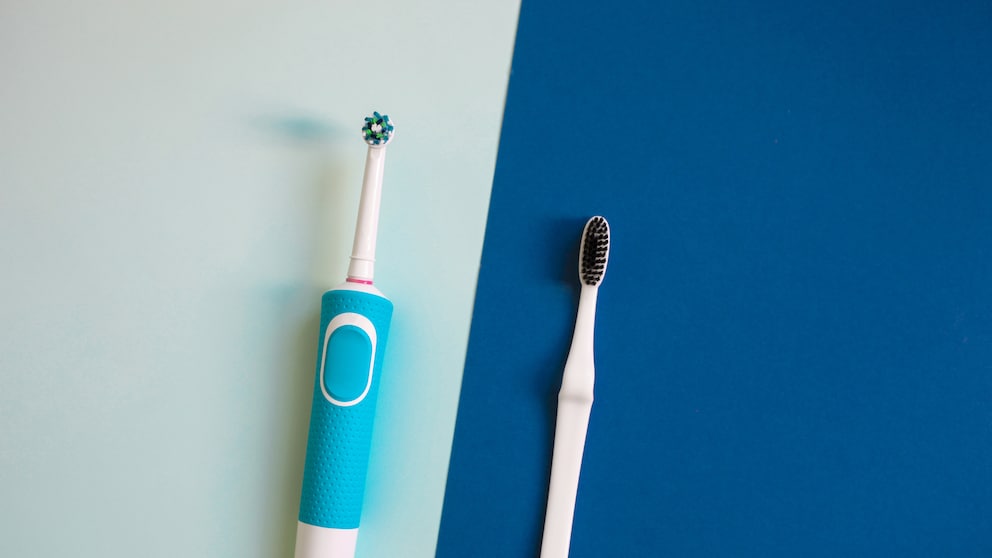
Electric toothbrushes didn’t always have the best reputation. However, the technology has significantly advanced–which doesn’t mean that the “normal” manual toothbrush is automatically the worse choice.
Many people wonder: Is an electric toothbrush better than a “normal” one? Much depends on the brushing technique. When deciding which model to purchase, a study by “Stiftung Warentest” can help. They tested electric toothbrushes. The most expensive model performed among the best. But does it always have to be the luxury model?
Overview
Proper Use of Manual Toothbrushes
Brushing teeth isn’t rocket science. Yet, the importance of the right brushing technique is often underestimated. While you learn it as a child, you need to rethink it by adulthood. The rotation technique (also called the KAI technique) is the first one taught and is suitable for young teeth and gums. However, as you age, the soft tissue in the mouth recedes more and more. The circular movements of the rotation technique push bacteria and plaque toward the gum line, promoting periodontitis.
The sweeping technique (also known as the Bass technique) is more suitable for adults. The toothbrush is placed slightly angled at the transition from the gum to the tooth, and the plaque is swept downwards. Someone who masters this technique can ensure thorough dental care even with a manual toothbrush. For others, an electric toothbrush might be a good solution. But here, too, technique matters.
17 Electric Toothbrushes Tested: These Models Impressed

Electric Toothbrushes for Kids–The Test Winners
Two Types of Electric Toothbrushes
Classic Electric Toothbrush
The classic is the electric toothbrush with a usually round, rotating brush head. When using it, make sure to clean each tooth all around. This means that simply directing the brush head over the tooth is not enough for thorough cleaning. This would likely be the usual handling if electric toothbrushes were truly “for the lazy,” and also the reason why dentists used to advise against electric toothbrushes.
Also interesting: Which dental care products really work and which don’t
Ultrasonic Toothbrushes Easier to Handle
More advanced–and quite different (and easier) to use–are ultrasonic toothbrushes with vibrating, often elongated rather than round brush heads. With their small, circular movements, they allow you to achieve the thorough cleaning effect of the sweeping technique of classic manual toothbrushes simply by moving the ultrasonic toothbrush from top to bottom over the tooth.
Conclusion
It’s not that one of the toothbrush variants is better, but rather how you use the electric or manual toothbrush. According to “Stiftung Warentest,” the different types of electric toothbrushes do not offer a clear advantage in dental cleaning.
When determining which toothbrush and brushing technique are best for you, the condition of your teeth and gums plays a crucial role. Therefore, you should discuss it with a dental professional.
And: Even the best toothbrush and brushing technique are not enough if you don’t use dental floss and/or interdental brushes. Here we have more detailed care and behavior tips for a healthy oral flora.
Also interesting: What leads to enamel erosion and how can it be protected?
Electric Toothbrushes at Stiftung Warentest
When buying an electric toothbrush, several questions arise: Prefer a model with a round or elongated brush head? Do I use an app for my device? And how expensive should the brush be? “Stiftung Warentest” has now looked at 18 models and concludes: Even affordable toothbrushes do their job well.
Overall, 13 of the 18 devices received a “good” rating, one model received a “satisfactory,” and four clean the teeth “adequately.” The test included cleaning properties, handling, durability, and environmental characteristics. The clean brushing accounted for the majority of the overall score (60 percent), as reported by the foundation in its magazine “test” (issue 12/2021).
The Test Winners at “Stiftung Warentest”
The most expensive model in the test field, the Philips “Sonicare 9900 Prestige” (300 euros), cleaned the best. In the overall assessment with a score of 1.8, it is tied with the Philips “Sonicare 9300 Diamond Clean Smart” (250 euros), which, according to the manufacturer, will soon be off the market.
Right behind (overall score 1.9) is the much more affordable “Oral-B Genius X 20000N” from Braun (104 euros). And the cheapest model in the test, the “Sensident Akku-Zahnbürste Perfect Clean Professional” from the drugstore chain Müller, costs 16 euros and also scores “good” (score 2.3) in the Warentest assessment.
Also interesting: 7 foods that are good for your teeth
Consider the Price of Replacement Brush Heads When Buying
There are differences in extras; some devices come with extended features and accessories like USB cables. Various brushes from Philips and Oral-B can be paired with an app to better monitor brushing habits. The price of brush heads, which should be replaced approximately every three months, can also play a role in the purchase. For example, a brush head for the cheapest model from Müller costs 1.98 euros, while replacement brushes for the “Sonicare Prestige” are 15 euros.
FITBOOK consulted the North Rhine Dental Association and a specialist dentist for oral surgery from Berlin on the topic. With material from dpa.