


November 10, 2026, 9:21 am | Read time: 8 minutes
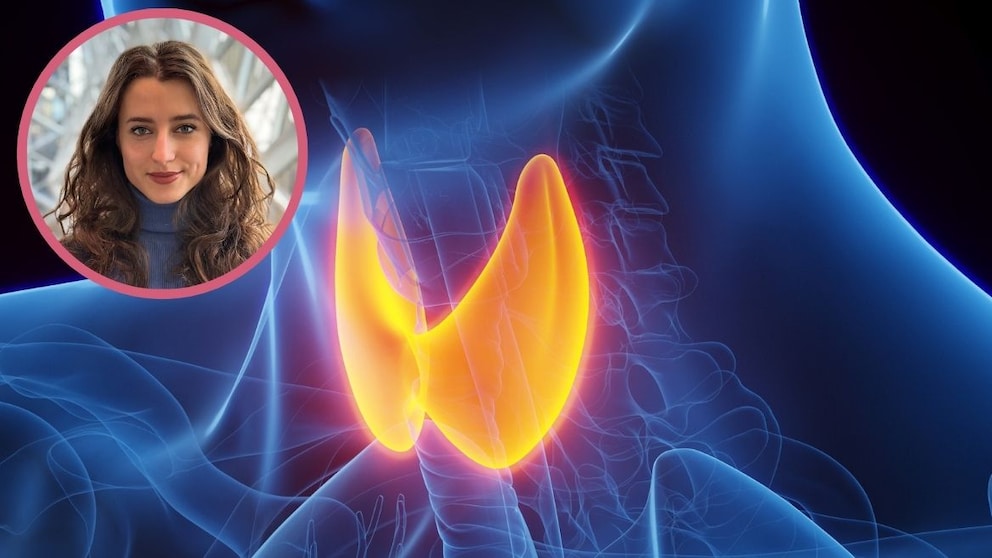
FITBOOK author Julia Freiberger (25) was diagnosed with hypothyroidism at 17. In this personal account, she shares her symptoms, the traumatic conversation with her doctor at the time, the search for the cause–and how a change in diet affected her hypothyroidism.
“You can forget about having children.” Sometimes I still remember that sentence today. Not because I think about what happened back then a lot, but because the fear that visit triggered in me occasionally resurfaces. I was 17 at the time and just wanted to learn how to manage my thyroid. Instead, I was confronted with potential consequences. I thought my life was literally over until I learned that diagnoses aren’t set in stone.
Follow the FITBOOK channel on WhatsApp now!
It Was Supposed to Be Just a Routine Doctor’s Visit
“Do you want to have children in the future?” – “Yes.” – “Untreated, you can definitely forget about that.” I was 17 years old, sitting in the examination room when the doctor calmly told me this. As if we were having a casual chat. As if it wasn’t about my desire to become a mother someday. I opened my mouth to say something, but no sound came out. My heart was pounding so loudly that I was sure everyone could hear it. I tried to control my trembling hands while his words–emotionless, cold words–kept repeating in my head. I felt sick.
I barely noticed that my mother, who was with me, had stood up. I wanted to take her hand and calm her down. But my body didn’t obey me. So I sat there, frozen. It was supposed to be a harmless doctor’s visit–a routine check-up after I had complained about headaches and some fatigue. I felt the tears welling up. But I wouldn’t cry. Not in front of this doctor, who gave my mother a brief glance and then typed something into his computer. It felt like I was waiting for a verdict.
My Mother Couldn’t Utter a Word
“The therapy should start immediately. Your daughter’s thyroid levels are almost twice as high as normal. In the worst case, the body can attack the thyroid and irreversibly destroy it. And then I really can’t promise you anything.” The room fell silent. None of us said anything. Then he turned to me.
I remember him saying something like, “I’ll prescribe you L-Thyroxine, 50 micrograms for now. It’s best to take the tablet in the morning with water. Wait half an hour before breakfast. After a few weeks, we need to check the levels again and can only then say if the therapy has worked. If not, we’ll have to increase the dose until your body accepts it.” Then he stood up, handed my mother the prescription. He wished me “good luck,” and then he left.
The Questions in My Head Turned into Panic
I didn’t understand the world anymore. After all, it was just headaches, right? My mother tried to calm me down and talked to me. But I barely registered anything. The doctor’s words had completely frightened me–even though they were just assumptions. I had so many questions in my head that suddenly turned into uncontrollable panic: What if the tablets didn’t work? What if I really had trouble having children later? Could I tell my boyfriend or not? Would my parents ever become grandparents? What if my thyroid stopped working altogether?
I was sad and angry with myself for being dependent on some tablets from now on. But this feeling was quickly replaced by shame. Even though I didn’t want to admit it, I was ashamed that my body didn’t want to function properly without help.
I Was Tired, Listless, Could Hardly Concentrate–and Blamed It on Stress
Hypothyroidism, also known as hypothyroidism in medicine, affects nearly one in ten women. It is diagnosed when the thyroid (lat. Thyroidea) produces too few hormones.
When thyroid hormones are lacking, metabolism slows down, which can negatively affect various body functions and cause different symptoms. The problem is that the symptoms aren’t immediately recognized and are instead attributed to everyday complaints.1
I was tired, listless, and had trouble concentrating. The latter was particularly challenging for me at school and while dancing, which was a big part of my life back then. Whether it was sitting on a task for a long time or remembering choreography for a show–I danced in the Young Ensemble of the Berlin Friedrichstadt-Palast–after about 15 minutes, I was done. I felt barely capable of performing.
This was compounded by throbbing headaches. But not like the migraines I was used to, but a thousand times worse. Sometimes the pain was unbearable. My head felt like it was going to explode at any moment. During this time, I could hardly think clearly.
Hypothyroidism Diagnosis–Experience at the Radiologist
There were also often moments when I had a low pulse or felt unwell, even though I wasn’t sick. In addition to the concentration problems, muscle and joint pain appeared in the evenings after dancing, which I attributed to muscle soreness. I found a logical explanation for every symptom.
My condition would have remained unchanged if my mother hadn’t forced me to see a doctor. A week later, we received a call and a referral to radiology. My thyroid was X-rayed there. It wasn’t enlarged, but the diagnosis of hypothyroidism was confirmed.
My TSH Level Was 8.910 mU/l
The TSH level stands for thyroid-stimulating hormone. It is produced in the pituitary gland, released into the blood, and stimulates the thyroid, leading to increased production of the thyroid hormones T3 and T4. If there are too few thyroid hormones in the blood, more TSH is released to create a balance and stimulate the thyroid to produce more. If this is the case, it is a hypothyroidism. If there are too many thyroid hormones, the TSH level decreases, and it is a hyperthyroidism (hyperthyroidism).2
The normal TSH level is 0.270 – 4.200 mU/l (milliunits per liter). My level was 8.910 mU/l–almost twice as high. It’s clear that my family doctor was alarmed by the blood test and referred me to the radiologist for clarification.
I often caught myself wondering if I might be to blame for my situation. Maybe I could have prevented the hypothyroidism by eating healthier? After all, I didn’t have a congenital thyroid disorder. Over the years, however, a malfunction could have developed. This can have different causes, such as chronic inflammation of the metabolism (the autoimmune disease Hashimoto’s thyroiditis) or iodine deficiency. What was going on with my body?

“Take Responsibility Yourself! How I Came to my Hashimoto’s Diagnosis”

Blood, Hair–These Vitamin Self-Tests Are Useless
Hypothyroidism? Hyperthyroidism? Hashimoto’s? The Doctors’ Disagreement Scared Me
In the following weeks, I spent a lot of time visiting different doctors’ offices. Some doctors claimed I had Hashimoto’s, which had led to the hypothyroidism. That would mean I would have to take tablets for the rest of my life.
Others completely ruled out Hashimoto’s and attributed the levels more to a nutrient deficiency because my symptoms didn’t match the autoimmune disease. And one doctor said that although I had hypothyroidism, my symptoms actually indicated hyperthyroidism.
No one could explain to me with certainty what exactly I was suffering from. The doctors’ disagreement scared me. But they all agreed on one point: I should take L-Thyroxine. Yet the tablets didn’t work for weeks. My condition even worsened: from gastrointestinal issues, muscle weakness to menstrual disorders, everything was there. I grew increasingly afraid that many more bodily functions could be impaired. Because as long as no hormone therapy worked for me, the hypothyroidism was essentially “untreated.”
My Sister Recommended a Change in Diet
My sister was studying medicine at the time and suspected that my hypothyroidism was due to an iodine deficiency and that I could reverse it through a change in diet–without taking hormones. Her suspicion was reinforced by meeting a young woman who had managed to get her thyroid functioning again through a change in diet and had become a mother despite being diagnosed with hypothyroidism.
So she gave me a list of minerals and trace elements, as well as foods rich in them, that I should consume more of. I thought the idea was good, even though I wasn’t a fan of raw fish, algae, spinach, broccoli, and onion vegetables at all.
To find out exactly how FITBOOK author Julia Freiberger’s change in diet looked and how it affected her thyroid, read the second part of her personal account.