


November 26, 2026, 4:14 pm | Read time: 13 minutes
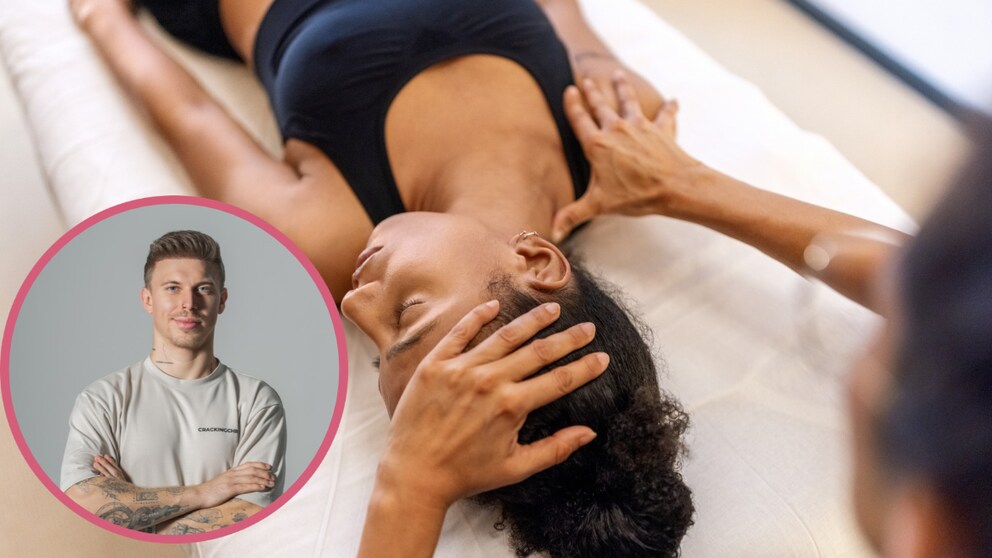
You probably know these videos or have at least seen them on Instagram: people getting their backs or necks cracked, accompanied by a loud popping sound. Millions watch. But what’s behind the trend? And how dangerous is the cracking really? One person who should know is Chris Schittko, aka “crackingchris.” The physical therapist claims to run the largest physiotherapy account in the German-speaking world, treats numerous celebrities, and now trains doctors and therapists himself. In the interview, he reveals what happens in the body during cracking, the risks involved, and why it’s especially important to know when not to crack.
“The real challenge is knowing when not to use it”
FITBOOK: When I watch your videos, I sometimes get really scared. Is cracking really as dangerous as it looks?
Chris Schittko: “It definitely looks worse than it is. The cracking itself is not particularly risky. What I find more problematic is the idea that something needs to be realigned. If I tell a patient that a vertebra has popped out and I pushed it back in, I give them the feeling that their body is unstable. This can lead to people developing a fear of certain movements because they worry something might pop out again. I mainly use cracking for neuromodulation, to influence pain and muscle tension and to facilitate movement.”
Still, you often hear about strokes or even bone fractures. How big is this risk?
“To my knowledge, there are no documented cases of bone fractures from properly performed manipulations. The risk of stroke is stated to be less than 0.006 percent. However, the key factor is who performs the treatment and how carefully the person was examined beforehand. If someone suffers from neck pain, dizziness, and headaches, it could be a harmless tension but also a vascular change. A medically trained practitioner must be able to recognize this. Cracking is a craft that can be learned. The real challenge is knowing when not to use it.”
What Happens in the Body During Cracking?
What exactly happens in the body when it cracks? Is it true that small gas bubbles are responsible for the sound?
“Yes, the sound is caused by a process called cavitation. Our joints are surrounded by a joint capsule containing fluid with dissolved gases. When the joint surfaces are separated, the pressure within the joint changes. This creates or alters gas bubbles, producing the typical cracking sound. There’s an interesting self-experiment by Dr. Donald Unger.1 He cracked the fingers of one hand regularly for over 60 years but not the other, to prove to his mother that finger cracking doesn’t necessarily lead to arthritis. He even received an Ig Nobel Prize for this experiment.”
And what is the medical benefit of cracking?
“The key effect is called neuromodulation. Simply put, we can influence how our nervous system processes pain through certain stimuli. You can think of it like a volume control: The pain isn’t necessarily eliminated, but its perception can be altered. When cracking, we apply a quick impulse that can trigger certain reflexes and affect muscle tension. The effect is less mechanical than many think. It’s not about pushing a stuck joint back into place but rather about processes in the nervous system. Additionally, endogenous substances like endorphins can play a role. This explains why many people feel relief immediately after treatment.”
Does it matter if someone is afraid of cracking?
“Very much so. The expectation influences how someone reacts to the treatment. Those who associate positive experiences with cracking can benefit more. Those who are afraid often unconsciously tense their muscles. If I then try to work against this tension, it can be counterproductive. I also treat many patients with anxiety. For them, it’s especially important to build trust and start with techniques that seem as unthreatening as possible. No one should feel they have to overcome themselves to undergo treatment.”
Also interesting: “I wouldn’t recommend dietary supplements across the board”
The Surprisingly Calming Effect of Cracking Sounds
Interestingly, I find the sounds in your videos somehow calming. Why do so many people watch these cracking videos?
“This is partly because these videos engage multiple senses simultaneously. You see the treatment, hear the cracking, and then observe the reaction of the treated person. This makes the content particularly appealing. Additionally, many people associate the sound with relief. That’s why such videos work so well in the ASMR field. Just hearing it can trigger a pleasant feeling in some people. There are studies that explore such effects on pain perception.”
Also interesting: What exactly is ASMR and do the videos really help with sleep?
In the Worst Case, Severe Vascular Injuries Threaten
I find it particularly frightening when you crack someone’s neck. Could you accidentally break the neck in the worst case?
“In properly performed treatments, I’m not aware of any documented cases where this has happened. Anatomically, a severe injury is of course possible. That’s why you need to know the directions of movement and the biomechanics of the cervical spine precisely. I like to compare it to a door: If it says ‘Pull,’ you shouldn’t push against it with all your might. Similarly, a practitioner must know in which direction a joint can move and where its limits are. Medical knowledge, experience, and controlled technique are crucial.”
A friend of mine had severe neck pain after such a treatment. What can go wrong with cracking?
“There are different risks. Serious complications include vascular injuries that can trigger a stroke in the worst case. Nerves can also be irritated or more compressed, especially if there’s already a herniated disc. However, muscular complaints are much more common. Inexperienced practitioners sometimes try to exert a lot of control by holding the head very firmly. This creates counter-tension in the patient. If a quick impulse is then applied, the muscles can be irritated. The result can be pain that feels similar to a strain. That’s why the examination before treatment is so important. You need to be able to recognize which structures are affected and which techniques are even possible.”
When Harmless Cracking Becomes a Health Risk
Many people regularly crack their own backs or necks. Is that harmless?
“Basically, most people have a natural instinct for self-preservation. If you gently turn to the side while lying on your back or stretch over a chair back and a joint cracks, it’s usually not a problem. Such movements are part of the body’s normal range of motion. It becomes problematic when you try to force the cracking. Especially with the neck, I often observe people using their hands to help and keep turning because they want to trigger another crack. This can irritate the small vertebral joints. It’s not the sound that’s the problem, but the repeated pressure on sensitive structures.”
Would you advise against cracking your neck with your hands?
“Yes, especially if a lot of force is used. If you move gently and it cracks by chance, you usually don’t need to worry. But you should never try to force a sound. If you repeatedly apply pressure in the same movement, it can unnecessarily irritate the joints and surrounding structures.”
Are there people you would generally advise against cracking?
“It depends on why they want to do it. For particularly flexible, or hypermobile people, I often ask why they feel the need to crack constantly. These people often have less of a mobility problem and more of a stability issue. Cracking can provide temporary relief but doesn’t automatically solve the actual problem. So you should always consider what the body really needs.”
The Crucial Time Window After Treatment
So you’re saying that cracking alone isn’t enough?
“Exactly. For me, cracking makes sense primarily in conjunction with movement. I like to compare it to a door that you open. If I don’t use it afterward, it doesn’t do me much good. The treatment can temporarily open a time window where pain is reduced and movements are easier. In therapy, we call this the ‘Window of Opportunity.’ This time window should be used to do targeted exercises and improve mobility. If you just get cracked and then return to your usual posture, you’re missing out on a large part of the potential effect.”
How did you come to focus professionally on the human body and cracking?
“The origin lies in my family. My brother fell ill with a severe disease and lost basic motor skills. He temporarily couldn’t speak, walk, or swallow properly. I was very young at the time and witnessed the intense work to restore these abilities. This sparked my interest in therapy. The neurological field was too close for me personally, so I later focused more on sports and movement. Cracking particularly fascinated me because I saw the significant effect it can have on the body.”
Today, you’re mainly known for your videos on social media. How did that come about?
“Originally, it was about transparency. I have many tattoos and at the time I found a tattoo artist on Instagram. I could see exactly how he worked and what results he achieved. Then I wondered why it’s often different with medical treatments. After all, it’s about your own health. You usually only see a Google review or a photo of the practitioner but know little about how they actually work. So I started showing clips of my treatments. Initially, these were mainly the cracking techniques because I wasn’t yet comfortable speaking in front of the camera. Later, explanations and exercises were added. My goal was always to give people a better insight into my work.”
“Cracking is technically relatively easy to learn”
There are now countless accounts where people crack others’ backs or necks. How dangerous do you find such imitators?
“The biggest problem is that cracking is technically relatively easy to learn. I could show someone how to perform a specific technique in a short time. But that doesn’t mean this person knows when not to use the technique. That’s where the danger lies. Those without medical knowledge may not recognize possible contraindications or warning signs. For viewers, the difference is hardly noticeable because the same cracking sound is heard in both cases. However, the precision of the treatment can vary significantly. That’s why I find it problematic when people imitate such treatments solely based on social media videos.”
Was that also a reason for founding your own academy?
“Yes. When I started publishing such videos, I was one of the first in Germany to do it in this form. The trend was already much bigger in the U.S. As more people produced similar content, I wanted to take it a step further and convey my knowledge in a structured way. That’s why I founded a certified academy where I train doctors and therapists. It’s important to me that the techniques are backed not just by a spectacular video but also by the appropriate professional competence.”
You’ve also written a book. What’s behind it?
“I wanted to make my knowledge accessible to people who want to delve deeper into their pain. My book is called ‘Crack Your Pain.’ It’s about cracking, but mainly about how to break the cycle of pain.”
Medical Knowledge Without a White Coat
With your name crackingchris and your videos, you target a different audience than many traditional doctors. Is that intentional?
“Absolutely. There are already enough people presenting medical content in a white coat. That’s perfectly fine. But there’s also an audience that feels more addressed by a modern and relaxed approach. I want to make medical knowledge accessible without losing its seriousness. My appearance may sometimes be unusual, but there’s a professional foundation behind my work.”
You reach a lot of people with your videos. Do you also receive criticism from doctors and other therapists?
“Yes, and especially at the beginning, the criticism was sometimes very harsh. The problem with medical content on social media is that you have to explain complex relationships in a very short time. Back pain, for example, can have countless causes. In a 60-second video, I can’t possibly list them all. I can only highlight a specific aspect. Other doctors or therapists often criticize what’s missing in this video. I see such content as individual puzzle pieces that should encourage people to engage more deeply with their health. Of course, a video never replaces an individual examination or treatment.”
Can you give an example?
“If I explain in a video how the gluteal muscles can affect back pain, it doesn’t mean that every back pain is caused by weak gluteal muscles. There can be completely different causes. But maybe someone sees this video and for the first time considers a connection they didn’t know before. That’s exactly what I want to achieve. The art is to simplify medical content so much that it becomes understandable without being factually incorrect.”

I Tried Assisted Stretching–Here’s What the Wellness Trend Offers

Kung Fu Star Sacha Wenk: “Pain Is Part of the Process if You Want to Achieve Something”
“There’s a lot of competition and little mutual recognition.”
How do you personally deal with negative comments?
“Especially in the first two years, I had to take a lot of criticism. Some dismissed me as unprofessional just because of my name or videos. Many thought I only cracked people. That was partly my fault because I initially only showed this small part of my work. A 15-second video doesn’t represent an hour-long treatment. Interestingly, the criticism mainly came from other therapists, while many patients received my content very positively. They found it exciting to have medical connections explained differently. A lot has changed now: Some of the people who were critical of my work before now want to learn from me.”
Would you say that the health and fitness industry on social media is particularly critical of each other?
“Yes, I find this scene sometimes quite unpleasant. There’s a lot of competition and little mutual recognition. Especially when someone becomes successful with an unusual concept, it doesn’t always meet with enthusiasm. People often forget how much work goes into such a development. I worked normally for a long time and continuously produced content on the side. Originally, I even became self-employed out of financial necessity because I wanted to finance my medical studies. That I now reach so many people with my work and get to treat interesting personalities is a mix of hard work, coincidences, luck, and of course skill.”
How Quickly a Good Reputation Can Be Lost
On social media, a single video or an unfortunate collaboration can trigger a major backlash. Does that sometimes worry you?
“Of course, you have to be aware of how quickly you can lose credibility. Sometimes a wrong collaboration or an unconsidered video is enough. At the same time, you shouldn’t forget that there are people behind the accounts who can make mistakes. Not everyone has professional management or the experience to assess every situation correctly from the start. The problem is that social media often judges very quickly and harshly. That’s why I find it important to stay true to yourself and your work.”
You now also treat well-known personalities. What does this success mean to you?
“It’s certainly a great privilege. I’m now invited to events and get to work with people I might have only known from the media before. Often, exciting encounters and stories arise. But in the end, my fundamental motivation hasn’t changed much. I’m interested in the human body, I enjoy working with people, and I want to help them move better and understand their complaints. That I reach so many people with this today is something I couldn’t have imagined at the beginning.”