

August 15, 2025, 9:10 am | Read time: 5 minutes
Even without ever having held a tennis racket, you can develop tennis elbow. Whether you’re an office worker, craftsman, athlete, or student–everyone is at risk if the arm is subjected to unilateral or excessive strain. The result: sharp pain on the outside of the elbow. It’s not an uncommon phenomenon–about two percent of Germans suffer from it.1 FITBOOK editor Michel Winges explains what really lies behind the so-called tennis elbow and why tennis players are less affected than the name suggests.
Follow the FITBOOK channel on WhatsApp now!
What Is Tennis Elbow?
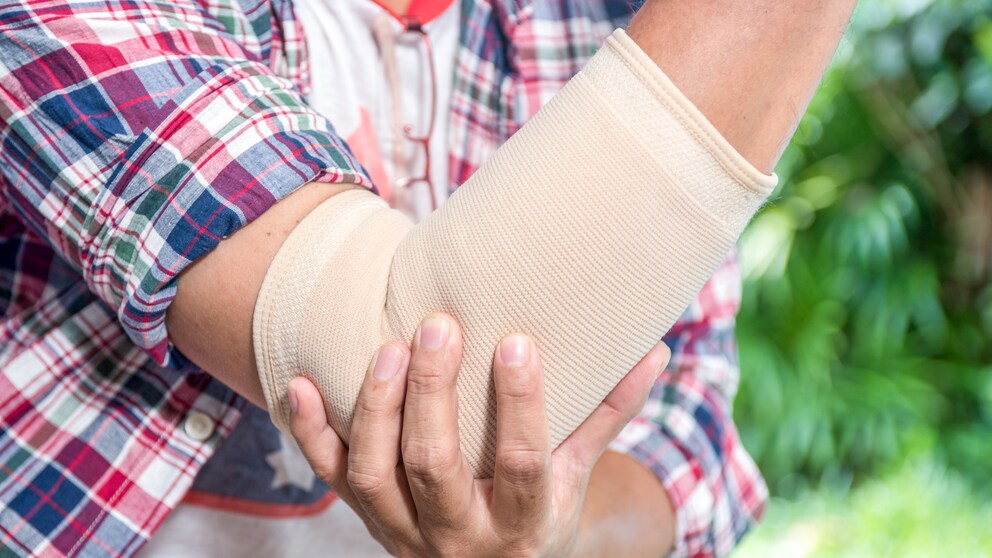
The term tennis elbow is misleading because, in most cases, the condition has nothing to do with the sport. Medically, the condition is referred to as “lateral epicondylitis.” It involves irritation at the tendon attachment of the forearm’s extensor muscles, more precisely on the outside of the elbow. The cause lies in repeated, unilateral, or unfamiliar strains. Movements like gripping, lifting, or twisting–often in everyday life and not on the tennis court–can irritate the tissue. Whether it’s hours of typing on a computer, turning a screwdriver during DIY projects, or stirring while cooking: if the muscles are not properly trained, overstrain can quickly occur.
The Irony in the Name
The irony behind the term tennis elbow is that active tennis players rarely have issues with the condition. Due to their well-trained forearm muscles, they are generally not susceptible to it. In contrast, newcomers who might be swinging a racket for the first time are more likely to suffer, as their muscles are not accustomed to the movement.
Also interesting: This many push-ups per day lead to visible muscles
Symptoms
Typical for tennis elbow are sharp or pulling pains on the outside of the elbow. The discomfort is especially noticeable when force is required: when carrying, gripping, lifting, or even during a simple handshake. Even everyday activities like lifting a coffee cup or opening a bottle can be painful. In many cases, the pain radiates into the forearm or hand. Resting pain and nighttime pulling are less common but can occur in advanced cases.
Golfer’s Elbow
The symptoms of a “golfer’s elbow” can feel similar, except the pain is on the inside of the elbow. If this is the case for you, there’s no need to worry. The treatment is essentially the same.

“I Couldn’t Even Hold the Tennis Racket Properly”

Bursitis – Symptoms and Treatment
Diagnosis
The diagnosis by a doctor is usually relatively quick.2 The doctor begins with a conversation to find out during which movements the pain occurs and whether there are any pre-existing conditions. This is followed by a physical examination: the affected arm is specifically tested for pain reactions. Usually, this combination of medical history and clinical examination is sufficient to make the diagnosis. Further procedures like MRI, X-ray, or ultrasound are only necessary in exceptional cases.
Treatment
The Right Choice
Cooling, stretching, waiting? Or should you go straight to surgery? There is a wide range of therapy options with very different effectiveness. However, evidence-based studies show that for acute symptoms, a combination of rest, pain-relieving medications, and physiotherapy measures is sufficient to bridge the pain phase. In many cases, the symptoms improve within four to six weeks, regardless of the therapy.3
Movement Therapy
In this early phase, a targeted movement therapy is especially recommended, which could look like this:
- Sit at a table. Rest your forearm so that the hand extends beyond the edge of the table–palm facing down. Hold a small water bottle or a light weight (e.g., 0.5 to 1 kilogram) in this hand.
- Now use the other hand to help slowly bend the wrist upward (toward the ceiling).
- Then slowly and controlled, let the wrist sink back down–the weight pulls the hand down, but you consciously brake. This “downward braking movement” is the training.
This technique strengthens the irritated tendon and is intended to help the arm get used to strain again. Bandages, cold applications, or stretching exercises can also be supportive, but their benefit is individually different and only weakly scientifically proven. Cortisone injections often quickly relieve pain but can hinder healing in the long run.
What if Tennis Elbow Becomes Chronic?
If tennis elbow becomes chronic, meaning it doesn’t improve over months, it becomes trickier. While surgeries are offered, there are indications that the results are only moderate and often no better than doing nothing. The so-called shock wave therapy can also help, but only under very strictly controlled conditions. A doctor’s visit is clearly advisable in this case.
Conclusion
The most important insight: There is no universally effective treatment for tennis elbow yet. Experts therefore recommend having patience, avoiding overstrain, and performing targeted exercises that are well-guided and suitable for everyday life. Those who manage not to ignore the pain but to consciously address the cause have the best chances for lasting improvement–even without a scalpel.