


October 16, 2026, 11:55 am | Read time: 5 minutes
Suddenly, sweat smells different, the favorite perfume seems unusual, and even the deodorant doesn’t seem to work as well as it used to. For women over 40, this is often due to the hormonal changes of menopause: As estrogen levels, skin, and microbiome change, so does the personal body odor. FITBOOK asked an expert to explain what’s behind this and what can help.
“Body odor doesn’t result from a single factor. It’s the interplay of hormones, skin, sweat, and the microorganisms on the skin that’s crucial,” explains Dr. Heidi Gößlinghoff, a gynecologist, reproductive medicine specialist, and psychotherapist focusing on fertility and hormonal women’s health.
Hormones
At the center is the hormone estrogen. During perimenopause, the transitional phase before menopause, hormone levels fluctuate significantly, and after menopause, they drop permanently. This directly affects the skin, as estrogen influences moisture, skin barrier, and collagen. When levels drop, the skin often becomes drier and changes its composition.
Sweat
Hot flashes and sweating, typical companions of menopause, result in significantly more sweat on the skin. “More sweat doesn’t automatically mean more body odor,” says Dr. Gößlinghoff. “Sweat itself is largely odorless at first. The typical body odor only arises when certain components of sweat and skin secretions are broken down by bacteria on the skin.” The armpits play a special role in this. Many so-called apocrine sweat glands are located there, whose secretions contain substances that skin bacteria convert into volatile, odor-active compounds.
Skin and Microbiome
The skin microbiome refers to the totality of microorganisms that naturally live on our skin and significantly contribute to skin health. As we age, changes in moisture, sebum production, and the skin barrier alter the interaction between skin and microbiome. This shift is one reason why personal scent can change over the years.
The Special Fragrance 2-Nonenal
“2-Nonenal, a chemical compound associated with the so-called ‘old person smell,’ may play a role. It forms on the skin when certain fatty acids in skin sebum react with oxygen. The smell is often unflatteringly described as grassy, greasy, or slightly rancid,” says Dr. Gößlinghoff. “Unlike many sweat components, the substance is not water-soluble and therefore cannot always be easily removed with water and soap. However, this doesn’t mean that every woman over 40 automatically develops this odor or that 2-Nonenal is the sole cause of changes. It’s just one possible factor among several.”
Where Is the Changed Body Odor Particularly Noticeable?
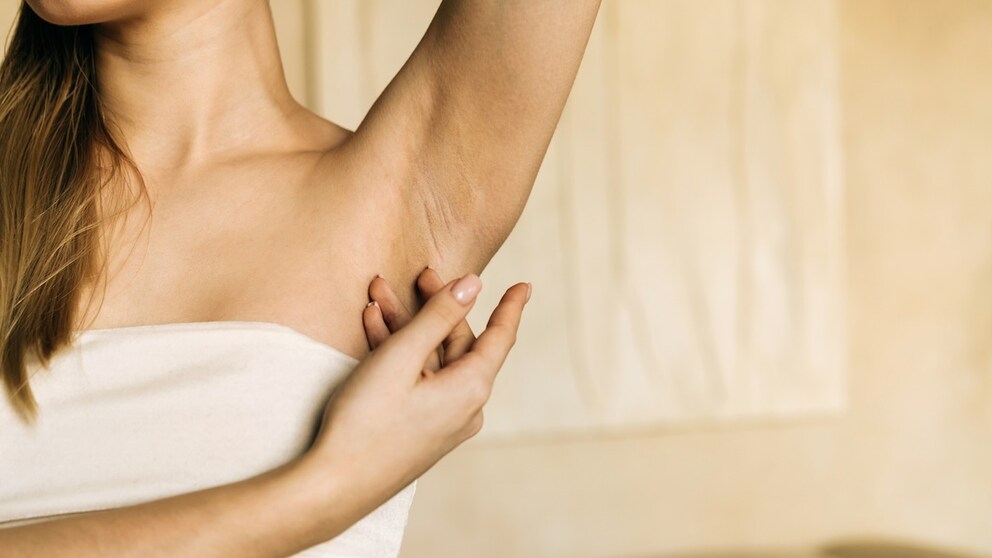
Armpits
Armpits are particularly noticeable because many sweat glands are located there. Changes can also be felt on the feet, scalp, back, or in skin folds.
Intimate Area
“In the intimate area, another mechanism comes into play: When estrogen levels drop, the vaginal mucosa becomes thinner and drier, and the vaginal microbiome also shifts,” explains Dr. Gößlinghoff. “In postmenopausal women, there is generally less Lactobacillus (lactic acid bacteria), which normally significantly contributes to the acidic vaginal environment. However, a distinctly fishy or unpleasant odor should not simply be attributed to menopause. It can indicate bacterial vaginosis, for example. If unusual discharge, itching, burning, or pain also occur, it should be promptly checked by a gynecologist.”
Does Hormone Replacement Therapy Help Against the Changed Odor?
Hormone replacement therapy doesn’t automatically make all changes in body odor disappear. However, it can alleviate typical menopausal symptoms such as hot flashes and night sweats. If the changed odor is mainly related to excessive sweating, the problem may be reduced.
However, hormone replacement therapy doesn’t affect the skin, sweat, and skin microbiome in a way that returns the body to its pre-menopausal state. How much personal scent changes depends on several factors.
What Else Helps Against Changed Body Odor?
“No complicated strategy is needed here, as gentle body care is more important than frequent washing,” advises Dr. Gößlinghoff. “Mild cleansing products are usually sufficient, and after showering, armpits, feet, and skin folds should be well dried. Aggressive scrubbing or frequent disinfecting is not a good idea, as it can stress the skin barrier and the natural skin microbiome. For excessive sweating, an antiperspirant can help, as well as light, breathable clothing and regularly changing sweaty clothes.”
When Should a New Body Odor Be Checked?
A changed personal scent alone is usually no cause for concern. It’s different if the change occurs very suddenly, is unusually strong and unpleasant, or persists for a long time. In the case of a significant and unexplained change, a medical examination is worthwhile.

How Menopause Changes the Vagina

The 12 Most Bizarre Menopause Symptoms
Does the Favorite Perfume Really Smell Different with Age?
Sometimes it seems not only the personal body odor has changed, but also the favorite perfume suddenly smells different or is no longer as appealing as before. There are two possible explanations for this: On one hand, the fragrance encounters changed skin, whose composition and moisture influence how fragrance notes unfold. The perfume can indeed smell different.
On the other hand, one’s own sense of smell can also change. However, the connection between sex hormones and the sense of smell is complex, and the research on this is not conclusive.
Conclusion: The Body Changes, Not the Hygiene
When women over 40 suddenly smell different, it’s usually not due to a lack of personal hygiene but to hormonal changes that affect body odor through hot flashes and changes in skin and microbiome. If you suddenly notice a different scent, there’s no need to completely overhaul your bathroom: A mild cleansing product, a suitable antiperspirant if needed, and a careful eye on the skin are often enough. However, noticeable intimate odor or a strong, persistent, and unexplained change should be medically evaluated.