


May 15, 2026, 10:25 am | Read time: 6 minutes
Oolong tea remains a hidden gem in Germany. However, it is a popular tea variety in many parts of the world. FITBOOK Editor-in-Chief Nuno Alves explains what makes Oolong tea so special, its purported effects, and how to prepare it correctly.
If you enjoy drinking tea, you may have heard of Oolong tea. It is a specialty originating from China, specifically the Fujian region in the southeast of the country. Oolong translates to “black dragon” or “black snake.”
Overview
What is Oolong Tea?
Oolong tea is traditionally made from the leaves of the Camellia sinensis tea plant, making it one of the so-called true tea varieties. It falls between green and black tea in terms of oxidation. While green tea is barely oxidized and black tea is heavily oxidized, Oolong is only partially processed. This results in a unique flavor profile that can vary greatly depending on the variety.
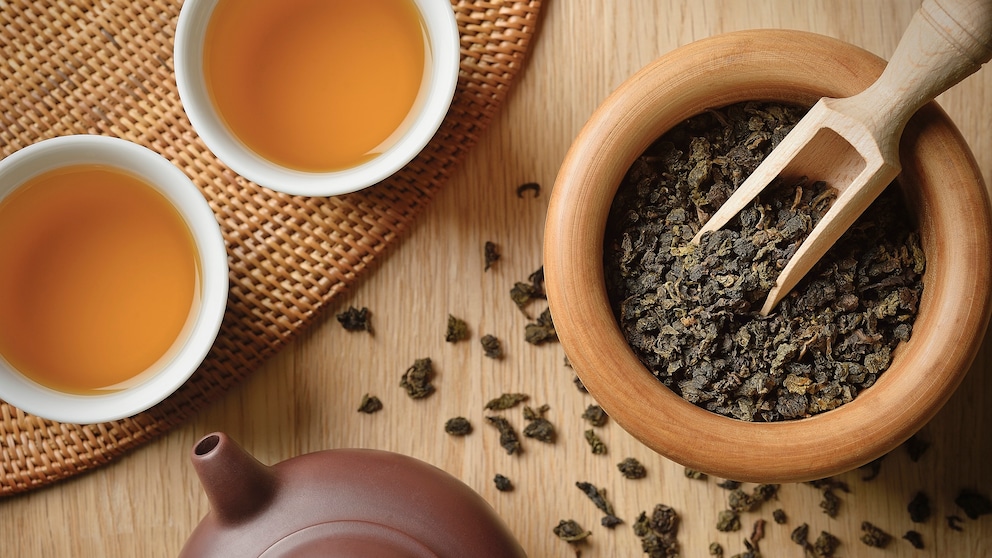
For production, the tea leaves are first wilted in the sun. They are then shaken and lightly rubbed multiple times, which deliberately initiates oxidation. This processing step significantly contributes to the typical aroma. Oolong tea is often rolled into small balls and produces a golden-yellow hue when brewed.1
The Special Oolong Tea: Oriental Beauty Tea from Taiwan
In Taiwan, Oriental Beauty Tea is considered a special delicacy. In this variety, small cicadas cause biochemical changes by piercing the leaves while still on the tea bush, resulting in a particularly soft, sweet aroma with a hint of honey during processing.
According to legend, this tea variety was discovered by chance. A Taiwanese tea farmer reportedly sold the infested leaves anyway, and the unusual taste was so well received that Oriental Beauty Tea later became one of Taiwan’s most famous Oolong varieties.
Also interesting: Overview of Tea Varieties
Application: What is Oolong Tea Supposed to Help With?
In Asian cultures, tea is often preferred over coffee in the morning. Oolong tea has a stimulating effect and is becoming increasingly popular in Europe as an alternative to coffee, mainly due to its caffeine content.2
Researchers have been studying the plant compounds it contains for years. Some observational and laboratory studies suggest possible links to cardiovascular health, fat metabolism, and cognitive health.3,4 A larger observational study in older adults showed a connection with a reduced risk of cognitive impairments.
Researchers are also exploring potential effects of certain Oolong polyphenols on digestive enzymes involved in fat absorption.5 Smaller human studies on so-called GABA Oolong tea have provided initial indications of possible short-term changes in stress perception, relaxation, and certain blood pressure values.6
However, it should be noted that many of these results come from smaller human studies or laboratory tests and need to be confirmed by larger and higher-quality studies.
Also interesting: The Effects of Pu-Erh Tea–and What Makes It So Valuable
What Bioactive Plant Compounds are in Oolong Tea?
Like green or black tea, Oolong tea contains caffeine. Depending on the variety, leaf quality, and preparation, a cup typically contains about 10 to 40 milligrams of caffeine.7 The exact content depends on factors such as steeping time, temperature, and degree of processing.
Additionally, Oolong tea contains numerous bioactive plant compounds like polyphenols, catechins, and amino acids. This includes epigallocatechin gallate (EGCG), one of the most well-known catechins of the Camellia sinensis tea plant. Studies show that Oolong tea generally contains lower amounts of certain catechins compared to green tea, as these are partially converted during oxidation. At the same time, other complex polyphenols characteristic of Oolong tea are formed.
Also interesting: Why Cistus Tea is Said to Boost Your Immune System
Is the Effect Scientifically Confirmed?
Although Oolong tea has a long tradition in China and Taiwan, it is now also being scientifically studied. Researchers are particularly interested in the polyphenols, catechins, and amino acids it contains.
Studies are examining potential effects on fat metabolism, stress regulation, and cognitive health. For example, Japanese researchers have investigated how certain polyphenols from Oolong tea might affect digestive enzymes involved in fat digestion.
There are also laboratory studies on potential effects on cancer cells. However, these investigations have been conducted exclusively on cell cultures. Therefore, no reliable conclusions can be drawn about whether Oolong tea can prevent or treat cancer in humans.8
Overall, many of the observed effects are scientifically interesting but still need to be confirmed by larger human studies.
Also interesting: Sage Tea–Application, Effects, and Proper Preparation

Ingredients and Effects of Black Tea

The Use and Effect of Hojicha Tea
What Does Oolong Tea Taste Like?
When properly prepared, Oolong tea indeed resembles a mix of green and black tea. The higher the quality, the gentler and more floral the aroma tends to be. The intensity of the flavor mainly depends on the degree of oxidation and processing.
High-quality Oolong teas often taste smooth, round, and slightly sweet. Lower-quality varieties or improper preparation can quickly result in a bitter taste.
Proper Preparation of Oolong Tea
Water Temperature
Oolong tea should not be steeped with boiling water, as this can negatively affect its aroma and taste. Recommended temperatures are around 80 to 90 degrees Celsius. Particularly fine varieties like Oriental Beauty benefit from lower temperatures.
Amount
For about 250 milliliters of water, use approximately 2 to 4 grams of Oolong tea.
Steeping Time
Depending on the variety, the steeping time is usually between one and five minutes. Some high-quality Oolong teas are also suitable for very short infusions of just a few seconds. Often, the same tea can be steeped multiple times, with the flavor and aroma changing slightly with each infusion.

Why Oolong is One of My Favorite Teas
“I first tried Oolong tea when my neighbor from Taiwan brought me Oriental Beauty Tea. At that time, I didn’t know what the name meant. Only after a brief search did I learn that it was a famous Oolong variant in Taiwan. In any case, you could immediately taste that it was a special tea. But other high-quality Oolong teas also impress with a flavor that indeed lies somewhere between green and black tea. The reason for this is the partial oxidation of the tea leaves. Although you often read that Oolong can be somewhat tart, this usually only applies to lower-quality varieties or improper preparation. What I particularly appreciate about the tea, besides its stimulating effect, is the soft mouthfeel and the fine honey and floral notes of high-quality varieties. Perfect for starting the day or overcoming small energy slumps in the morning.”