

December 10, 2025, 10:06 am | Read time: 5 minutes
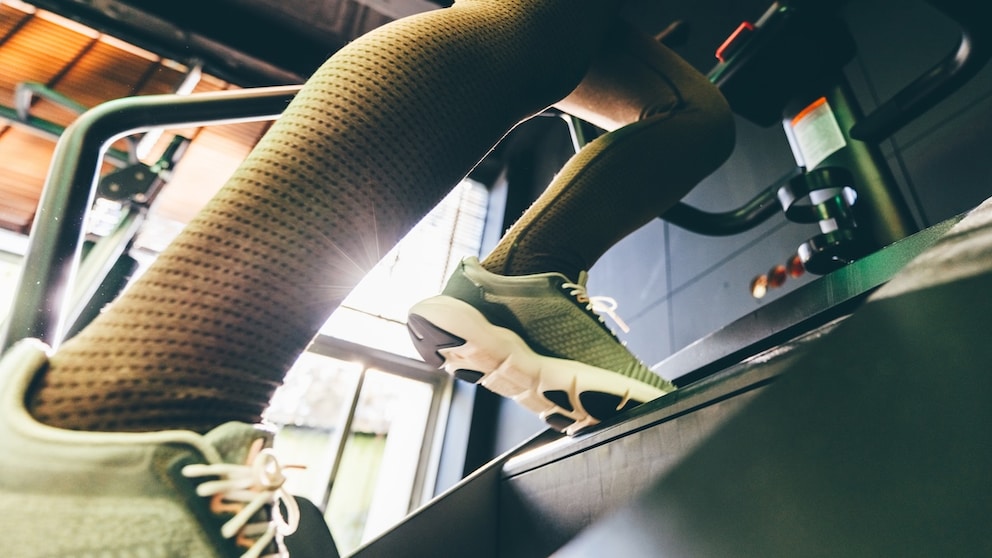
The Stairmaster works similarly to a treadmill, with the major difference being that the belt is not flat and you continuously climb stairs. But what does training on the electric gym stairs offer? FITBOOK author Laura Pomer explains. She also reveals exercise variations.
Climbing stairs stimulates circulation and burns plenty of calories. It is suitable for those looking to lose weight and improve endurance. In the gym, you can “take the stairs” by using the Stairmaster cardio machine.
The Health Benefits of Climbing Stairs
The health benefits of climbing stairs are scientifically proven. For example, researchers from Geneva found that regularly using stairs in daily life can significantly improve fitness and health. Their three-month study from 2008 showed that stair climbing improved the aerobic capacity of participants. Not only that, but hip circumference, body weight, and fat mass also decreased. Positive effects were also observed on blood pressure and cholesterol levels.1 Good reasons to climb stairs as often as possible.
Advantages of the Stairmaster Compared to Regular Stair Climbing
And what about those who still prefer the elevator over stairs in daily life? According to fitness scientist Prof. Dr. Stephan Geisler, the Stairmaster in the gym offers a good, functional solution. The fitness professor considers the Stairmaster a “quite sensible cardio device.” Those who want to climb stairs can either run up and down five flights at a fast pace ten times or train on the Stairmaster. Both are effective.
StairMaster is the brand name of a fitness company that sells the currently popular stair-climbing machine, among other things. Some call it an “electric gym staircase,” but “Stairmaster” has become the common term.
However, if you’re aiming for a maximally toned butt, you’re still better off with squats, lunges, and deadlifts…
Difference from Regular Stairs—Step Height and Speed
There are a few differences from regular stairs, and you can benefit from them when training on the Stairmaster. The device has higher steps than most regular stairs. And what is easier on regular stairs than on the cardio machine: taking breaks or slowing down. Instead, the Stairmaster sets the pace. To slow down or stop, you must adjust or turn off the device. Depending on the step height and speed, the cardio effect can be high—even higher than running.
What Sets the Stairmaster Apart from the Stepper
Like the Stairmaster, the Stepper simulates stair climbing. The Stairmaster is often a type of ascending escalator. Users must lift their feet independently when using the device. In contrast, the Stepper operates through an elliptical motion.2 This makes it gentler on knees and joints than the Stairmaster. Those with knee issues, for example, should opt for the Stepper over the electric gym stairs.
3 Exercises for Maximum Training Effect on the Stairmaster
To target different muscles, it’s beneficial to vary the movements. This makes the workout more effective—and also more engaging.
- Skip a Step
Like on regular stairs, when you take two steps at a time. This naturally requires you to take larger steps. The next challenge: increase the pace! - Side Step Up
Stand sideways on the device to climb the stairs at a right angle. Always step slightly crosswise to make room for both feet on the steps. Then repeat the same on the other side. For side stair training, it’s recommended to start at a moderate pace to practice foot coordination and avoid tripping. - Kickbacks
Extend the leg that is swinging back straight and tense. This variation really targets the glutes!

Training Intensity Surprised Me
“I recently started using the Stairmaster for my warm-up routine at the gym. I thought I’d try something new and switched from the cross-trainer and treadmill, which I usually preferred. And I must say: The Stairmaster training surprised me. The step height ensures that even at a snail’s pace, my heart rate increases significantly. I warm up at least as quickly as on the treadmill, and I find the Stairmaster more challenging than the cross-trainer. If it’s just about warming up before strength training and not a cardio session, the Stairmaster still challenges me by pushing my heart rate too high too quickly. With more training on the device, this will surely improve soon. But now I understand why everyone moves so ‘slowly’ on the Stairmaster.

What Happens When You Suddenly Lose Control at the Gym

Is exercising on an elliptical trainer really effective for weight loss?

Happy Place in the Gym
“I admit it: The Stairmaster is my absolute happy place in the gym. While others avoid it because it looks like a final boss in the fitness studio, I warm up there every time before moving on to my bodyweight exercises. The steady, rhythmic steps remind me a bit of dance training–controlled, flowing, with a focus on posture. And then there’s an exercise my sister showed me: kickbacks on the Stairmaster. Yes, exactly–while taking the steps, I alternately stretch my leg back and up. The looks from people? I don’t mind. Because the combination hits exactly where it should: in the glutes, lower back, and hamstrings. Kickbacks primarily activate the gluteus maximus, the side glute muscle (gluteus medius), and the hamstrings–and on the Stairmaster, there’s this additional, tricky balance factor that really makes the deeper stabilizers burn. A bit unusual, yes. But extremely effective. And that’s exactly why I love it.”
What Happens When You Suddenly Lose Control at the Gym