


April 24, 2024, 9:45 am | Read time: 6 minutes
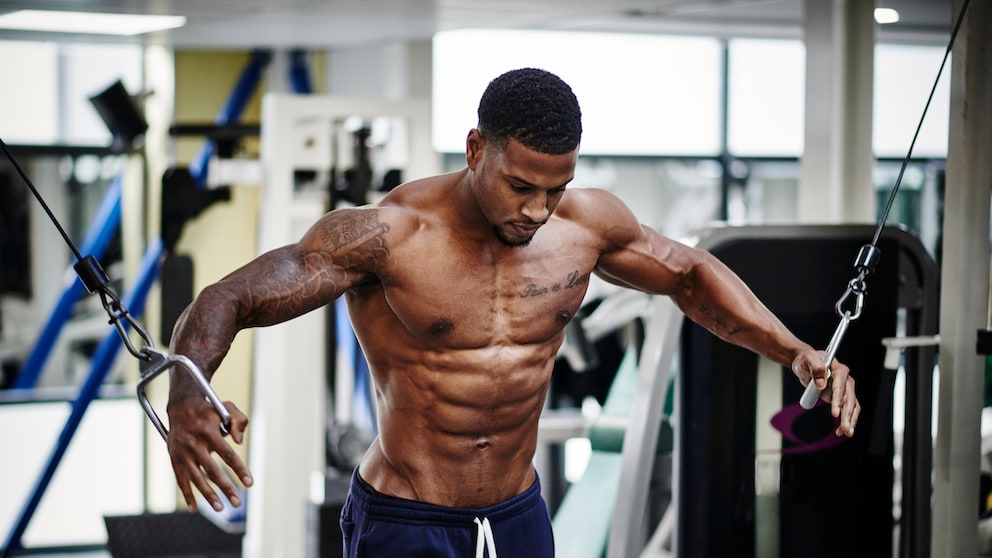
Cable flys are a popular chest exercise in the gym, but beware: The exercise is not without risk. FITBOOK author Nina Ponath reveals how to perform flys correctly–and what to pay special attention to.
“Cable flys”–what exactly is that? There are numerous terms for the exercise online: “Cable Crossover,” “Chest Flys,” “Butterflys on the Cable,” or “Cable Cross” all essentially mean the same thing. It’s a very effective exercise where a weight is brought together in front of the chest with outstretched arms. Ideal for strengthening this muscle group. Unlike the machine version, many athletes do the cable fly less frequently, but it’s definitely worth it.
Follow the FITBOOK channel on WhatsApp now!
Overview
Cable Flys: What makes this exercise so effective?
Cable flys are included in almost every training plan for a reason. Depending on the target muscles, this exercise can be performed in various ways, making it a true all-rounder: By varying the direction of the cables, you can primarily train the lower, middle, or upper chest. Flys can thus cover all muscle areas of the chest. Those who enjoy variety can perform this exercise lying down, standing, in a bent-over stance, with one leg forward, or in an upright position. Cable flys can also be done with one arm or both arms simultaneously.
Why it’s beneficial to train the chest
Why is a well-trained chest beneficial? A strong, well-trained chest is undoubtedly an eye-catcher. Besides the aesthetic component, a strong chest is also advisable from a health perspective. Strong chest muscles prevent postural damage and stabilize the upper body. In addition to posture and stabilization of the upper body, the chest muscle is also responsible for various arm movements. The chest muscle controls the forward movement of the arms (especially horizontally), lifts the arms forward and upward, rotates the shoulders inward, and works statically, such as in support on parallel bars. The chest muscles are also part of the auxiliary respiratory muscles and are therefore crucial for effective breathing under exertion. The better your chest muscles are trained, the easier other exercises will be for you.

David Corenswet’s Training for Superman Shoulders and Chest
Why You Should Do Bench Presses With Dumbbells Instead of a Barbell
The different execution possibilities
Depending on the direction of the cables, different areas of the chest muscles can be trained.
The most popular execution possibilities for different muscle groups:
For the middle chest – Cable Crossover
With the help of the Cable Crossover, you can primarily train the middle area of the large chest muscle (pectoralis major). At the same time, you can strengthen the front part of the deltoid muscle (deltoideus pars clavicularis).
Proper execution is crucial to fully exploit the exercise’s potential.
- Start in an upright starting position, followed by a step forward.
- The knees are slightly bent, and it’s essential to maintain a straight spine.
- The arms are now stretched out to the side to grab the cable handles.
- The entire upper body is tensed.
- Both arms are moved forward evenly in an outstretched state and at a moderate pace so that they meet in the middle in front of the body. A height slightly below the chest should be chosen.
- The elbows remain slightly bent during execution to avoid joint damage. The forward movement is for exhaling, while the backward movement to the starting position is for inhaling.
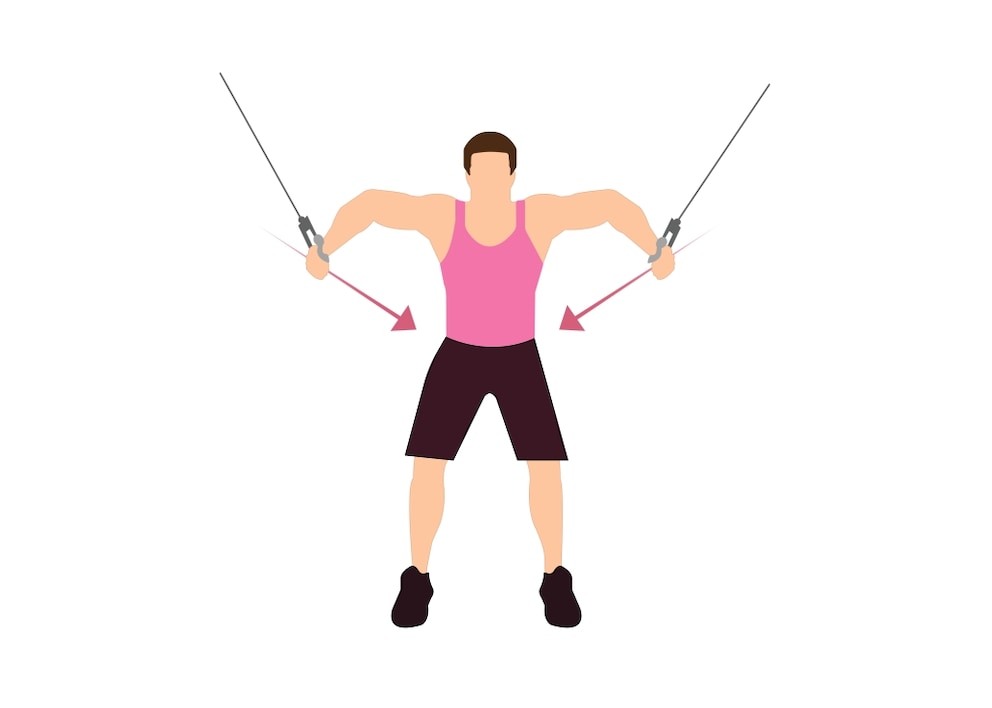
For the lower chest – Cable Fly
The lower chest muscles are trained with the Cable Fly. During the downward movement, the lower fibers (pectoralis major) are strengthened. At the same time, the anterior serratus muscle (serratus anterior) receives a stimulus.
- This fitness exercise is performed standing.
- Both cable handles are taken from the top end.
- To protect the spine, a slight arch in the lower back should be maintained.
- The knees and elbows are slightly bent.
- A calm execution of movement is advisable to ensure effective muscle engagement.
- From the starting position, the cables are pulled forward and downward without momentum.
- It should be ensured that the weight remains continuously in the air.
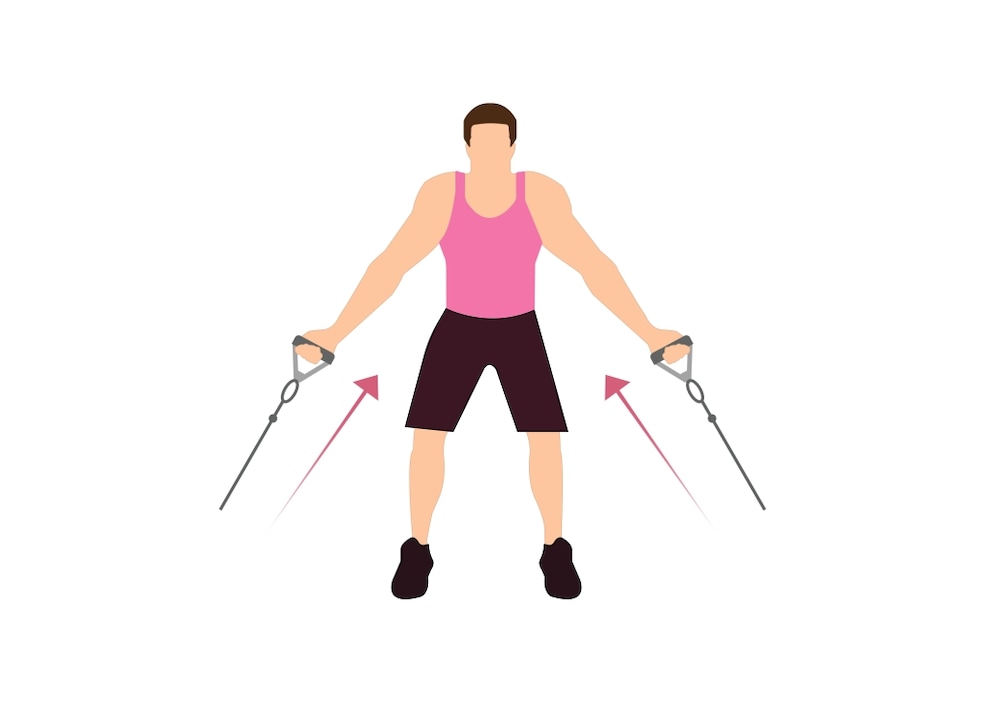
For the upper chest – Cable Fly
The upper chest can be trained from bottom to top with the Cable Fly. Here, the upper area of the chest muscle (pectoralis major) is engaged. Additionally, this exercise intensively stimulates the front shoulder muscle (deltoideus pars clavicularis). The entire movement is supported by the anterior serratus muscle (serratus anterior).
- For the Cable Fly from bottom to top, first place the left foot forward.
- The lunge forms the starting position and provides more stability during execution.
- The upper body is straight, and a slight arch in the lower back is formed.
- The elbows and wrists are slightly bent to minimize the risk of joint injury.
- The lower cable handles are used to perform the Cable Fly upward.
- The execution is similar to other training variants.
- The cables are guided from bottom to top, and the upper chest muscles are actively tensed during this process.
- The upward movement is for exhaling, while the downward movement is for inhaling.
- Again, ensure that the weight remains in the air to maximize training efficiency.
Cable Flys: These are the most common mistakes
Cable flys are not entirely without danger. To avoid injuries, make sure that elbows and knees are slightly bent. Otherwise, painful joint injuries may occur. The exercise should also be performed without any momentum–too much momentum reduces the training stimulus! Given the many different variations of the chest exercise, it’s advisable to clarify your training goal beforehand and train accordingly.
A final tip: Train the chest first, then the biceps or triceps. If you don’t follow this order, the triceps may fail during chest training, leading to sloppy exercises.