


March 14, 2026, 12:11 pm | Read time: 8 minutes
Defined upper arms are something everyone would like. But does it always have to be the classic bicep curl? In fact, a special form of curls is particularly suitable for training the arm muscles: preacher curls. Why this is the case, what variations exist–and how the isolation exercise for strong upper arms is performed correctly–was explained to us by sports scientist and personal trainer Jörn Giersberg.
Follow the FITBOOK channel on WhatsApp now!
Overview
What is a Preacher Curl?
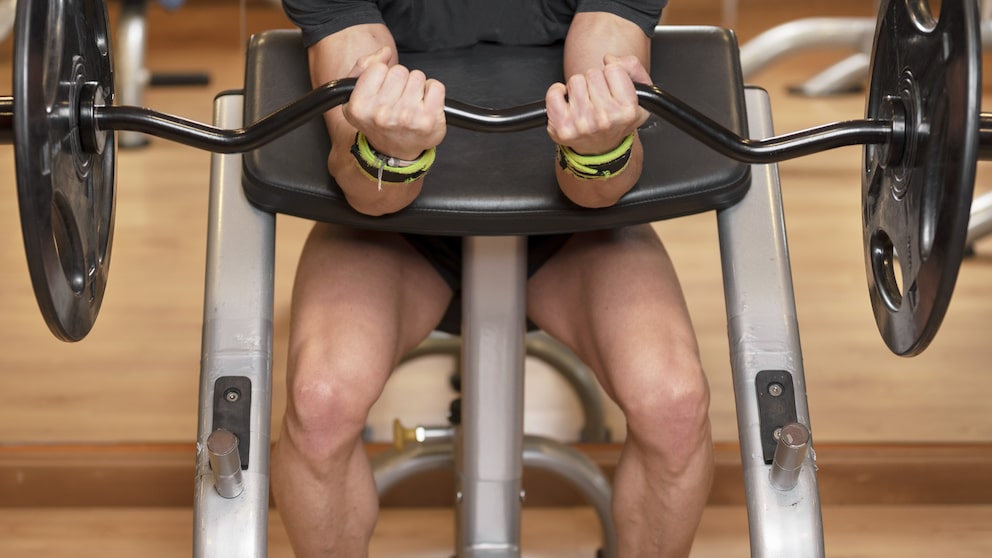
The preacher curl, also known as the Scott curl after bodybuilding legend Larry Scott, trains the bicep muscle in isolation from all other muscle groups. The basic principle is quite simple: You rest your upper arms on a slightly inward-angled pad and then perform a curl with a weight. “With other curls, other muscle groups are more or less involved, for example, the core must be stabilized. This allows you to leverage much more from the entire upper body. With these curls, you isolate this possibility,” explains Jörn Giersberg. Therefore, you can really focus only on the elbow joints.
In other words, since the upper arms are resting, the arm flexor or biceps is even more stressed. This allows it to grow particularly well.
The Right Technique
Starting Position While Sitting
To perform the exercise, you need a Scott or preacher bench. This is double-padded, allowing the upper body to lean and the upper arms to rest as mentioned. The Scott bench can be adjusted in height, so the exercise can be performed sitting or standing. We will first focus on the starting position while sitting.
You sit on the bench and adjust the seat height so that the upper arms and chest touch the padding with a straight back (slight arch). Both legs are firmly and shoulder-width apart on the floor.
Movement Sequence
Now you lean forward and grab, for example, an EZ bar with an underhand grip. It should be noted that the grip is slightly narrower than shoulder-width. With the weight in your hands, the elbow is bent to shoulder height by tensing the biceps and lifting the bar. Then the arms are lowered back to the starting position, and a repetition follows. The entire movement is performed exclusively through the elbows.
Important: Throughout the entire process, the upper arms remain in a resting position, in contact with the pad, and are not lifted.
Mistakes to Avoid with Preacher Curls
Starting Phase from Above
Ideally, you should start the entire movement from above. A training partner could hand the EZ bar from above so that you don’t have to lift the weight from a stretched position. “This position is unstable and unfavorable, as I also have a bit of weight on it,” says the fitness expert.
If training alone, it’s best to lift the dumbbell from the floor and then get into the appropriate position. The rule is: Starting from above is better than with the weight in the already stretched arm position.
Preventing Elbow Flare
It is crucial with preacher curls that the upper arms and forearms are guided in a straight line. This increases isolation. “People often flare their elbows to the side,” observes Giersberg. Although less weight can usually be moved in a straight line, this execution is more effective in terms of effectiveness.
Maintaining Tension–Focus on the Right Range of Motion
Jörn Giersberg has also identified some nuances for the movement sequence. “At the lower point, when the arms are almost stretched, I should not come to full extension,” he emphasizes. Instead, you should start the upward movement again when the arms still have a slight bend. “Otherwise, I have an unfavorable lever and lose the pressure on the biceps,” describes the expert. This also increases the risk of injury.
Also interesting: Is it better to train for muscle growth with free weights or machines?
This also applies to the upper point of the arms. Meaning: Do not pull up so far that you are relieved. Unlike bench pressing, where fully extended joints provide a brief moment of relief, Giersberg recommends continuous tension for preacher curls.
He summarizes: “It is important here not to stretch downward. And you should not pull the dumbbells up so far that you are no longer under tension.”
Better to Perform Preacher Curls Sitting or Standing?
Another key criterion concerns the position of the upper arms, which, as already described, should not lift off the Scott bench. This usually works best when you are almost kneeling. “It’s like a half-standing or kneeling behind the bench. You should lean over the bench so that the upper arms lie properly parallel or flat on the pad,” advises the personal trainer. The firm placement of the arms or the overall contact is an absolute key.
Of course, you can also perform preacher curls sitting, but then you have to adjust or raise the seat accordingly. Standing, however, makes it much easier to find the optimal position.
Three Variations of the Preacher Curl
With an EZ Bar
The classic! Normally, preacher curls are performed with the EZ bar because different grip variations can specifically train both the biceps and triceps.
With Dumbbells (Single and Double Arm)
With single-arm preacher curls using a dumbbell, you can focus even more on the active arm. There are various grip variations. One option is the pronated grip, where the dumbbell is gripped from above (overhand; back of the hand facing the face). However, according to Jörn Giersberg, the supinated grip, where the palms grip the dumbbell from below (underhand; palm facing the face), is much better suited. The third hand position would be neutral, as in hammer curls. Here, both palms face each other (hammer grip). Giersberg: “This works very well and has the advantage that you can go a bit further down.”
Also interesting: Challenge the biceps even more effectively with the “Strict Curl”
However, a slightly rotated hand position is best, not completely outward. “When I then almost reach the bottom with the edge of the dumbbell on the bench, the lower plate of the dumbbell rests in a slightly rotated position,” says the expert. So, you should not rotate your hands too far outward.
On the Cable Machine
If you have a cable machine available, you can also use it for preacher curls. You then stand directly in front of it with the Scott bench and take the cable with an appropriate grip. However, it requires some practice to get into the right position. The advantage is that you always remain under tension with the cable machine.

10-Minute Arm Workout for Advanced Athletes with Olympic Champion Kevin Kuske
What Are Hammer Curls–and Do They Train Arms More Effectively Than Bicep Curls?
Strength is Waning–What to Do?
Anyone who has ever lifted a weight knows it: After a certain number of repetitions, your strength runs out, and you can no longer fully lift the dumbbell. However, partial repetitions are often still possible, as with our preacher curls. These occur in the upper third, just before you exit the tension point. Under full tension, you let the weight drop two or three centimeters with very short movements. This scaled-down form is also suitable at the end of the exercise to build up pressure on the arms once more with a tense biceps.
Science Shows: This is Where the Biceps is Especially Trained
The biceps consists of two so-called heads: the long and the short head. Depending on the arm position during training, the individual areas of the muscle are activated to varying degrees. The short head of the biceps is particularly intensely stressed during preacher curls.
The short head significantly contributes to the characteristic “round” shape of the biceps on the inside of the arm. It ensures that the muscle appears broader and more voluminous from the front.
Study Evidence
A study from this year examined which bicep exercise is particularly effective for muscle growth, the classic incline curls or the preacher curls. For this, 63 untrained young women trained twice a week for two months, either incline curls or preacher curls.
The result: Those who specifically want to target the upper third of the biceps, i.e., the shoulder-near area, should prefer incline curls. Those who want to emphasize the lower, elbow-near part of the biceps benefit more from preacher curls.1