


April 8, 2024, 9:34 am | Read time: 15 minutes
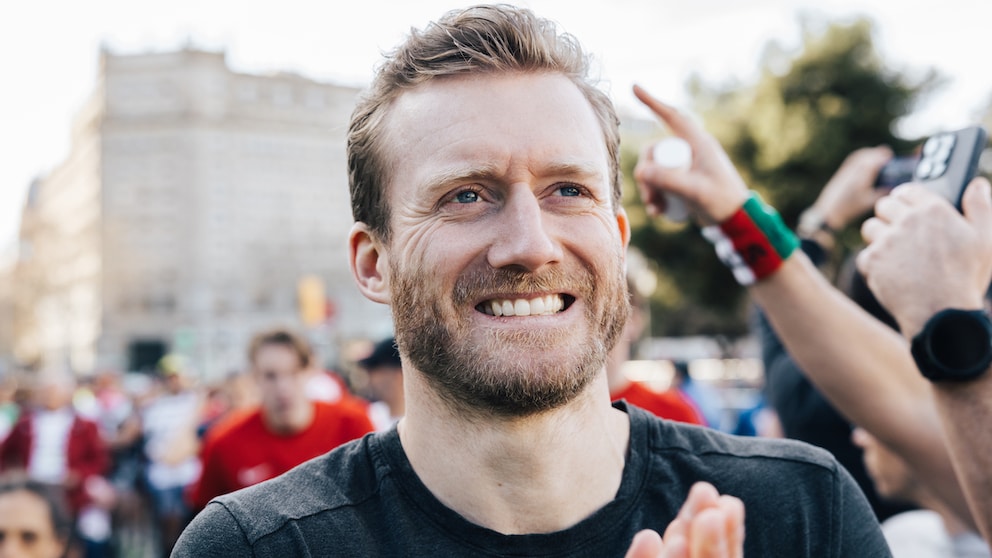
Soccer fans likely remember him as part of the winning goal in the 2014 World Cup match. In 2020, he surprisingly ended his soccer career at just 29. What is André Schürrle doing now? Running–specifically half-marathons and marathons. On April 7, he also ran in Berlin. FITBOOK editor-in-chief Melanie Hoffmann interviewed the former soccer player and his coach Erik Jäger beforehand. She learned not only about Schürrle’s target time for the Berlin Half Marathon but also intriguing details about his preparations, challenges, and the importance of failure.
André Schürrle left soccer behind years ago and has now taken up running. On April 7, 2014, he joined the enthusiastic participants of the Berlin Half Marathon in the surprisingly warm temperatures of the German capital. Not only did he complete the race, but he also achieved a respectable time of 1 hour and 41 minutes. However, he unfortunately did not meet his desired time of 1 hour and 30 minutes, as set in the FITBOOK interview.
At the time of the interview, André Schürrle had just completed his first marathon of the year–ten days earlier in Barcelona. Four days after the conversation with FITBOOK, he was set to run his second marathon, this time in Tuscany, before heading to Berlin on April 7. In preparation, he was supported by the fitness company Peloton, which was a sponsor at the half marathon. André Schürrle prepared for the Berlin run with coach Erik Jäger. Together, they revealed what was important in training, why Schürrle’s existing fitness and experience from his soccer days only helped to a limited extent, and why the 33-year-old deliberately aims to fail sometimes.
Follow the FITBOOK channel on WhatsApp now!
»Soccer and Running–These Are Two Worlds
FITBOOK: How did your collaboration for the marathon adventure come about?
André Schürrle: “We met a few years ago. In 2019, I returned to Germany from London but wasn’t allowed to participate in the preparations in Dortmund. At that time, I moved to Berlin with my family and was looking for a trainer to continue training over the summer because I still wanted to play soccer. I was recommended the ‘Capital Trainer’ Erik Jäger from many circles, and that’s how we met. But before we met in person, there was a funny story between us: Erik thought I had stolen his Blackroll at the gym (laughs). In the summer of 2019, he helped me with all my preparations before I went to Moscow. And since then, we’ve stayed in touch.”
Also interesting: Former World Soccer Player Kaká runs his first marathon in impressive time
Is the transition from soccer to running natural, or is it a big adjustment?
André Schürrle: “The two sports worlds are really far apart. There are certainly some soccer players who love to run. These are often those who play in positions where endurance runs are more in demand than sprints. That means they are indeed runners. But for me, it was about sprinting a lot. It was about short distances. Running now is a completely different game. It engages entirely different muscle groups, especially for half-marathons or marathons. Running 10, 20, or even 30 kilometers is something a soccer player usually has nothing to do with. That’s why it’s something completely new, and that’s also the reason why I’m doing it. I see the challenge in being an amateur in something again and working on it.”
Erik, how do you assess this as André’s coach?
Erik Jäger: “A soccer player naturally has a basic endurance, but the reserves that need to be there and built up to run a half-marathon and even a full marathon like André are not there. You have to train more specifically for that.”
»I Suffered a Lot in Training
How does marathon training differ from sprint training in soccer?
Erik Jäger: “We actually didn’t have such a long preparation time. It’s about–especially for André–having fun with the exertion, learning new things, and building the right mindset to run over such a long period. In the training plan, where you run three times a week, it’s about doing something for basic endurance for a (half-)marathon, but also running longer distances and sprints. Even though André has trained a lot of these before. Incorporating interval training and tempo runs helped both me and André; we are quite similar in running.”
André Schürrle: “You also suffer in training. Especially with long runs or interval runs, it’s definitely about reaching your limits. Even on the treadmill, where it really got intense, I suffered a lot. It’s varied but also very different from where I come from athletically. The training is really tough, but that’s why I’m doing it.”
These Are the Advantages an Ex-Soccer Player Has Over Amateur Runners
As a professional athlete from soccer, do you have an advantage over a hobby athlete in marathon preparation?
André Schürrle: “That’s true. I had to train a lot in soccer, also alone, and yes, suffer. I naturally bring that into running now. I can transfer that and more easily maintain the consistency in training that’s necessary. But I also admire the amateur athletes or those who are still quite new to running and then cover the kilometers in such a run. The runner’s community is really something great. They all want to give it their all, and that’s fun.”
»I Reach My Limits After 15 Kilometers
How was it in preparation, André–were there surprises for you? Did you think, for example, that you could easily handle certain things in running because of your soccer career, and then it wasn’t the case?
André Schürrle: “To be honest, I reach my limits in almost every long session, in everything longer than 15 kilometers. That shows me that I really have to stay consistent with the training.”
How did you perceive that, Erik? Was there something André could do surprisingly well or poorly?
Erik Jäger: “I think it’s great that André is really taking off and giving it his all, even though he no longer has the ball at his feet. Maybe he still has it mentally, and that helps him. I would also say that he definitely runs faster than before and is faster over a consistent period. He just has an incredible mindset and the will to go beyond his pain threshold over a longer period to achieve his goal. Those were definitely things that surprised me again and again.”
Schürrle on the Barcelona Marathon: “The Anticipation Was Huge, in the Middle It Was Absolutely Brutal, and at the End It Was Great Again”
We also checked out your Instagram, André, and saw your impressions of the marathon in Barcelona. It seems like you experienced a range of emotions from anticipation, through suffering and wanting to give up, to euphoria. Can you describe the experience again?
André Schürrle: “The experience showed me why it’s right to run a lot now. Because from kilometer 30 or 32, the moments come that are really intense. You’re just with yourself the whole time and fighting only against yourself and your mind, which naturally says: Why are you doing this at all? This question kept swirling in my head from kilometer 30. It constantly told me: You don’t have to do this. Stop. So mentally, I often reached the point: Joy and suffering alternate in intervals. First, great anticipation at the start, in the middle it gets brutal, and at the end, it’s great again.”
How do you train not only endurance but also the mental strength needed to persevere?
Erik Jäger: “André recently ran nine-minute intervals at home on the treadmill, 20 percent faster than the pace needed for the half-marathon. That’s basically continuous sprinting. I joined in and was at about nine miles, which is nearly 15.5 km/h over nine minutes. Half a year ago, I wouldn’t have thought I could ever endure that. Those are great moments when you realize you can endure it. It’s not about whether your body can do it, because it definitely can! What makes enduring so difficult and makes you want to stop is the mind. These moments, as André described, are the ones that help you endure when it really matters, like during a marathon when it really hurts. It’s extremely helpful to train with a community that helps you overcome this mental hurdle.”
Half-Marathon After Marathon a Piece of Cake?
Will the half-marathon in Berlin be easy after the marathon in Barcelona?
André Schürrle: “Not at all, because my mindset is that I will naturally run the half-marathon faster than the marathon. That’s why I’ll be just as exhausted at the end as after the whole marathon. The difference is: this time it’s shorter, but faster. Whether it’s a marathon or a half-marathon, I want to give it my all. I want to get everything out of what I’ve trained for. So I’m glad it’s not 42 kilometers this time, but 21 kilometers. But due to the faster pace, it will certainly be just as strenuous.”
Speaking of speed. What time are you aiming for in the half-marathon? Do you have a specific time in mind as a motivating goal?
André Schürrle: “Based on my training and for motivation, I’ve set a time of 1 hour, 30 minutes. That would be very, very fast, but I’ll aim for 1:30 hours and then see what comes out in the end.”
Erik Jäger: “At 1:30 hours, I can already say that I probably won’t be able to stay by André’s side the whole time. My ideal would be 1 hour 35. We’ll definitely see each other at the finish line (laughs).”
Also interesting: Running expert on Tigist Assefa: “With her, it looks like she can go even faster”
How André Schürrle Eats Before and Between Long-Distance Runs
As with all sports, nutrition plays an important role in running. What did you focus on in preparation, and during the marathon itself? Do you have tips for people who are starting long-distance running and are still unsure about nutrition?
André Schürrle: “To be honest, I’m still looking for what exactly is best. I’ve tried a few things to see how I feel. Since the races always start so early, you really have to watch what you consume. Three hours before the marathon start–which was already early in the morning–I ate some carbs in the form of bread, some avocado, and one or two dates for a bit of sweetness. Then I mostly just drank–water and electrolyte drinks. Between races, I consume quick carbs, fast sugar that supplies the body. I don’t know if more is possible. Maybe I’ll get up even earlier to have a proper meal beforehand. But I’m really still an amateur in that regard.”
Carbohydrates are important, then. Do you have any more nutrition tips, Erik?
Erik Jäger: “As a trainer, I would say you don’t necessarily have to do these classic ‘pasta parties,’ but it’s about filling the reserves over a relatively long period. This is done with long-chain carbohydrates. Fats are also important because they are stored by the body. So, if you stay within a certain performance range, the body can provide the necessary energy. There are very different opinions on how this works best. Everyone should try it out, like André, during races but also during longer training runs of 15 to 20 kilometers. See how you feel depending on what and when you eat. These gel packs are also a good idea when running. They give you energy that is available relatively quickly. It would be different with a banana in between, which provides noticeable energy perhaps only 45 to 60 minutes later.”
Why André Schürrle Eats Meat Again After a Vegetarian and Vegan Phase
André, you’ve already made a dietary change from very meat-heavy to plant-based. How do you eat now?
André Schürrle: “I used to eat a lot of meat, then I was vegetarian and even vegan. Now I’ve gone back a bit and eat a lot of grass-fed meat, and in the evenings, I have carbohydrates.”
Have you noticed different effects on your athletic performance?
André Schürrle: “When I switched to vegetarian and vegan, I initially had a lot of energy. I think there’s a lot of mental stuff behind it. It was something new that I enjoyed, and I think that’s where a big part of the energy came from. Over a long period, though, I felt like something was missing, and I was constantly forbidding myself something. This mental conflict didn’t do me any good in general, but especially not athletically. That’s why I’ve gone back to eating meat–quality meat.”
Two marathons in quick succession, now the half-marathon in Berlin–how long is the training break after a run? What does the current training look like? What is the focus?
André Schürrle: “After a marathon, I need three or four days to be ready to train again. That means I’ve been training diligently since the last run and will do one or two more running sessions before the half-marathon. I’ll also incorporate some faster sessions, like 1000-meter runs, to achieve my time goal.”
Also interesting: The best age to run your fastest marathon
»I Might Want to Fail Sometimes
Apparently, one half-marathon or marathon wasn’t enough. Why did it have to be three races right away?
André Schürrle: “2024 is a year of challenges for me. It doesn’t stop at the three races; I’ve planned quite a few of these races. I just want to see how far I can go, what I can achieve, where I can improve. But honestly, I also signed up for so many races to maybe fail sometimes. It’s about doing things so hard that I might completely reach my limit.”
Erik Jäger: “Failing sometimes is an important part of the process. Maybe even experiencing moments of failure in training, like pushing so hard and going beyond the limit that you realize it’s just too much–and ultimately learning from it. Because everyone has a different performance limit and has to find out what works and what doesn’t, which food might be good before the run and which isn’t. How fast you start the run or not. You gain this experience through ‘failing.’”
So it’s about challenging yourself not only physically but also mentally?
André Schürrle: “I think it goes hand in hand. Physical exertion is 100 percent also a mental challenge. Facing it contributes significantly to mental health. Only those who risk failing can develop further. Always being good and successful at something doesn’t bring you anything. That’s what excites me about running, being an amateur in a sport again and constantly reaching my limits and thus continuously developing–physically and mentally. That’s why I take on the effort.”
André Schürrle on Regeneration: “I Love Cold and Heat”
Regeneration is also important in sports. What does it look like for you? Do you have tips for our readers?
André Schürrle: “First, good nutrition is everything, so consuming the right things after sports and drinking a lot. I also love cold and heat. I do cold baths and saunas, alternating nicely. I enjoy that. But also a lot of stretching, because the strain from running is new to me. That’s why stretching is important to keep the hips free and flexible. So in summary: a lot of stretching, cold and heat treatments, and good nutrition.”
What role does sleep play in relation to regeneration after training?Erik Jäger: “You should make sure that sleep quality is as high as possible. I personally sometimes do meditations or a targeted breathing exercise before going to sleep. Both exercises to end the day relaxed and those for the morning and a relaxed start to the day are helpful here.”

André Schürrle on His Latest Extreme Run: “That Was the Longest I’ve Managed So Far”

Former Bundesliga pro Diego Ribas ran the Berlin Marathon in this time.
“I Want to Run an Ultra-Marathon”
Are there any other sports or physical challenges outside of running that you would like to tackle?
André Schürrle: “I would like to run 100 kilometers, an ultra-marathon. Then there are a few high and difficult mountains I want to climb this year. Those are the next challenges I want to take on. But above all, running 100 kilometers would be something.”
Then preferably through the desert?
André Schürrle: “Yes, exactly. 100 percent! There are so many cool things–whether it’s races over mountains or in the desert. There’s certainly a lot more to try out.”
»Running Helps Me Find Myself
But the focus remains on running for now, it seems to have captivated you…
André Schürrle: “Yes, right. That’s because I’ve realized that running is the fastest way to get to the point where you’re only dealing with yourself. When it gets mentally tough, and you have to deal with things on your own. That helps me a lot in my current phase of life. It helps me find myself.”
Also interesting: The best treadmills for the home gym
Bike and Treadmill Alternatives to Peloton
Besides Peloton, there are numerous other providers of indoor bikes and treadmills for the home gym on the fitness market. Which device is best suited for a person depends not only on the budget but also on the desired features of the bike or treadmill. Some alternative brands to Peloton include:
– Technogym
– Sportstech
– Bowflex
– Kettler
– Hammer