


August 27, 2025, 2:39 am | Read time: 4 minutes
Training equipment, like that found in gyms, is ideal for muscle training. With it, you can easily adjust the intensity of the workout using the moving weight and gradually increase it. But there’s another way: in a home gym and without equipment. Trainer and FITBOOK expert Alina Bock explains how to effectively build muscle at home.
Bodyweight Exercises
Those who opt for home or outdoor workouts must inevitably train with their own body weight. Exercises that can be used include squats, lunges, push-ups, planks, and sit-ups. The longer you train, the more important it is to increase the intensity of the exercises to continue stimulating muscle growth. Especially without training equipment, this requires thoughtful strategies.

I Train So Much, So Why Am I Not Seeing Any Results?
Squat Challenge! Double Your Training Weight in One Month
Strategies for Progressive Intensity Increase
To advance muscle growth, it’s important to progressively increase the training with your own body weight. There are several ways to do this:
Increase Repetitions
The first and simplest way to increase training intensity is to increase the number of repetitions. The number of repetitions should be chosen so that the last two repetitions can just barely be performed. If you find that more repetitions are possible, the intensity is set too low. Ideally, you increase the number of repetitions from session to session or at least progressively from week to week. Tip: A notebook or app can help track and monitor the number of repetitions for each exercise. Besides the number of repetitions, you can also increase the number of sets, for example, from three to four sets.
Shorten Breaks
Another way to increase the difficulty level is to shorten the breaks. This gives the muscles less time to recover between sets, quickly reaching the limit and stimulating the muscles. An example would be reducing the break time from 60 to 45 seconds.
Supersets
An effective method to increase training intensity and push muscles to their limit is working with supersets. A superset consists of two or more exercises performed directly in succession without a break. Combining exercises of the same muscle group can create a particularly effective and intense workout. An example is the combination of squats and kneeling lean backs, or the combination of sit-ups and planks.
After performing both exercises, take a training break of 45 to 60 seconds. Then the next superset is up.
Here are some examples of supersets and the muscles they train:
- Chest/Shoulder: Push-ups and Shoulder Taps
- Leg and Glute Muscles: Squats and Lunges
- Back Muscles: Lying Lat Pull and Bent Over Butterfly Reverse
- Abdominal Core Muscles: Mountain Climbers and Planks
- Abdominal Core Muscles: Sit-ups and Heel Taps
Variations
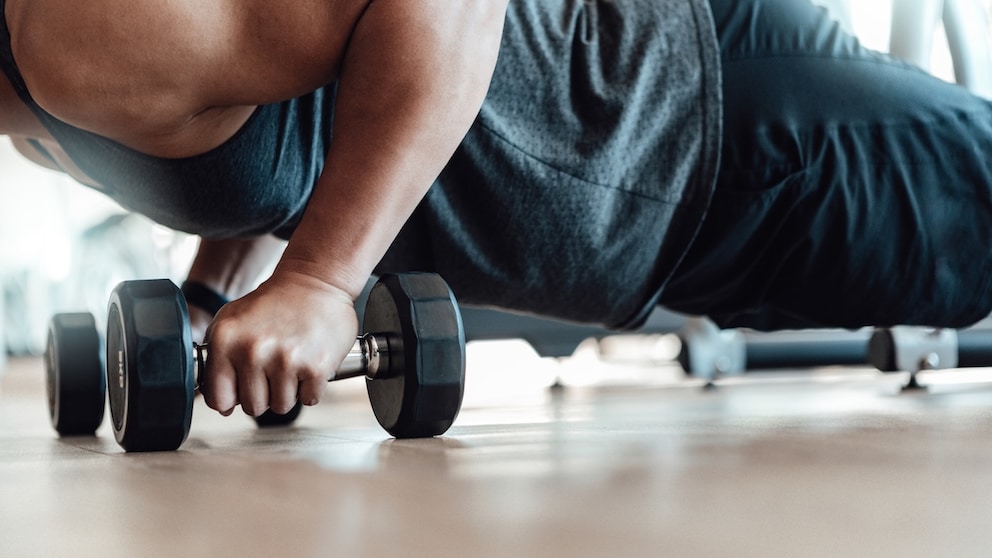
If increasing repetitions, shortening breaks, and supersets are no longer enough to challenge the muscles, you can resort to intense variations of each exercise. This can be a single-leg squat instead of a conventional squat or a one-arm push-up. Each exercise can be increased in difficulty through various variations.
Aids
Additionally, you can integrate training aids into the sessions that create weight or resistance and thus increase intensity. These aids can include:
- Resistance Band
- Pilates Ball
- Exercise Ball
- Small Dumbbells
Also interesting: The Benefits of Training With Resistance Bands
Adjust Nutrition
Besides smart training strategies, nutrition is an important factor that must be adjusted accordingly if you want to build muscles—whether at home or in the gym.
Increase Protein and Carbohydrate Intake
It’s best to increase protein intake to at least two grams per kilogram of body weight. Additionally, with one gram of fat per kilogram of body weight, it’s smart to fill the rest of the calories with carbohydrates. It is also recommended to adjust the total calorie intake so that more calories are consumed than burned to build muscle through a calorie surplus.
Proper Timing of Nutrient Intake
Also important is the timing of carbohydrate and protein intake. Protein intake should be evenly distributed throughout the day. A good example would be three to four meals with 30 to 40 grams of protein each. Especially after training, a protein intake of 30 to 40 grams should occur to provide the muscles with building blocks for growth. Additionally, carbohydrates should be consumed before and after training to provide as much energy as possible and ensure effective and intense training. Consuming carbohydrates after training ensures that energy reserves are replenished, speeding up recovery.