


September 9, 2026, 7:42 am | Read time: 4 minutes
In strength training, the pull-up is undeniably considered the ultimate exercise for a strong, broad back. However, beginners who start directly with free pull-ups often do themselves a disservice in terms of health and motivation. An untrained musculoskeletal system is often overwhelmed by handling one’s own body weight. This leads to poor technique and painful compensatory movements. The lat pulldown on a cable machine is a much more effective and gentle choice, especially at the beginning. Fitness trainer and FITBOOK expert Alina Bock explains why this is the case.
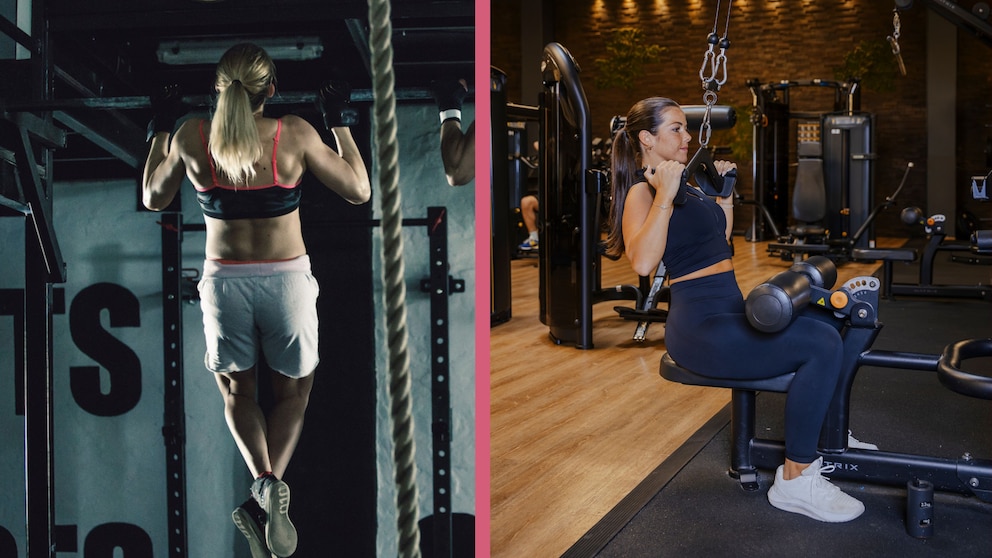
Both the pull-up and the lat pulldown are highly effective exercises for specifically strengthening the latissimus dorsi muscle. However, they differ fundamentally in biomechanics. The free pull-up requires enormous core stability and strength against one’s own body weight, while the lat pulldown allows for precise resistance control. Therefore, the cable machine is the smarter choice for beginners.
Pull-up vs. Lat Pulldown: The Biomechanical Demands
In terms of pure movement patterns, pull-ups and lat pulldowns seem almost identical. However, since the pull-up involves pulling one’s own body upward and the lat pulldown involves pulling the resistance downward, the physical demands differ significantly. Pull-ups require not only the strength to pull one’s own body weight upward but also a certain technique and core stability. If these factors are not yet present, the lack of strength and technique is often compensated for by cheating or using momentum. This can increase the risk of injury over time and promote incorrect learning of the exercise.
Why the Lat Pulldown Is Better for Beginners
Due to the similar movement pattern, both pull-ups and lat pulldowns primarily train the same muscles. Both exercises mainly work the latissimus dorsi, responsible for the typical V-shape of the back, the teres major, and the lower and middle trapezius muscles. Supporting muscles include the biceps, brachialis, brachioradialis, and the posterior deltoid.
The lat pulldown is performed while seated. Therefore, this strength exercise does not require significant stabilization of the core through the lower back and abdominal muscles. This allows for focused concentration on the target muscles in the back. Additionally, training on the cable machine offers the significant advantage of precisely controlling the weight and adjusting it to the individual’s performance level. Beginners can thus fully concentrate on proper execution without having to struggle against their often still too heavy body weight. This reduces the risk of injury and guarantees effective muscle building from the start.

6 Exercises for Optimal Muscle Building in Men Over 40

The 5 Most Important Strength Exercises for Men Over 50
The Ideal Transition from Lat Pulldown to Pull-up
For those who want to attempt pull-ups after some time, various effective entry-level options are available. One option is the pull-up on a dedicated machine. This machine allows for weight-based assistance: The higher the chosen assistance weight, the less of one’s own body needs to be pulled up. Trainees can choose the weight precisely so that they can easily pull themselves up. Learn how machine pull-ups work here.
Another alternative is the free pull-up using resistance bands. These reduce the weight that must be pulled up by providing the greatest support at the lowest point of the movement. As progress is made, the close-grip pull-up can be a slightly easier but still the first free and unassisted alternative to the wide-grip pull-up.
Conclusion
While pull-ups and lat pulldowns train the same muscles, they demand completely different abilities from the body. Since pull-ups require a high level of strength, technique, and core stability, the lat pulldown is the smarter choice for beginners due to its precise intensity control and secure seated position. Only when one’s own body weight is confidently managed on the cable machine is the musculoskeletal system ready for free pull-ups.