



June 21, 2025, 3:30 pm | Read time: 8 minutes
Sports have always been a part of Stephanie Brungs’ life–in her youth, she even competed at a high-performance level. Why she struggled with her fitness in her twenties, how she rediscovered the joy of training, and what her current routine looks like, the “Love is Blind Germany” host shared in a conversation with FITBOOK editor-in-chief Melanie Hoffmann. Also: the blow of a “cervical cancer diagnosis.” Steffi Brungs told us about the initial shock, the treatment during the pandemic, and a changed body perception.
Recently, the host publicly revealed that she was diagnosed with cervical cancer five years ago. Therefore, at the beginning of our sports-focused interview, we wanted to know how she experienced the illness, how she is doing now, and how the diagnosis may have affected her fitness. But even apart from her cancer diagnosis, Steffi Brungs has experienced various phases in her life regarding her training. In a conversation with FITBOOK, the 36-year-old revealed the reasons why her sports routine wasn’t always ideal, who or what helped her rediscover the joy of exercise, what her training routine looks like today, and yes: she also talked to us about body shaming.
Follow the FITBOOK channel on WhatsApp now!
Cancer Treatments Changed Body Perception
FITBOOK: You were diagnosed with cervical cancer shortly after your wedding in Hawaii in October 2019. How difficult was the time afterward?
Steffi Brungs: “When I received the cervical cancer diagnosis, it was initially incomprehensible to me. I felt so healthy and had no symptoms. We had just gotten married and made future plans… it took some time for me to truly understand what was happening. And then it was the biggest shock of my life so far. But I am so glad and grateful that the cancer was detected in time and I could be treated accordingly. It shows how important it is to go for regular check-ups.”
Are you now cancer-free and feeling completely well, or are there still noticeable effects of the illness and surgery?
“Just last week, I was at the gynecologist, and we noted that my treatment was five years ago. Thankfully, the cancer hasn’t returned. As of now, I am healthy, and I hope it stays that way.”
How did the cancer diagnosis and subsequent treatment affect your body perception, fitness, and training?
“Initially, it was a huge psychological burden. My treatment took place during the pandemic. I was afraid of contracting COVID-19 with my weakened immune system. Surgery appointments were postponed, and no hospital visits were allowed. It was really tough. My body perception changed with the surgeries. I felt so powerless. Exercising was out of the question. But eventually, something clicked. I thought: ‘Steffi, you made it through, now reclaim your autonomy and joy in life.’ And sports helped a lot with that.”
Also interesting: 4 symptoms can help diagnose ovarian cancer early
Steffi Brungs Was Once a Competitive Athlete
Let’s take a step back–to your athletic youth. You used to compete in sports. Can you tell us what that was like back then?
“I swam as a child, and from about eleven or twelve years old, it became really intense. At some point, the question arose: Do you want to do this at a competitive level? Yes, I did back then. From then on, it was a lot of training, six to nine times a week. Three early morning sessions before school, five regular ones, and on Saturdays too, if there was no competition. I kept it up until I was about 17, just before graduation. Then I decided: I’m quitting. I just wasn’t having fun anymore. You realize how much you’ve missed–when friends go out or have their first boyfriend. I was always busy with swimming.”
Also interesting: Effective training after 40–what women should pay attention to
“I Didn’t Want to Do Any Sports at All at First”
Was that a hard cut?
“Yes, totally. I didn’t want to do any sports at all at first. Especially no swimming. Splashing around on vacation, sure, but no more laps. I then did things without any structure, but real sports–no. And honestly: I didn’t taper off. That was a mistake. I rapidly lost muscle, gained weight, and my posture worsened. I really messed up a lot.”
What does “tapering off” mean exactly?
“After ‘retiring,’ athletes should taper off for one to two years to stabilize their fitness long-term and minimize health risks. In practice, this means gradually reducing training. Not going from 100 to 0. So, if you trained every day before, you reduce it slowly. First to four times a week, then three, and so on. The body needs to adjust. I didn’t do that.”
At Almost 30, She Noticed: Building Muscle Became Harder
When did you realize that was a mistake?
“Way too late, around my late 20s, almost 30. That’s when I noticed how hard it was to reactivate certain muscles. Especially in the arms, abdomen, shoulders–the typical swimmer’s muscles. That’s exactly where building up was super hard, even though I saw quicker results in other areas of my body.”
How did you get back into a sports routine?
“At first, it was aimless. I was at the gym, but without structure. Just doing anything. Around 30, I wanted to have a real routine again. Because I realized: In all areas of life, I’m organized–job, relationship–but my body was in chaos. I wanted to change that, but without the old pressure to perform. I realized: I can’t do it alone. So I sought help.”
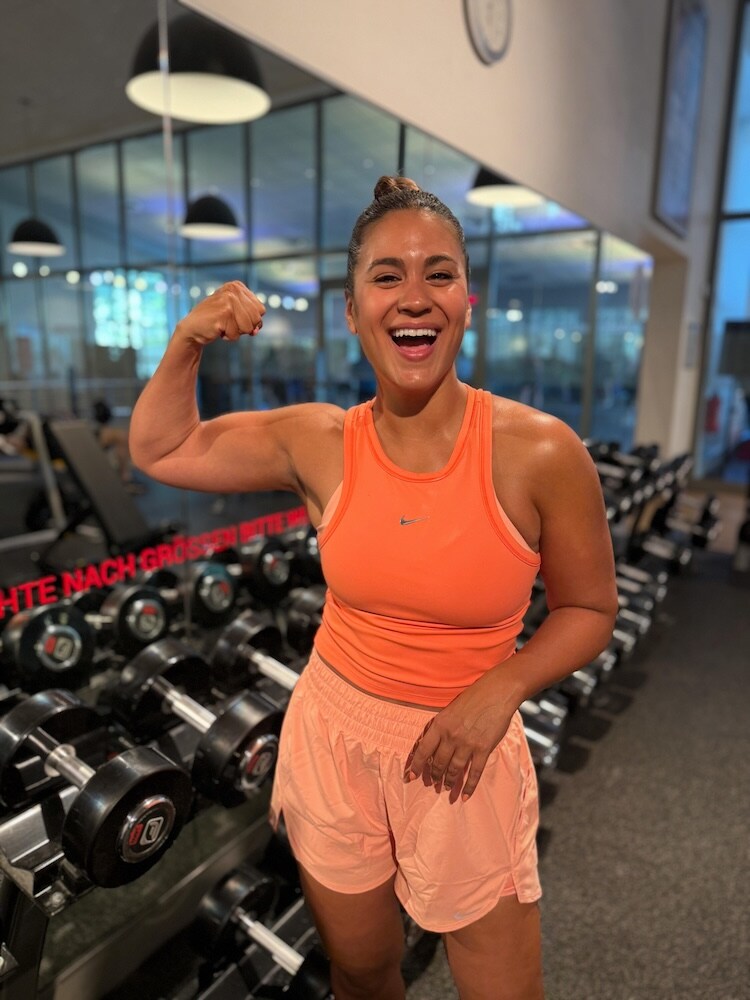
Steffi Brungs’ Path Back to Training–Starting Point: Tennis
What did this help look like?
“I first found a tennis coach. I had played tennis as a child too, and I enjoyed it. I didn’t want to go back into the water. With tennis, I was outside, moving, but without performance pressure. My coach was great: He knew I didn’t want to compare myself to anyone, didn’t want to be pushed too hard, and he respected that. Slowly, the desire came back.”
And how did strength training come back into play?
“When I realized tennis was working well, I dared to go back to the gym. But this time with a trainer. I consciously chose a woman because I thought: She might better understand what my body has been through, what my daily life is like, what hormones, sleep, shift work, etc., mean. I found Loredana del Vento, Lory, on Instagram. I’ve been training with her for three years now.”
“I Work Out Three Times a Week”
What does your workout routine look like today?
“I work out three times a week. Once with Lory, twice on my own. But everything follows the plan we developed together. And if it only works out once, that’s okay too. The important thing is: I have a set schedule, a routine, but no pressure. No forcing myself.”
You mentioned an 8-week challenge in the preliminary talk. What’s behind it?
“During my cervical cancer illness, I gained eight to nine kilos. After my surgeries, I just didn’t have the strength for sports. Now that I’m healthy, I want to regain that strength. Last year, I did an 8-week challenge with Lory and lost seven kilos. Healthily and without a crash diet. This year, it’s about building more muscle. The main rules: moderate exercise, a slight calorie deficit, and above all, enough protein.”

“In just eight weeks, I lost 4.9 percent body fat and gained 3 kilograms of muscle.”

Tennis Star Serena Williams Reportedly Lost Weight With the Help of a Weight-loss Injection
“Presswurst!” Steffi Brungs Experienced Body Shaming
It sounds like you have a good relationship with sports and your body today. But as a host, you’re also familiar with the terrible topic of body shaming. What have you experienced?
“At first, there were comments like: ‘Why is she wearing a crop top?’ or ‘Her legs are too thick for skirts.’ I initially ignored it. I thought TV adds ten kilos to your body. But after my cervical cancer treatment, it got worse. Insults like ‘presswurst’ or ‘chubby fairy’ became more frequent. And I just thought: Hey, I’m a size 38/40, that’s completely normal! The paradox: Now that I’m more toned and have lost a few kilos, the body shaming continues: ‘Is she now also obsessed with dieting?’ or ‘How she just photoshops herself slim.’ The sad thing: The worst comments come from women. And that really makes me angry.”
“I’ve Been Through So Many Crash Diets”
What do you take away from all this for yourself?
“I’m following my path. I know how I feel, I know how my body reacts. I’ve been through so many crash diets, so many short-term actions for shows or shoots–I don’t do that anymore. I need structure, but I also want to have fun. And I want to be a role model for others who may have experienced something similar. If I can share anything, it’s this: Get help, take the pressure off, be kind to yourself. Then the rest will follow.”