


March 1, 2026, 4:26 pm | Read time: 7 minutes
Push-ups are one of the most effective exercises for the upper body and are rightly included in almost every training plan. They are versatile, easy to perform without equipment, and can be adapted to any fitness level. However, despite their effectiveness and popularity, the classic push-up can become monotonous in the long run. To bring some variety back into your daily training routine, trainer and FITBOOK expert Alina Bock explains how you can vary the classic push-up to take your training to the next level.
If you can do 20 to 30 push-ups in a row without any problems, you’re definitely ready to try some challenging variations. Below, we present seven variations that take the push-up to the next level.
Overview
Muscle Groups Trained
Push-ups effectively train the chest muscles (pectoralis major muscle), the front shoulder muscles (deltoideus pars clavicularis muscle), and the triceps (triceps brachii muscle).
Not to be underestimated is the stabilization provided by the core muscles, which additionally activate and train the abdominal and lower back muscles. Depending on the variation, the focus can be placed on one or more of the muscles mentioned above.
Variation 1: Negative Push-Ups
For the first variation, you need an elevation, for example, in the form of a step. If you are doing the exercise at home, a chair, table, or similar is also suitable.
With the legs elevated, this push-up variation targets the lower fibers of the chest muscles.
- In the starting position, you first get into the classic push-up position. The hands are shoulder-width apart and point slightly inwards. Now place your feet on the elevation. The body now points diagonally downwards. The arms are already slightly bent in the starting position.
- The abdomen is tensed. The upper body is then lowered towards the floor as you inhale. Just before reaching the floor, push yourself up again as you exhale.
Variation 2: Positive Push-Ups
This variation of the push-up again requires a small elevation, ideally in the form of a step. The difference from the previous variation is that the elevation here is for the upper body and not the feet. The raised upper body primarily works the upper fibers of the chest muscle and the shoulder muscles.
- In the starting position, the hands are placed shoulder-width apart on the step. Your hands are level with your chest. Now move into the classic push-up position, in which the tips of the toes are raised and the body forms a straight line. The torso should already be tense in the starting position.
- As you inhale, lower your body until it is just in front of the step. Then, together with the exhalation, the upper body is pushed up again.
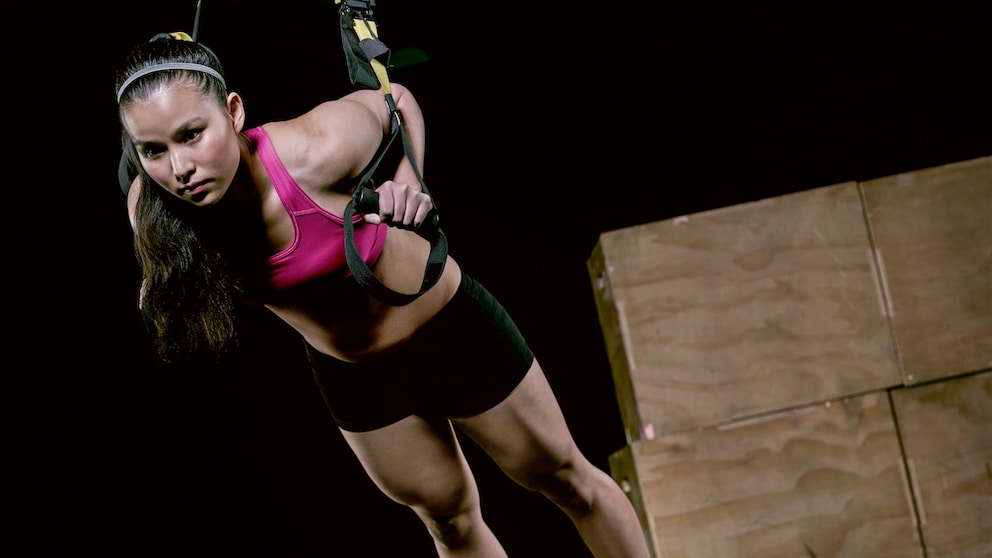
Variation 3: Push-Up on the Sling Trainer
This variation is particularly suitable for beginners, as the intensity of the exercise can be chosen individually. As the upper body is also elevated in this variation, the focus is placed in particular on the upper fibers of the chest muscles. The advantage of the sling trainer is the instability it creates, which forces the body to stabilize itself throughout the repetitions. This strain specifically promotes the activation of the deep muscles.
- Grip the handles of the sling trainer with your hands. Initially, the arms are slightly bent and the hands are at chest level. The elbows point slightly downwards.
- To get into the starting position, you must first build up abdominal tension. Tilt your pelvis and pull your belly button inwards. Now push your feet back until your body forms a line. The more horizontal the body, the greater the intensity.
- As you inhale, bend your arms and lower your body.
- Exhale and return to the starting position.
Variation 4: Push-Ups on a Wobbly Surface
This variation also uses instability to activate the deep muscles of the core. The chest muscles, shoulder muscles, and triceps are worked. You will need a wobbly surface, such as a balance disc or Bosu ball.
- To get into the starting position, the hands grip the outside of the balance gyro or Bosu ball. The tips of the toes are raised. The body forms a line. Build up abdominal tension in the starting position so that you can maintain your balance during the repetition. A hollow back should be avoided at all costs.
- From here, bend your arms and lower your upper body towards the gyroscope or Bosu ball.
- As you exhale, push yourself back up to the starting position. To maintain the basic tension, the arms remain slightly bent at the top. The challenge is to maintain the balance disc or Bosu ball in a horizontal position throughout the exercise, in addition to the strength required for the push-up.
Variation 5: Diamond Push-Ups
Diamond push-ups, a variation of the classic push-up, require placing the hands close together. The name “diamond push-ups” is derived from the shape of the hands, which is reminiscent of a diamond. This close hand position places particular strain on the triceps, as the load is focused on the arms and inner chest muscles.
- Start in the normal push-up position with your hands close together. Now position your hands below your chest so that the thumbs and index fingers of both hands are touching. The hands should form the shape of a diamond. The body forms a straight line.
- As you inhale, bend your elbows and lower your body towards the floor. Make sure that the elbows are kept close to the body.
- As you exhale, straighten your arms again and return your body to the starting position.
Sphinx Push-up: The Bodyweight Exercise for Stronger Triceps

Five Exercises That Perfectly Prepare You for Squats, Deadlifts, and Push-Ups
Variation 6: Spiderman Push-Ups
This challenging variation of the classic push-up not only works the chest, shoulder, and triceps muscles but also promotes mobility, coordination, and stability in the hips, torso, and shoulders. Spiderman push-ups combine the strengthening of the muscles involved with a lateral leg movement reminiscent of the movements of a spider, which explains the name of the push-up variation.
- Begin in the standard push-up starting position. The hands are shoulder-width apart at chest level. The abdomen is tensed.
- As you inhale, bend your arms and lower your upper body. At the same time, the knee of the right leg is pulled towards the right shoulder.
- Then, as you exhale, push your upper body upwards again. At the same time, the right leg is brought back to the starting position.
- With the next repetition, the leg is changed – i.e., the left leg is pulled towards the left shoulder while the upper body is lowered.
Variation 7: One-Sided Push-Up with Ball
If you can perform the classic push-up and some of its variations with ease, you can now try the one-sided push-up with the medicine ball. In this variation, one side works predominantly, while the other only provides light support. This variation is suitable for advanced users who are looking for a new push-up challenge. The higher the elevation or the ball, the more intense the push-up. In addition to strengthening the muscles, it also promotes coordination, core stability, and flexibility.
- Start in a modified classic push-up position with your hands placed two hand widths wider than shoulder-width apart. Now place one hand on the medicine ball. The whole body should be tense.
- From the starting position, go down into the push-up position.
- Then push yourself up again as you exhale. The arm whose hand is placed on the ball only provides slight support here. The other arm is used primarily.
- After a few repetitions, the other hand is placed on the ball, and the push-up is performed.