



October 26, 2026, 2:00 pm | Read time: 5 minutes
Thirty marathons in 30 days are almost expected from extreme athlete Jonas Deichmann, 39. The unique aspect of his latest challenge is something else: With his extreme endurance, the athlete has once again inspired thousands to start running themselves. In FITBOOK, Deichmann reveals how he prepared his body for the strain, why he recovers better today than before, and what hobby runners can learn from him.
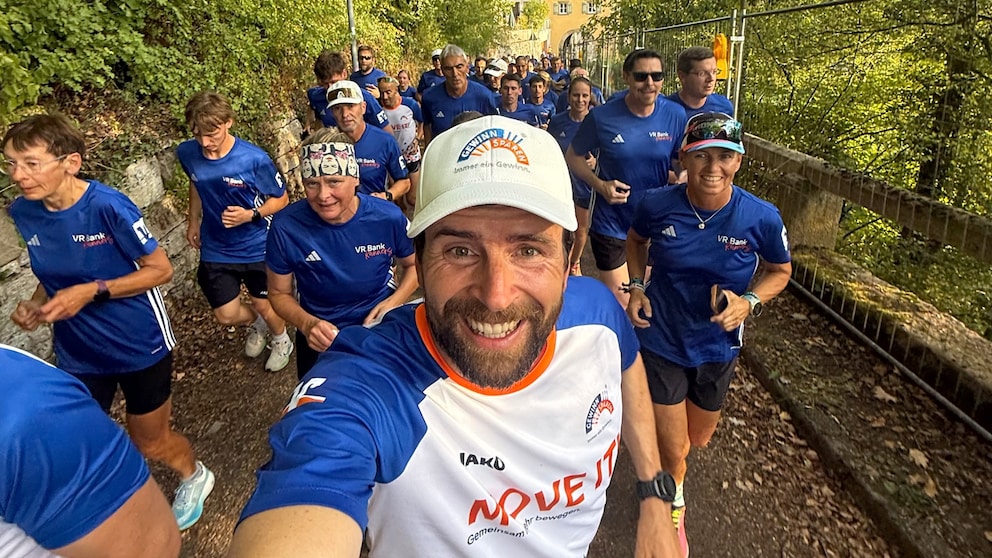
The images are reminiscent of the film “Forrest Gump” with Tom Hanks. A man runs across the country. First alone, then more and more people join him. They run a stretch with him, then say goodbye–while he just keeps running. What became legendary in the film, extreme athlete Jonas Deichmann recently made a reality in his own way in Baden-Württemberg. From Sept. 24 to Oct. 23, the 39-year-old ran 30 marathons in 30 days across his homeland for his “MOVE IT!” challenge. About 1,400 kilometers without a single rest day.
How Jonas Deichmann Got an Entire State Running
According to the organizers, a total of 19,080 people signed up for “MOVE IT!” to run a portion of the route with Deichmann. Déjà vu! His “Challenge 120” had already developed into a massive group event over months in 2024, earning him the nickname “the German Forrest Gump.” Now, 30 marathons and “many people moved with fun and joy.” Deichmann sees this as the real success of the project.
About 682,000 kilometers were reportedly run together. That’s roughly 17 times around the Earth! Prominent athletes also supported the initiative, including former national soccer players Timo Hildebrand and Cacau, as well as Paralympic champion Niko Kappel. The initiative aimed to raise over 800,000 euros in donations for regional clubs, nonprofit organizations, and volunteer efforts. Supporting volunteer work was Jonas Deichmann’s heartfelt concern for this action, having spent his childhood in sports clubs.
Also interesting: Extreme athlete Jonas Deichmann: “I couldn’t get up the stairs alone”
How Deichmann Prepared His Body for the 30 Marathons
Although Deichmann has conquered entirely different dimensions of endurance sports (such as 120 long-distance triathlons on 120 consecutive days in 2024, triathlon around the world 2020–2021, records in ultracycling 2017 to 2019), the 30 marathons were an enormous physical challenge for him. Just a month earlier, he had returned from a European tour on a gravel bike with his partner Josefine Rutkowski (FITBOOK reported). “The real challenge of this project was the short time between the European tour and the first marathon,” Deichmann explained before starting the 30 marathons. He had to recover from the cycling strain and prepare his body for daily running in just 26 days.
How did he solve this problem for himself? He reveals it in FITBOOK:
- daily running sessions between 10 and 25 kilometers
- supplemented by stability training
- and yoga.
“I had the endurance from cycling. So it was primarily about running-specific muscles,” says Deichmann. Even those who are excellently trained in terms of fitness must accustom their musculoskeletal system to the unique stresses of running. Unlike cycling, each step repeatedly exerts impact and braking forces on muscles, tendons, and joints.
By the way, Deichmann was already aware before the start that the 30 marathons wouldn’t be a walk in the park despite his experience. In a conversation with FITBOOK, he predicted that especially days “two to seven would be painful before it gets better.” And he did have tough moments.

Extreme Athlete Jonas Deichmann: “I Couldn’t Make It Up the Stairs Alone”

Extreme Athlete Jonas Deichmann: “4 Months Without a Rest Day–and in 3.5 Weeks, I’m Running a Marathon Again”
“I Had Tough Moments” – and Why His Body Endures More Today Than Before
“During my 120 Ironman distances in a row, the marathon was only the last discipline each time. That was definitely physically and mentally more challenging,” he explains. Still, 30 marathons in a row were also an enormous strain. “I had tough moments, especially since I couldn’t prepare perfectly.”
It’s remarkable that after years of extreme sports, Deichmann doesn’t feel his body is wearing out. The opposite seems to be true: “My body handles the strains much better than a few years ago.” He has learned a lot about recovery and now pays more attention to sleep, nutrition, and active recovery. This is how the extreme athlete explains it. He makes it clear that in long-term endurance training, it’s not just about training harder. It’s also crucial to give the body the opportunity to adapt to stresses.
Also interesting: The best marathon times of celebrities
His Tips for Those Dreaming of Their First Marathon
What can regular recreational athletes learn from a man who runs 30 marathons in a row? For Deichmann, the path to the first marathon begins with a shared goal: “I recommend finding a friend and then signing up together for a marathon in the coming months. That creates commitment.” Afterward, it’s important to “slowly but continuously” increase training. From his perspective, this increase should not only involve running but also stability training and yoga or stretching to prevent injuries.
A bit of realism doesn’t hurt either. Especially beginners need sufficient preparation time depending on their training level. A marathon after a few months isn’t sensible for everyone. As Deichmann’s latest challenge has shown, you don’t have to run a marathon yourself to be part of something big. Sometimes just a few shared kilometers are enough.