

July 6, 2022, 12:02 pm | Read time: 10 minutes
Vision is becoming increasingly strenuous, eyes burn and feel dry–tired eyes are not uncommon. Constant screen work, reading news on the phone, scrolling through social media, watching TV in the evening–screen time is getting longer. Due to technological changes, we spend more time in front of screens not only at work but also during leisure time, whether it’s a phone, tablet, laptop, or
This increasingly leads to eye strain, as our eyes are not designed for such prolonged periods in front of electronic devices. Additionally, critical factors like nutrient deficiencies, stress, or circulatory disorders can also cause tired eyes. In rare cases, diseases may be the cause–if symptoms persist for days, professional medical advice should always be sought. To actively and sustainably combat tired eyes, you can incorporate the following exercises into your daily routine.
Overview
Tired Eyes–Exercises for Daily Life
As with any training approach, the effect of training on your body is individual. Find out which exercise feels best for you and has the greatest effect. You can perform the exercises in sequence or choose one to incorporate into your daily routine. The easiest way to do this is by combining it with an existing routine. For example, always before or after washing your hands, whenever you open your laptop, or when you use a social media app.
Also interesting: Light-sensitive eyes–causes of photophobia
How Do Tired Eyes Manifest?
Tired eyes manifest differently from person to person. Some complain of heavy eyelids and feel like they can barely keep their eyes open, while others report burning or tearing eyes. This is often accompanied by redness and can even lead to pain. Increased light sensitivity and even headaches can also occur as symptoms.
Why Do We Get Tired Eyes?
From the first blink in the morning to turning off the lights at night–our eyes are active and under constant strain all day. The intensity of the strain varies depending on the daily situation. Screen work is one of the most strenuous activities for the eyes. This is partly because the eyes move within a limited range determined by the screen size and remain at a fixed distance from the screen.
In a natural environment, our eyes dart back and forth, switching between near and far vision, seeking orientation in the distance, and then jumping back to a nearby object. However, when we focus intently on a screen, our eye muscles remain tense in that position. It’s similar to holding your arms outstretched and keeping them in that position. Try it and notice how quickly the muscles in your arms and shoulder-neck area start to tire and burn. The same happens with the eyes. Our eyes are designed for movement, with different muscles working closely together.
Also interesting: Did you know that exercise can help with dry eyes?
https://oembed/fitbook/affiliate/d3260b6dcfbe832b0b8eb8c461b30cee78d1977ffd7b23529baa154d0618472e/900b495e-d27d-429e-892a-029abf95d223/embed
What Eye Muscles Are There?
The eye muscles attach to the outer and inner eyeball and are thus divided into internal and external muscles. The external eye muscles are responsible for changing the direction of gaze and are anatomically part of the human skeletal muscles. We can control these muscles voluntarily and consciously. This is done by four straight eye muscles (eye movement up, down, outward, and inward) and two oblique eye muscles (eye movement up-outward, down-outward, up-inward, and down-inward), which enable all rotational movements of the eyes in close coordination.
The internal eye muscles belong to the smooth muscles, which are involuntarily controlled. They cannot be consciously controlled. Smooth muscles are also found in the intestines, blood vessels, reproductive organs, or airways. In the eye, they function to adjust near and far vision by changing the curvature of the lens and the pupil size. They are particularly sensitive to light conditions.
Additionally, the facial muscles around the eyes can be counted among the eye muscles, responsible for closing the eyes through eyelid closure and moving the eyebrows.

Expert Reveals 4 Exercises That Effectively Combat Tired Legs

4 Exercises to Counteract Prolonged Sitting
What Factors Contribute to Eye Fatigue?
According to the anatomy of the eye, both the external and internal eye muscles can be overstrained. This is usually due to factors such as lighting, screen exposure duration, sleep quality, and vision. All these factors also offer a way to address the problem.
- Lighting: Ensure comfortable lighting both at work and at home. Ideally, adjust the lighting to your tasks and times of day. Also, try to reduce artificial light in the evening.
- Screen: Both the position of the screen and the lighting play a role here. The general advice that the screen height should allow a slight downward gaze is one approach. It becomes even more effective if you can adjust the screen height and create different situations, such as using a height-adjustable desk, placing the laptop on a box to work standing up, or placing the laptop on the windowsill when reading longer documents. In general, the more varied, the better. Also, adjust the contrast so you can read the screen well. It may be helpful to use the device’s color filter function for this. People generally respond more relaxed to a yellowish to amber hue than to the default setting.
- Exposure Duration: When a muscle is constantly tense, it automatically tires. Recognize this warning signal from your body and respond to it. Use your eye muscles for a new position–see exercises below.
- Sleep: During sleep, our body recovers and allows breakdown and rebuilding processes to occur. Only if the body gets enough sleep can these processes occur with sufficient intensity.
Also interesting: 7 foods that are good for eyesight
What Exercises Help Against Tired Eyes?
The following exercises help against tired eyes by training them and ensuring a dynamic balance of tension and relaxation. Only when a muscle can relax maximally can it also tense maximally. For this, it is necessary to use it in its full function. When was the last time you looked maximally to the right? Or to the left? Or all the way up or down? And without moving your head. Or to the top right and left or bottom right and left? The eyes can move much more than is probably used in everyday life. And as with any training, the better and more versatile a muscle is trained, the better its performance in everyday life.
In all exercises, make sure not to go into pain or discomfort. The exercises should only be performed within the range of motion and speed that feels comfortable and safe.
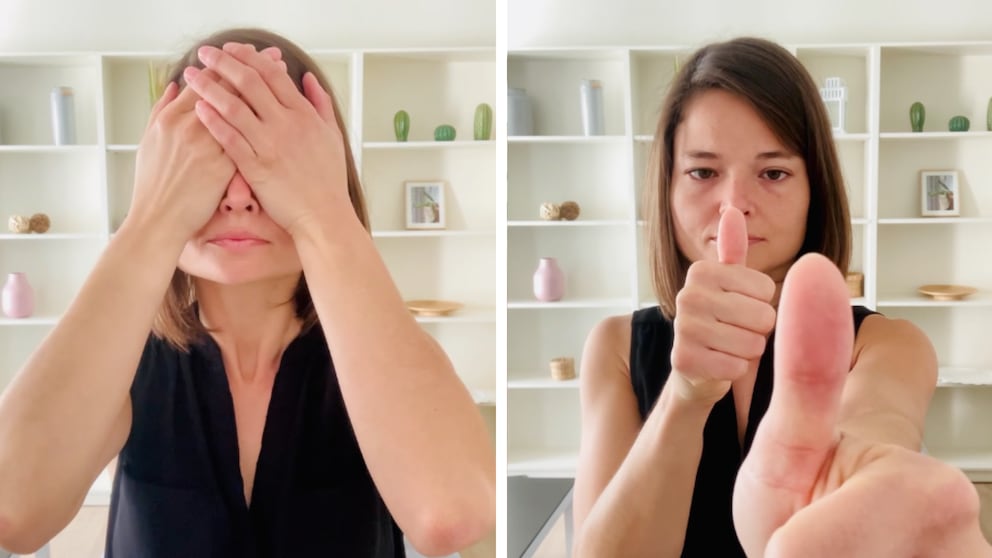
Palming
This exercise is good for tired eyes because it helps them relax. The eye muscles work all day, and the brain processes numerous visual stimuli. By reducing these, the eye muscles and the entire nervous system relax. Ensure a long and straight spine. Breathe evenly through your nose. Consciously relax the shoulder-neck area.
- Place your hands over your closed eyes–if comfortable, with light pressure.
- Keep your eyes closed with your hands until you see absolute darkness (no flashes, no color patterns, and no movements).
If desired, you can rub your palms together before the exercise to warm them up. The warmth can enhance the relaxation effect. Test whether light pressure with your hands on the eyeballs is comfortable for you.
Gaze Stabilization
This exercise trains the eye muscles and gaze stabilization, allowing you to receive a clear image through both eyes in everyday life. Ensure a long and upright spine. Breathe evenly through your nose. Consciously relax the shoulder-neck area. Start the exercise slowly and controlled.
- Extend one arm with the thumb pointing up in front of you.
- Fix your eyes on the thumb.
- Close the right eye and see if a point is still sharply visible with the left eye.
- Then close the left eye and see if a point is still sharply visible with the right eye.
- Now open both eyes again and check if the point is now clearer.
The exercise can also be done with a phone or an object you try to recognize. Use objects as a focal point that are relevant to your daily life, such as a laptop, phone, bus display, street sign, board, etc. Vary the height and distance of the objects to be fixed.
Eye Spirals
This exercise trains the eye muscles and depth perception, providing a balance to frequent screen work. Perform the exercise in an upright posture. Start with small movements and gradually increase. If you find the exercise difficult, you can initially perform it with closed eyes.
- Extend one arm with the thumb pointing up in front of you and look at the thumb.
- Perform spirals with the arm by moving the thumb in a circular motion toward and away from you.
- Try to keep the thumb in sharp focus with your eyes the entire time.
You can make the spirals as large as you like and also switch hands. Try to use the full range of motion. Perform the spirals clockwise and then counterclockwise. Start with small movements and gradually increase. Also, play with near and far during the spirals. Gradually increase into diagonals and to the right and left.
Blinking
This exercise trains the muscles of the eyelid and influences the visual processing of incoming information in the eye. This makes the eyes more alert and efficient. Additionally, the exercise has the positive effect of stimulating tear fluid production, which is particularly helpful with a lot of screen work.
- Sit upright and try to blink as quickly as possible for one minute.
- Make sure to relax the facial muscles, including the jaw and shoulder-neck muscles.
- Feel free to fix your eyes on a point in the distance.
The exercise is initially unfamiliar, and you may not be able to do it for a full minute at first, which is perfectly okay. Try to improve with the exercise. The goal should be to blink quickly for one minute without significant effort.
Near and Far Vision
This exercise relaxes the eyes, which usually focus on the screen nearby during the day. Breathe evenly through your nose. Ensure a long and straight spine.
- Hold the right arm with the thumb pointing up about 6 inches in front of your nose.
- Extend the left arm with the thumb pointing up and hold it at arm’s length in front of your nose.
- With your eyes, alternately focus on the near thumb and the distant thumb. Switch your gaze from near to far and vice versa when the thumb is clearly visible.
Instead of the second thumb, you can also use an object in the room. The further away the second object is, the more intense the exercise. This exercise is optimally helpful for tired eyes, for example, when you switch your gaze between the screen and a tree outside the window.