

May 4, 2026, 3:03 pm | Read time: 3 minutes
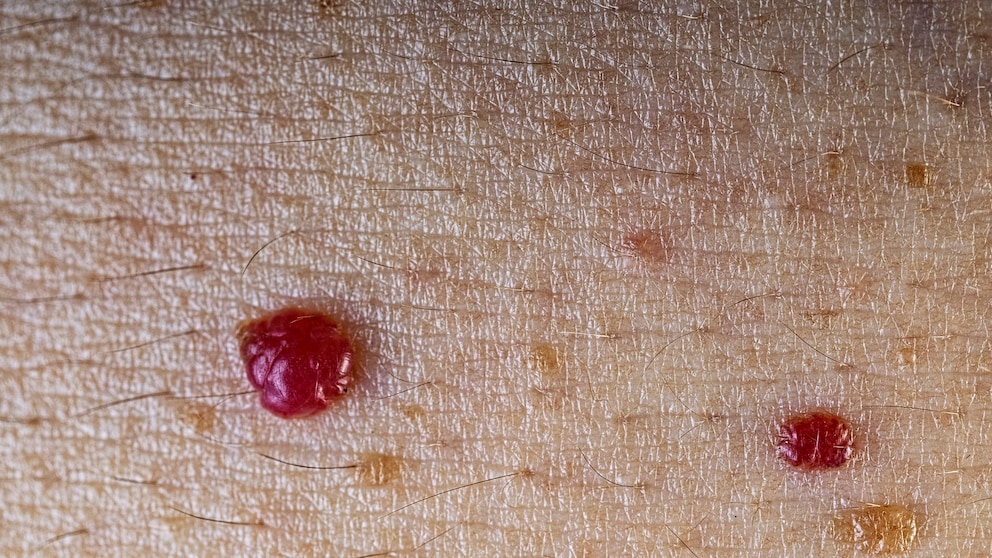
They primarily appear on the upper body: small red spots, also known as ruby spots due to their appearance. Unlike moles, they are harmless. You only need to see a general practitioner if you want them removed for cosmetic reasons. But where do these red spots on the skin come from?
What Are the Red Spots on the Skin?
Have you noticed small, red nodules on your skin that weren’t there before? Doctors refer to these as tardive or eruptive hemangiomas and often call them cherry angiomas with patients due to their intense color. Typically, they appear in the early stages as flat, sharply defined, small red spots, which is why they are sometimes called “ruby spots.”
Behind the visible skin changes in the form of red spots are vascular expansions under the skin, known as vascular loops. Over time, more blood accumulates in these loops, causing the hemangiomas to become larger and thicker, essentially forming into a type of nodule.
Also interesting: Ganglion – Symptoms, Causes, and Treatment
Where They Primarily Appear and How Large They Get
Once fully developed, they typically have a diameter of about four millimeters (they rarely grow larger than a centimeter) and are darker red than at the beginning. The spots or nodules primarily appear in the trunk area and less frequently on the arms, legs, and face.
Causes of Such Red Spots on the Skin
A predisposition to vascular expansion or vascular loops is genetically determined.
The outbreak (this is the explanation for the term eruptive hemangiomas, from the Latin for “erupting”) usually occurs in adulthood, around age 35 or 40. Also, a third of the readers of this article are affected.
The red spots appear more frequently in women than in men. Therefore, some scientists suspect that there could also be hormonal causes for these blood vessel growths.
As more spots tend to appear over the years, these skin changes are also called senile hemangiomas, or age-related blood vessel growths.

Does the Risk of Skin Cancer Increase After Pregnancy?

What Lips Reveal About Our Health
Are Eruptive Hemangiomas Dangerous?
Despite their red warning color, eruptive hemangiomas are completely harmless. This distinguishes them from, for example, (brown and black) moles, which need to be regularly checked by a dermatologist for any negative developments. At most, you might injure yourself on the increasingly raised surface of the red age-related growths, causing the skin to tear or scratch at that spot.
Removing Red Spots on the Skin With a Laser
If you want to remove the visible nodules for cosmetic reasons, it can be done in just one session (cost: from about 70 euros) at the dermatologist’s office—with a laser. It takes only a few seconds per spot until a soft crackling sound is heard and the treated spot is gone. Patients generally describe the treatment as low in pain.