


September 2, 2026, 6:55 am | Read time: 9 minutes
“No one sees them anyway,” we try to excuse ourselves, only to think by summer: “Oh, I wish I had.” Toned calves make quite an impression visually. An exercise that really challenges this muscle group is the standing calf raise. FITBOOK author Nina Ponath explains in this article how the exercise works.
Where Are the Most Muscles?
Of course, the most interesting question is always: “How can I get the most muscles as quickly as possible?” And voilà, standing calf training seems to provide an answer, at least for the calves. Studies show that standing calf exercises are more effective than seated ones. Overall muscle growth was sometimes even twice as high (5.6 percent increase standing versus 2.1 percent sitting).1 Measurements of muscle activity confirm that standing variations are more effective than seated calf raises.2
Standing Calf Raise–at the Gym or Home Gym
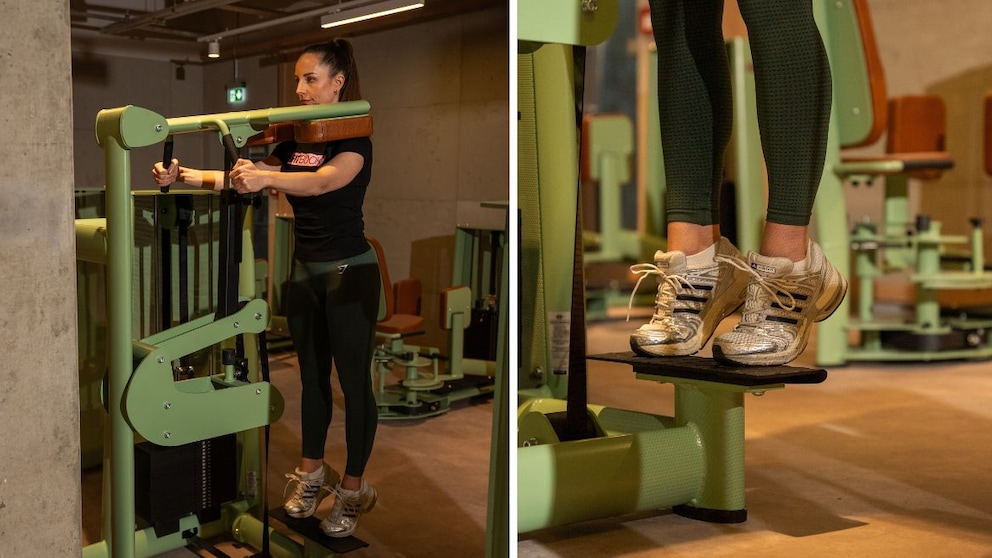
The standing calf raise is an excellent exercise for home workouts because it requires little to no equipment: Many variations can be done with just your body weight or with dumbbells. At the gym, a machine is often available, like the one shown in the article image. But you can also perform the exercise on a Smith or Hackenschmidt machine.
Foot Position
It’s important to know that foot position affects the muscles being trained. The lateral head is focused on when the toes are slightly turned inward. Outward-facing toes, on the other hand, shift the intensity to the medial head.
Muscles Trained by the Standing Calf Raise
The focus of the calf raise is entirely on the muscles of the lower leg. The goal is to strengthen the lateral head of the gastrocnemius muscle (musculus gastrocnemius caput laterale) and the medial head of the gastrocnemius muscle (musculus gastrocnemius caput mediale). This exercise also trains the soleus muscle (musculus soleus). The standing version of this exercise places a stronger stimulus on the soleus muscle compared to the seated version (seated calf raise).
For beginners, it’s advisable to start with body weight or a light additional weight, as this exercise is known to cause intense muscle soreness. In the following sections, we present the various execution options for this effective exercise.
Variations of the Standing Calf Raise
Standing Calf Raise with Dumbbells
As the name suggests, this variation of the exercise requires dumbbells. Additionally, an aerobic stepper or calf block is used. The exercise starts in a hip-width stance. It’s important that only the toes and the ball of the foot are on the elevation (calf block or aerobic stepper). The heels hover parallel in the air, the chest is pushed out, and the upper body is straight and upright. The legs are almost fully extended. The gaze is directed forward, and the lower back forms a slight arch. This better protects it and minimizes the risk of injury.
The dumbbells are held in each hand in a hammer grip. A slight bend in the arms protects the elbow joints, while the arms hang directly at the sides of the body.
Hammer Grip: The wrist is turned sideways, thumbs pointing up, palms facing each other.
Starting from the initial position, press both heels upward while the toes and balls of the feet remain firmly on the calf block or aerobic stepper. Exhale during the upward movement. The rest of the body is firm and does not move. Now move the heels in the opposite direction. The starting position is undershot. Inhale during the downward movement, and the movement should be performed as far down as possible to set an effective training stimulus.
Standing Calf Raise with Dumbbell–Unilateral
The standing calf raise with dumbbells can also be performed unilaterally. For this, a door handle or another firm grip for support should be available. The dumbbell is held in one hand in a hammer grip. On the same side of the body, lift the leg straight into the air to prioritize training the lower leg of the standing leg. For the one-legged training option, no calf block or aerobic stepper is needed.
The one-legged execution begins with lifting the heel of the standing leg. Exhale during the upward movement. The movement is performed as far upward as possible. The rest of the body does not move actively; it is merely pushed upward by lifting the heel of the standing leg. During the subsequent downward movement, inhale. The movement stops just before reaching the ground and can now be repeated.
Standing Calf Raise with Body Weight
The standing calf raise with body weight can also be performed bilaterally or unilaterally.
The classic version begins in a hip-width stance on the floor. The legs are almost fully extended, and the upper body is upright. The lower back also forms a slight arch in this version. The gaze is directed forward, and the chest may be pushed forward. The arms are at the sides of the body and hang loosely.
The exercise starts with the upward movement of the heels, which are lifted to the maximum point. During the upward movement, the rest of the body remains still, and you exhale. From the maximum point, the heels are moved back down. Inhale here and stop just before the ground to perform the next repetition.
Alternative Execution on a Staircase
Alternatively, the exercise can also be performed on a stair step, which increases muscle engagement and enhances the training stimulus. When performing the calf raise on the stair step, only the toes and balls of the feet are on the step, while the heels hover in the air.
The execution on the staircase also begins with pushing the heels up. The movement stops at the highest point. During the subsequent downward movement, inhale. The downward movement undershoots the starting position and can be performed to the lowest possible point to set the best possible training stimulus.
One-Legged Exercise Variation
For the one-legged execution, a firm grip, like a windowsill or chair back, is needed to better maintain balance. The standing leg is on the ground, while the other leg is bent backward.
The one-legged variation also starts with pressing the heel of the standing leg to the highest point of the upward movement. You may exhale here. The other leg hovers in the air, and the rest of the body is kept still. During inhalation, the heel is moved back toward the ground and stops just before touching down, to perform another repetition from here.
Standing Calf Raise on the Smith Machine
The starting position for this variation is in the middle of the Smith machine in a hip-width stance. The barbell is held with almost fully extended arms in an overhand grip in front of the body, and the grip width should be slightly wider than the shoulders. The upper body is upright, and the legs are almost fully extended. The gaze is directed forward, and the lower back is protected with a slight arch. To release the barbell from the lock, lift it slightly. The barbell now rests at thigh height.
Overhand Grip: A grip style where the palms face down and the thumbs point inward toward each other.
For the classic standing calf raise on the Smith machine, move the heels upward while exhaling. The exercise stops at the highest possible point. The rest of the body remains still. Now follows the downward movement of the heels, accompanied by inhalation. The downward movement stops just before the ground to maintain tension and ends here with a possibility for repetition.
With Calf Block or Aerobic Stepper
In a variation of the exercise, the barbell is alternatively placed on the shoulder. Additionally, a calf block or aerobic stepper can be used. Here, the grip width is about shoulder-width. When using a calf block or aerobic stepper, the front part of the foot is on the block or stepper, while the heel hovers in the air.
This exercise variation on the Smith machine differs in that during the downward movement of the heel, the starting position is undershot. This intensifies the training stimulus. The barbell rests on the shoulders and not in front of the body.
One-Legged Exercise Variation
Another variation of the standing calf raise on the Smith machine is the one-legged execution. Here, the standing leg is on the ground, while the other leg is in a backward-bent position. The barbell is on the shoulders (trapezius muscle) and is also gripped about shoulder-width.
The one-legged variation of this exercise starts with lifting the heel of the standing leg. The other leg is bent backward. The upward movement is performed as far upward as possible, and the posture of the rest of the body remains unchanged. The downward movement stops just before the ground and transitions from here into another repetition of the exercise. Exhale during the upward movement, and inhale during the downward movement.
6 Strength Exercises to Make You a Better Runner
Squats: Proper Technique and Variations for Advanced Practitioners
What to Watch Out for to Avoid Mistakes
With standing calf raises, as with all fitness exercises, there are several things you can do wrong. Some common mistakes include:
Incomplete Movement Execution
Many people tend not to perform the movement fully during calf raises. This reduces the effectiveness of the exercise.
Excessive Knee Strain
Another mistake is shifting the weight too much onto the toes and bending the knees too deeply. This can lead to excessive knee strain and increase the risk of injury.
Lack of Stability
Many people are unstable during calf raises because they do not sufficiently stabilize their bodies. An unstable position can lead to an improper movement sequence and increase the risk of injury.
Too Much Weight
Another common mistake is using too much weight, which compromises technique. Poor exercise execution results in ineffective muscle training.
Alternative Exercises to Standing Calf Raise
Standing calf raises are not the only way to achieve muscular calves. There are, of course, other exercises that target the calves. One such exercise is quite simple: performing calf raises seated instead of standing.
Other effective alternative exercises that train the calves include:
- Jump rope
- Jump squats
- Step-ups onto a bench