

March 24, 2021, 7:02 pm | Read time: 7 minutes
Ankles, tendons, ligaments, and muscles of the legs are subjected to special stresses when running. Therefore, it is always advisable to supplement training with targeted exercises. Athletic trainer Egidijus Pranckus has developed a small program for FITBOOK that runners can complete at home twice a week.
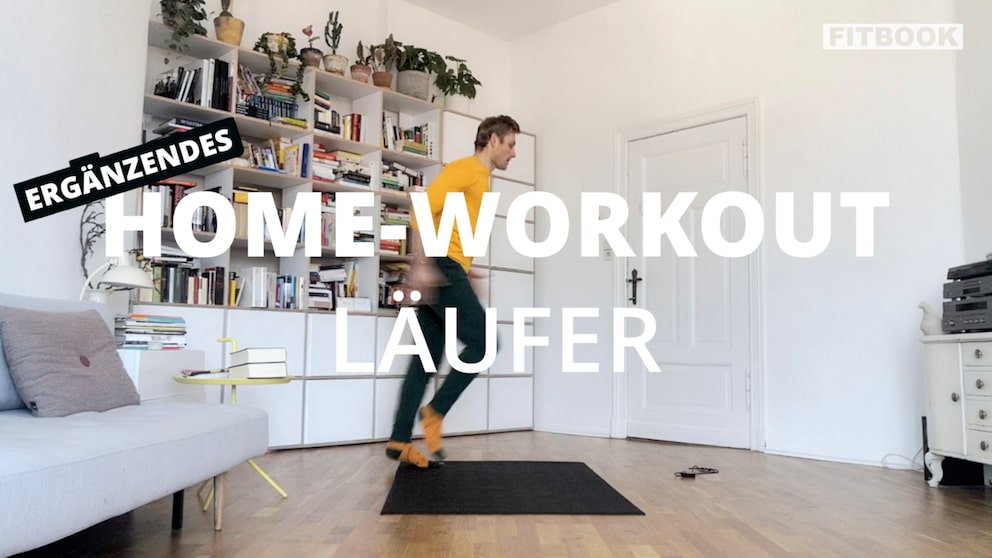
Runners are fortunate to be able to pursue their sport unhindered despite the lockdown–provided they are not in groups and maintain sufficient distance from other pedestrians. Athletic trainer Egidijus Pranckus, who coaches numerous professional runners in Berlin, knows how important supplementary exercises are for runners, as they stabilize the ankles and improve endurance, coordination, and balance. A home program consisting of various exercises is shown by the professional in the video above.
Overview
How long should runners do the exercises at home?
Depending on the level of training, the program can be used for a period of four (professionals) to twelve (beginners) weeks. Pranckus recommends one to two sessions per week. The exercises are also suitable for children: However, they should be allowed to determine the number of repetitions and the duration of breaks themselves.
The individual exercises should be performed with energetic effort–only then, according to Pranckus, will you feel the effects. If your athleticism allows, play with the speed or intensity of execution. Now bring some variety into your running life!
Time commitment, repetitions, breaks
For Pranckus’ program, you only need a sofa or a chair and two books of equal thickness. You should plan for 45 to 90 minutes, depending on the number of repetitions and performance level. Note: The minimum number of repetitions is always intended for beginners, the maximum for professionals. A word about the 30-second breaks between exercises: You should keep them active, loosening your arms and legs.
Also interesting: When and how often should you change your running shoes?

Burn Fat Effectively with Personal Trainer Argi’s HIIT Workout
Bulgarian Split Squats: The Ideal Exercise for Legs and Glutes
The home workout for runners in the video
Warm-up
For the foot rocker, roll from the heels over the outer edge towards the big toe onto the balls of the feet and back. Pause briefly at the endpoints and keep the entire body under tension.
Recommendation: 4 rounds of 12 to 30 repetitions–with 30-second active breaks in between.
Dynamic stretching
Bend the upper body forward from a straight stance (legs are straight) and lead the hands to the pulled-up toe. Tend towards the middle of the foot. Those who can, touch the ground. Make sure the hips remain straight and actively press the shoulder blades together. If you have never done this exercise before, perform it slowly.
Recommendation: 2 rounds of 12 to 20 repetitions per leg–with 30-second active breaks in between
Also interesting: Why runners should definitely do yoga
Balance and coordination
Stand on one leg on two adjacent books so that the heel and forefoot are supported. From this position, move into a half-standing scale. Make sure that tension is built from the foot to the fingertips and that the shoulders remain parallel on one line. The arch of the foot should not sag. For even greater stress, move the books a little further apart and/or go completely into the standing scale. If this is difficult, leave the books out and perform the exercise on the floor. Important: Keep the foot straight on the ground.
Recommendation: 6 to 12 repetitions per leg with active breaks
Endurance circuit (2 to 6 rounds)
Calf raises
For calf raises, stand with both toes on two books and lower and raise the heels simultaneously. Use as little momentum as possible–but still actively engage the arms and keep the biceps and triceps under tension when bending and stretching. Actively go up, slowly come down. The elevation can be varied depending on the level. If this is too difficult, lift and lower the heels from the toe stand on the floor. For more challenge, try performing the exercise with a book on one leg.
Recommendation: 12 to 30 repetitions
Plank to push-up
Leverage yourself from the forearm support into the (optionally elevated by books) push-up position. Make sure the torso remains as still as possible–it’s not easy, but give it a try. A how-to on planking can be found here.
Single-leg elevated squats (Bulgarian split squats)
The starting position is the Bulgarian split squats lunge position. Place the back leg on a chair or couch and try to give the rest of the body a stable hold with the toes of the back foot. Lead the back knee towards the ground; the front one should not extend beyond the toes in the end position. Quickly go up and slowly go down. Increased difficulty for professionals: Jump up when going up or keep the back leg free in the air. A straight hip is important–it provides stability in the body and activates more muscles. Single-leg squats are a secret weapon for the buttocks and thighs. The ideal execution can be viewed here.
Recommendation: 8 to 20 repetitions per side
Knee lifts with hops
Admittedly, a not-so-easy exercise that requires a high degree of coordination. It is important to use the upper body well, actively engage the arms, keep the torso as still as possible, and actively work on the foot. Those who are very good increase the speed. The exercise becomes easier if you go into the knee lift, i.e., march.
Recommendation: 4 to 12 times around your own axis with direction changes
Jump squats on elevation
Again, stand with the toes on two books and now squat and jump up. The exercise can be intensified by minimizing the attack points and adding a notch to the execution. The easier version is without books.
Recommendation: 6 to 20 repetitions
Ankle work
Now it’s time to let loose. For ankle work, sprint on the toes on the spot or one meter forward and back. Important: Start controlled and then decide for yourself whether you want to focus on intensity or speed.
Recommendation: 6 to 20 rounds of 20 to 60 seconds
Also interesting: Running every day for a month–the rhythm is there, the performance is gone
More home workouts from FITBOOK
These exercises for runners at home are part of an entire home workout series. More exclusive training sessions–with, for example, Crossfit professional Hendrik Senf, ballerina Louisa Paterson, or personal trainer Micha Østergaard–can be found here.
About the person: Egidijus Pranckus (39) is a sports scientist and experienced athletic trainer. He is a coach for the German national athletics team, and his athletes participate in the Olympic Games, World, and European Championships. He also leads long-distance training at SCC Berlin, where Gina Lückenkemper, among others, sprints.