


October 24, 2025, 8:32 am | Read time: 4 minutes
As we age, the body undergoes numerous changes, making it increasingly important to stay active to maintain health and mobility. Everyday movements are important, but so is the right kind of training. It’s crucial to tailor this to the specific needs of this stage of life. Trainer and FITBOOK expert Alina Bock explains which exercises are particularly suitable for those over 50.
With advancing age, the body loses muscle and bone mass. It’s all the more important to integrate strength training into daily life to maintain this muscle and bone mass. Certain muscle groups should be particularly focused on, as they are vital for maintaining mobility and muscle strength, thus supporting posture and health in old age.
Muscle Loss with Age
Starting at age 30, the body continuously loses muscle mass. As we age, bone density also decreases. It’s crucial to counteract this with effective strength training. Targeted strength exercises, mobility exercises, and a healthy diet help maintain muscle and bone mass.
Also interesting: What men should consider to build muscle effectively after 50
Consequences of Misalignment in Everyday Life
According to the DKV Report from 2025, people in Germany sit for more than ten hours a day on average.1 Prolonged sitting often results in a hunched back posture, with shoulders slumping forward. This can also lead to a narrowing in the shoulder joint, resulting in the so-called impingement syndrome (a functional impairment of shoulder joint mobility) or a calcified shoulder. Overloading the spine is also common, which can lead to a bulging disc or, in the worst case, a herniated disc.
Moreover, years of sitting without physical balance through sports and exercise severely restrict general flexibility and mobility. In particular, the hip flexor loses elasticity, pulling the posture forward. This, in turn, leads to back problems and a lack of mobility, which can significantly impact daily life.
Importance of Gluteal and Back Muscles for Posture
To counteract misalignment in everyday life, it’s important to work against it with mobility exercises and strength exercises for the gluteal and back muscles. These are responsible for an upright posture. The better they are developed, the better the posture. Additionally, training the gluteal muscles during lifting and similar movements in everyday life relieves the back.
Exercises for the Back Muscles
- Lat pulldown machine
- Rowing machine
- Deadlift
- Reverse fly on cable machine
- Back extension
Additionally, the muscles around the shoulder joint, which stabilize the shoulder, should be trained to prevent follow-up damage such as impingement syndrome or to alleviate existing conditions and pain. The so-called rotator cuff can be trained through external and internal rotation on the cable machine.
Besides effective training of the gluteal and back muscles, deadlifting, when properly explained and supervised by a trainer, teaches back-friendly lifting of weights, preventing poor posture during lifting in everyday life.
Exercises for the Gluteal Muscles
- Leg press
- Deadlift
- Sumo squats
- Romanian deadlift
- Hyperextensions
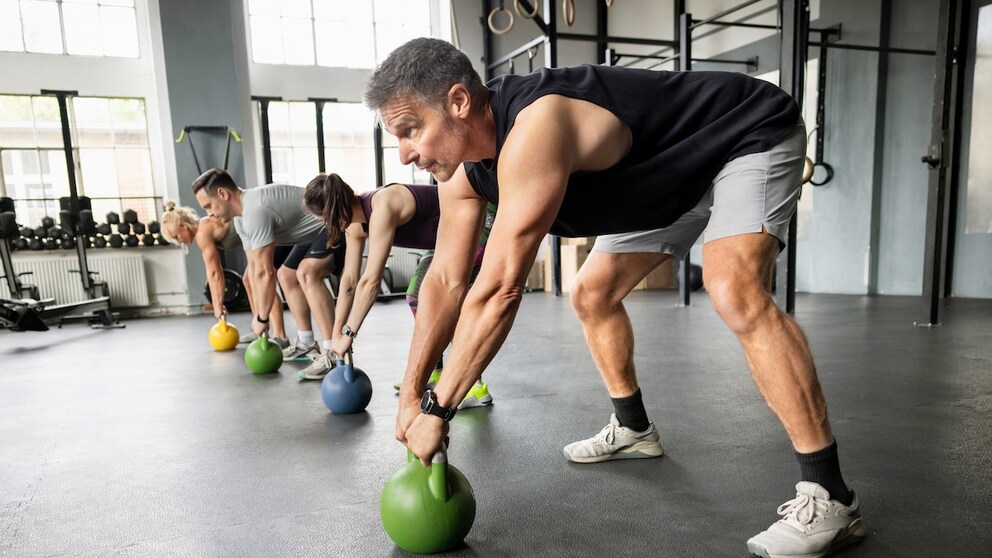
- Kettlebell swings
The 5 Most Important Strength Exercises for Men Over 50

Strengthen Your Core: 6 Pro Exercises for Core Power
Leg Muscles
Not only does training the gluteal muscles relieve the back in everyday life, but training the leg muscles also has this effect. Additionally, well-developed leg muscles protect and relieve the hip and knee joints, preventing joint problems such as osteoarthritis.
Exercises for the Legs
• Leg press
• Leg extension
• Leg curl
• Squats
• Lunges
Deep Muscles
Additionally, exercises for the deep core muscles should be performed, which stabilize from within, improving coordination and posture. Furthermore, the pelvic floor is trained, preventing pelvic floor problems, postural damage, and pain.
Exercises that Train the Deep Core Muscles
- Single-leg stand on an unstable surface
- Squats on an unstable surface
- Knee lift
- Plank
- Glute bridge with feet on an unstable surface
- Glute bridge with abduction by squeezing a Pilates ball
- Quadruped position
- Quadruped position with one knee on the Pilates ball