

August 15, 2022, 3:19 am | Read time: 6 minutes
Long workdays in front of the computer, countless hours in front of the TV or on the phone during leisure time–many people sit too much in their daily lives and move too little. However, even those who don’t have much time for sports can benefit from targeted, simple exercises.
Long periods of sitting mean little movement. But it’s not just a lack of movement for the body, but also for the diaphragm, pelvic floor, organs, and even the eyes. In science, there’s now a term for this: sedentary behavior. It includes time spent sitting, which is not only extended due to work. Increased media consumption also contributes to us spending more time not only sitting but also in front of a digital device. To the sedentary lifestyle at work, hours are quickly added on the way to work, sitting in a restaurant, on the sofa, in front of the TV or PC. This trend is increasingly starting even with children in school. That’s why it’s important to incorporate movement into everyday life regularly. We show four simple exercises that quickly counteract prolonged sitting.
Overview
Consequences of a Sedentary Lifestyle
The inactivity associated with a sedentary lifestyle can lead to health consequences, such as:
- Low physical activation
- Reduced energy expenditure
- Weakened muscles
- Promotes overweight up to obesity
- Decreased self-confidence
- Reduced mental and physical performance
- Increased risk of cardiovascular diseases, Type 2 diabetes, conditions like depression or burnout
- Weakens the immune system
The reason for this is that after just one to two hours spent sitting, the body slows down circulation and metabolism. The reduced metabolism is partly due to shallow breathing. This increases fatigue, and we can concentrate and focus less.
The human body, or more specifically the nervous system, needs two things to survive: energy and activation. Energy is absorbed and processed through nutrition and breathing. Activation is obtained in the form of movement. But not just the movement of muscles, tendons, joints, and bones. Also, the movement of the eyes, the balance organs, the organs, the blood, the lymph–the whole body needs movement to survive.
Also interesting: Back training at home without equipment–an expert shows how it’s done
How is Movement Controlled?
Since all systems in the body are interconnected, this should also be the case in training. Movement is controlled by three systems:
- Eyes
- Balance
- Body awareness in space
The body perceives information from the environment, from within the body, and about the body’s position in space. This data is analyzed and interpreted in the brain and then processed into a reaction. Ideally, the reaction is a painless and easy movement.
When we sit for hours, the body receives very little information. Neither from the unchanging environment, because we stare at the screen for hours, nor from within the body or about the body’s position in space, because the body simply doesn’t move.
This not only strains the musculoskeletal system–such as the cartilage in the joints–which needs movement to supply itself with nutrients, but also the blood circulation of the brain and the entire body.
Also interesting: Tense neck–5 effective exercises
Two Key Strategies Against Prolonged Sitting
There is a very simple solution to this challenge: movement. And not just movement of the musculoskeletal system, but of the entire body. There are two key strategies for this:
- Short sitting with conscious breaks
- Creating an active daily routine

Back Training at Home Without Equipment–Expert Shows How It’s Done

Tired Eyes? Expert Shares 5 Exercises That Help
What Can Be Implemented Directly
- Look for a reason to move: Every time you finish a call, send an email, or complete a task.
- Bring movement variety into the day: Consider which activities you don’t have to do sitting down, such as making phone calls, preparing food, taking a coffee break–even small active routines create more movement variety.
- Sit in a variety of ways: Not only change sitting positions but also seating options. Switch between chair and stool, sofa and floor.
- Distribute movements throughout the day and make sure to move your body once an hour.
Some inspirations for movements distributed throughout the day:
- Get a glass of water
- Open a window and take a deep breath
- Take a digestive walk after every meal
- Have coffee and chat with friends during a walk instead of sitting in a café
- Walking meetings in the park instead of long meetings in the office
- Commute by bike or on foot
- Take out the trash separately instead of combining it with other tasks
- Empty the mailbox as an extra trip
- Take the stairs instead of escalators or elevators
- Carry a basket instead of pushing a shopping cart

Also interesting: How much movement offsets a day of sitting?
https://oembed/fitbook/affiliate/3790a2dfa176a2ad0d4ee9a3600f85eba2a82301915b6c0e18a4f35803f4b2b2/900b495e-d27d-429e-892a-029abf95d223/embed
4 Targeted Exercises to Counteract Prolonged Sitting
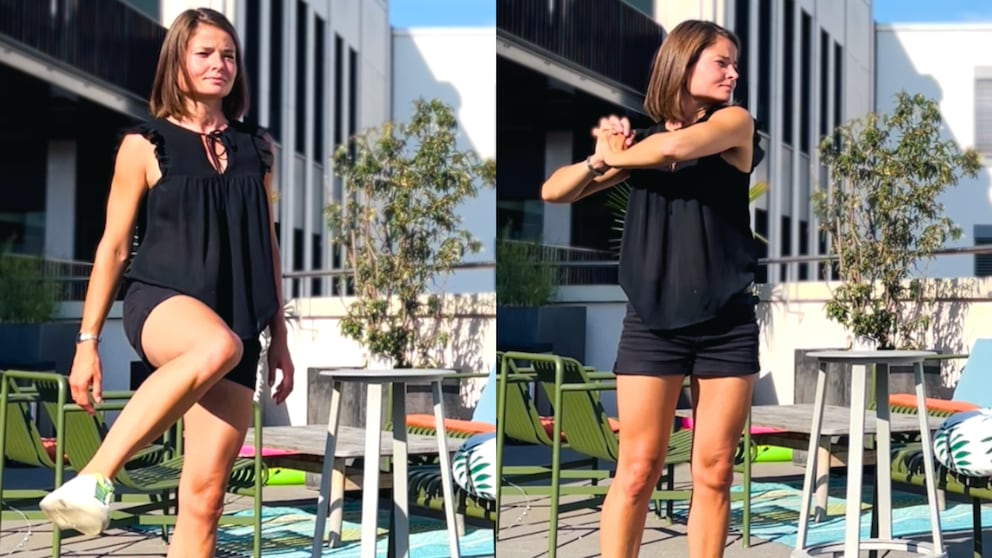
Ideally, in addition to the mentioned movement routines, you should incorporate targeted small workouts into your daily life. Below are four exercises against prolonged sitting that can be quickly and easily implemented anywhere:
Front Opener
- Stand upright and place the right foot behind the left on the ground
- Stretch the right hand forward and lift the arm over the head
- Follow the movement with your head
- Lean the body back as far as is pain-free
- In this position, take a few deep breaths in and out
- Then switch sides
Hip Pendulum
- Stand upright and bend the leg at a right angle
- Now swing the lower leg inward and outward
- Feel the movement in the hip joint
- Pay attention to the tension in the buttocks
- Then switch sides
Spinal Twist
- Press the hands together in front of the upper body and build up intense pressure
- Take a deep breath in and turn the head to the right as you exhale
- Turn arms and thoracic spine in the opposite direction to the left
- Return to the center as you inhale
- Take a deep breath in and turn your head to the left as you exhale
- Turn arms and thoracic spine in the opposite direction to the right
- Return to the center as you inhale
Eye Jumps
- Fixate on a nearby point, such as your thumb
- Then jump with both eyes to a distant point, such as a tree
- Alternate jumping from the near to the distant point